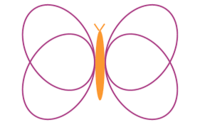
Symmetry

Flashcard
•
Mathematics
•
8th - 10th Grade
•
Practice Problem
•
Easy
+3
Standards-aligned

Wayground Content
Used 1+ times
FREE Resource
Student preview

15 questions
Show all answers
1.
FLASHCARD QUESTION
Front
What is symmetry in geometry?
Back
Symmetry in geometry refers to a situation where a shape or figure can be divided into parts that are arranged in a balanced and proportional manner. A figure is symmetric if it can be transformed into itself through certain operations such as reflection, rotation, or translation.
Tags
CCSS.4.G.A.3
2.
FLASHCARD QUESTION
Front
What is a line of symmetry?
Back
A line of symmetry is a line that divides a shape into two identical halves that are mirror images of each other. If a shape can be folded along this line, both halves will match perfectly.
Tags
CCSS.4.G.A.3
3.
FLASHCARD QUESTION
Front
What is the smallest angle of rotation that maps a figure onto itself?
Back
The smallest angle of rotation that maps a figure onto itself is known as the angle of rotational symmetry. It is the least angle through which a figure can be rotated to look the same as it did before the rotation.
Tags
CCSS.HSG.CO.A.4
4.
FLASHCARD QUESTION
Front
How do you determine the number of lines of symmetry in a shape?
Back
To determine the number of lines of symmetry in a shape, you can visually inspect the shape or use geometric methods to find all the lines that can divide the shape into two identical halves.
Tags
CCSS.4.G.A.3
5.
FLASHCARD QUESTION
Front
What is rotational symmetry?
Back
Rotational symmetry is a property of a shape that looks the same after a certain amount of rotation. A shape has rotational symmetry if it can be rotated around a central point and still appear unchanged.
Tags
CCSS.HSG.CO.A.4
6.
FLASHCARD QUESTION
Front
What is the angle of rotation for a shape with 5 lines of symmetry?
Back
The angle of rotation for a shape with 5 lines of symmetry is 360° divided by 5, which equals 72°.
Tags
CCSS.HSG.CO.A.4
7.
FLASHCARD QUESTION
Front
Can a figure have no lines of symmetry?
Back
Yes, a figure can have no lines of symmetry. An example is an irregular shape that does not have any line that can divide it into two identical halves.
Tags
CCSS.4.G.A.3
Access all questions and much more by creating a free account
Create resources
Host any resource
Get auto-graded reports

Continue with Google

Continue with Email

Continue with Classlink

Continue with Clever
or continue with

Microsoft
%20(1).png)
Apple

Others
Already have an account?
Similar Resources on Wayground

11 questions
Geometry Module 2 Vocabulary
Flashcard
•
9th - 10th Grade
15 questions
Linear Relationships
Flashcard
•
9th - 12th Grade
11 questions
Understanding Rates of Reaction
Flashcard
•
9th Grade
13 questions
The First Americans and Their Civilizations
Flashcard
•
9th Grade
10 questions
Key Causes of Indian Independence Movements
Flashcard
•
10th Grade
10 questions
Basics of Electrical Circuits
Flashcard
•
8th Grade
10 questions
Basic Concepts of Probability
Flashcard
•
8th Grade
10 questions
Avaliação 8º ANO
Flashcard
•
8th Grade
Popular Resources on Wayground
15 questions
Fractions on a Number Line

Quiz
•
3rd Grade
20 questions
Equivalent Fractions
Quiz
•
3rd Grade
25 questions
Multiplication Facts
Quiz
•
5th Grade
54 questions
Analyzing Line Graphs & Tables
Quiz
•
4th Grade
22 questions
fractions
Quiz
•
3rd Grade
20 questions
Main Idea and Details
Quiz
•
5th Grade
20 questions
Context Clues
Quiz
•
6th Grade
15 questions
Equivalent Fractions
Quiz
•
4th Grade
Discover more resources for Mathematics
14 questions
finding slope from a graph
Quiz
•
8th Grade
20 questions
Laws of Exponents
Quiz
•
8th Grade
12 questions
8th U5L9 Linear Models
Quiz
•
8th Grade
20 questions
Graphing Inequalities on a Number Line
Quiz
•
6th - 9th Grade
18 questions
SAT Prep: Ratios, Proportions, & Percents
Quiz
•
9th - 10th Grade
20 questions
Volume of cylinders, Cones and Spheres
Quiz
•
8th Grade
12 questions
Exponential Growth and Decay
Quiz
•
9th Grade
20 questions
One Step equations addition and subtraction
Quiz
•
5th - 8th Grade