
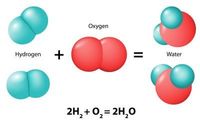
Law of Conservation of Mass 1

Flashcard
•
Science
•
8th Grade
•
Practice Problem
•
Hard
Standards-aligned

Wayground Content
FREE Resource
Student preview

15 questions
Show all answers
1.
FLASHCARD QUESTION
Front
What is the Law of Conservation of Mass?
Back
The Law of Conservation of Mass states that mass is neither created nor destroyed in a chemical reaction; the total mass of the reactants equals the total mass of the products.
Tags
NGSS.MS-PS1-5
2.
FLASHCARD QUESTION
Front
How do you determine if a chemical equation is balanced?
Back
A chemical equation is balanced when the number of atoms of each element is the same on both sides of the equation.
Tags
NGSS.MS-PS1-5
3.
FLASHCARD QUESTION
Front
What does the coefficient in a chemical formula represent?
Back
The coefficient in a chemical formula indicates the number of molecules or moles of that substance.
Tags
NGSS.MS-PS1-5
4.
FLASHCARD QUESTION
Front
In the equation 2SO2 + 2H2O2 ----> 2H2SO4, how many total hydrogen atoms are present in the products?
Back
There are 4 hydrogen atoms present in the products.
Tags
NGSS.MS-PS1-1
5.
FLASHCARD QUESTION
Front
How many nitrogen atoms are in the molecule NH3?
Back
There is 1 nitrogen atom in the molecule NH3.
Tags
NGSS.MS-PS1-1
6.
FLASHCARD QUESTION
Front
If 24 g of magnesium reacts with 38 g of fluorine, what is the total mass of magnesium fluoride produced?
Back
The total mass of magnesium fluoride produced is 62 g.
Tags
NGSS.MS-PS1-2
NGSS.MS-PS1-5
7.
FLASHCARD QUESTION
Front
What is a balanced chemical equation?
Back
A balanced chemical equation has equal numbers of each type of atom on both sides of the equation, reflecting the conservation of mass.
Tags
NGSS.MS-PS1-5
Access all questions and much more by creating a free account
Create resources
Host any resource
Get auto-graded reports

Continue with Google

Continue with Email

Continue with Classlink

Continue with Clever
or continue with

Microsoft
%20(1).png)
Apple

Others
Already have an account?



