
Relative Dating and the Law of Superposition

Flashcard
•
Science
•
6th Grade
•
Practice Problem
•
Easy
+2
Standards-aligned

Wayground Content
Used 1+ times
FREE Resource
Student preview

15 questions
Show all answers
1.
FLASHCARD QUESTION
Front
What is Relative Dating?
Back
Relative dating is a method used to determine the age of rocks and fossils in relation to one another, without determining their exact age.
Tags
NGSS.MS-ESS1-4
2.
FLASHCARD QUESTION
Front
What does the Law of Superposition state?
Back
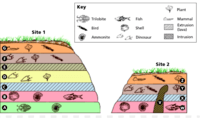
The Law of Superposition states that in undisturbed sedimentary rock layers, the oldest layers are at the bottom and the youngest layers are at the top.
Tags
NGSS.MS-ESS1-4
3.
FLASHCARD QUESTION
Front
What is a fossil?
Back
A fossil is the preserved remains or traces of ancient organisms, often found in sedimentary rock.
Tags
NGSS.MS-LS4-1
4.
FLASHCARD QUESTION
Front
How can fossils help in relative dating?
Back
Fossils can help determine the relative ages of rock layers by showing which layers contain similar types of organisms.
Tags
NGSS.MS-LS4-1
5.
FLASHCARD QUESTION
Front
What is an intrusion in geology?
Back
An intrusion is a body of igneous rock that forms when magma pushes into existing rock layers.
6.
FLASHCARD QUESTION
Front
If a layer of rock contains a fossil, what can be inferred about its age?
Back
The layer of rock is likely older than the fossil it contains, as the organism must have existed before it was buried.
Tags
NGSS.MS-ESS1-4
NGSS.MS-LS4-1
7.
FLASHCARD QUESTION
Front
What does it mean if a layer is described as 'younger' than another layer?
Back
A 'younger' layer is one that was deposited after the other layer, meaning it is closer to the surface.
Tags
NGSS.MS-ESS1-4
Access all questions and much more by creating a free account
Create resources
Host any resource
Get auto-graded reports

Continue with Google

Continue with Email

Continue with Classlink

Continue with Clever
or continue with

Microsoft
%20(1).png)
Apple

Others
Already have an account?



