
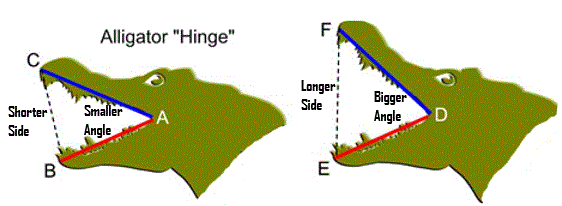
Hinge Theorem

Flashcard
•
Mathematics
•
10th Grade
•
Practice Problem
•
Hard
Standards-aligned

Wayground Content
FREE Resource
Student preview

15 questions
Show all answers
1.
FLASHCARD QUESTION
Front
What is the Hinge Theorem?
Back
The Hinge Theorem states that if two triangles have two sides of equal length and the included angle of one triangle is larger than the included angle of the other, then the side opposite the larger angle is longer than the side opposite the smaller angle.
2.
FLASHCARD QUESTION
Front
If two triangles have two equal sides, what can be inferred about their angles?
Back
The triangle with the larger included angle will have the longer side opposite that angle.
Tags
CCSS.HSG.CO.C.10
3.
FLASHCARD QUESTION
Front
In triangle ABC, if AB = AC and angle B is larger than angle C, which side is longer?
Back
Side BC is longer than side AC.
Tags
CCSS.HSG.CO.C.10
4.
FLASHCARD QUESTION
Front
How can the Hinge Theorem be applied to compare two triangles?
Back
By comparing the lengths of two sides and the included angles, one can determine which triangle has the longer opposite side.
Tags
CCSS.HSG.CO.B.7
5.
FLASHCARD QUESTION
Front
What is the relationship between angles and sides in triangles according to the Hinge Theorem?
Back
In triangles, larger angles are opposite longer sides.
6.
FLASHCARD QUESTION
Front
If triangle DEF has DE = DF and angle E is larger than angle F, which side is longer?
Back
Side EF is longer than side DF.
Tags
CCSS.HSG.CO.C.10
7.
FLASHCARD QUESTION
Front
What is the converse of the Hinge Theorem?
Back
If two triangles have two sides of equal length and the side opposite one angle is longer than the side opposite another angle, then the angle opposite the longer side is larger.
Access all questions and much more by creating a free account
Create resources
Host any resource
Get auto-graded reports

Continue with Google

Continue with Email

Continue with Microsoft
or continue with

%20(1).png)
Apple

Others
By signing up, you agree to our Terms of Service & Privacy Policy
Already have an account?

