
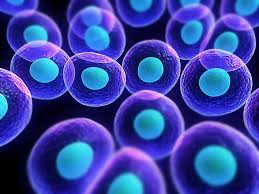
Cells (transport and osmosis) EOC Review 1

Flashcard
•
Biology
•
11th Grade
•
Practice Problem
•
Hard

Wayground Content
FREE Resource
Student preview

15 questions
Show all answers
1.
FLASHCARD QUESTION
Front
What is a eukaryotic cell?
Back
A eukaryotic cell is a type of cell that has a nucleus and membrane-bound organelles, such as ribosomes and the plasma membrane. Examples include plant and animal cells.
2.
FLASHCARD QUESTION
Front
What is facilitated diffusion?
Back
Facilitated diffusion is a type of passive transport that allows charged molecules (ions) and large molecules to cross the plasma membrane through channel proteins without the use of energy.
3.
FLASHCARD QUESTION
Front
What is the main difference between prokaryotic and eukaryotic cells?
Back
The main difference is that eukaryotic cells have a nucleus and membrane-bound organelles, while prokaryotic cells do not.
4.
FLASHCARD QUESTION
Front
What is the role of ribosomes in a cell?
Back
Ribosomes are responsible for protein synthesis in the cell, translating messenger RNA (mRNA) into polypeptide chains.
5.
FLASHCARD QUESTION
Front
What is osmosis?
Back
Osmosis is the movement of water molecules across a selectively permeable membrane from an area of lower solute concentration to an area of higher solute concentration.
6.
FLASHCARD QUESTION
Front
What is active transport?
Back
Active transport is the movement of molecules across a cell membrane from a region of lower concentration to a region of higher concentration, requiring energy (ATP).
7.
FLASHCARD QUESTION
Front
What is the plasma membrane?
Back
The plasma membrane is a biological membrane that separates and protects the interior of all cells from the outside environment, composed of a phospholipid bilayer.
Access all questions and much more by creating a free account
Create resources
Host any resource
Get auto-graded reports

Continue with Google

Continue with Email

Continue with Classlink

Continue with Clever
or continue with

Microsoft
%20(1).png)
Apple

Others
Already have an account?


