
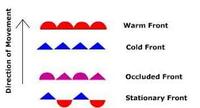
Weather Fronts

Flashcard
•
Science
•
9th - 12th Grade
•
Practice Problem
•
Hard

Wayground Content
FREE Resource
Student preview

15 questions
Show all answers
1.
FLASHCARD QUESTION
Front
What is a cold front?
Back
A cold front is a boundary that forms when a cold air mass pushes into a warmer air mass, causing the warm air to rise rapidly, often leading to thunderstorms.
2.
FLASHCARD QUESTION
Front
What is a warm front?
Back
A warm front is a boundary that occurs when a warm air mass moves over a cold air mass, leading to gradual lifting and typically resulting in steady rain.
3.
FLASHCARD QUESTION
Front
What is a stationary front?
Back
A stationary front is a boundary between two air masses that are not moving, leading to prolonged periods of cloudy and wet weather.
4.
FLASHCARD QUESTION
Front
What is an occluded front?
Back
An occluded front occurs when a cold front overtakes a warm front, lifting the warm air mass off the ground and often resulting in complex weather patterns.
5.
FLASHCARD QUESTION
Front
How are weather fronts formed?
Back
Weather fronts are formed when two air masses with different temperatures and humidity levels meet.
6.
FLASHCARD QUESTION
Front
What happens at a cold front?
Back
At a cold front, the cold air mass pushes under the warm air mass, causing the warm air to rise quickly, which can lead to the formation of thunderstorms.
7.
FLASHCARD QUESTION
Front
What happens at a warm front?
Back
At a warm front, the warm air mass rises over the cold air mass, leading to gradual cooling and cloud formation, often resulting in light to moderate precipitation.
Access all questions and much more by creating a free account
Create resources
Host any resource
Get auto-graded reports

Continue with Google

Continue with Email

Continue with Classlink

Continue with Clever
or continue with

Microsoft
%20(1).png)
Apple

Others
Already have an account?


