
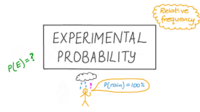
Experimental Probability

Flashcard
•
Mathematics
•
7th Grade
•
Practice Problem
•
Hard
Standards-aligned

Wayground Content
FREE Resource
Student preview

15 questions
Show all answers
1.
FLASHCARD QUESTION
Front
What is Experimental Probability?
Back
Experimental Probability is the probability of an event based on the results of an experiment or trial. It is calculated by dividing the number of times an event occurs by the total number of trials.
2.
FLASHCARD QUESTION
Front
How do you calculate Experimental Probability?
Back
Experimental Probability = \( \frac{\text{Number of times the event occurs}}{\text{Total number of trials}} \)
3.
FLASHCARD QUESTION
Front
If a spinner is spun 30 times and lands on blue 12 times, what is the experimental probability of landing on a color that is not blue?
Back
\( \frac{18}{30} = \frac{3}{5} \)
Tags
CCSS.7.SP.C.6
4.
FLASHCARD QUESTION
Front
What is the experimental probability of landing on '3' if it occurs 30 times out of 75 spins?
Back
\( \frac{30}{75} = \frac{2}{5} = 40\% \)
Tags
CCSS.7.SP.C.6
5.
FLASHCARD QUESTION
Front
What does a bar graph represent in the context of experimental probability?
Back
A bar graph visually represents the frequency of outcomes from an experiment, allowing for easy comparison of different outcomes.
6.
FLASHCARD QUESTION
Front
What is the difference between theoretical probability and experimental probability?
Back
Theoretical probability is based on expected outcomes in a perfect scenario, while experimental probability is based on actual results from trials.
7.
FLASHCARD QUESTION
Front
If a coin is flipped 24 times and lands on heads 13 times, what is the relative frequency of heads?
Back
\( \frac{13}{24} \)
Tags
CCSS.7.SP.C.6
Access all questions and much more by creating a free account
Create resources
Host any resource
Get auto-graded reports

Continue with Google

Continue with Email

Continue with Microsoft
or continue with

%20(1).png)
Apple

Others
By signing up, you agree to our Terms of Service & Privacy Policy
Already have an account?

