
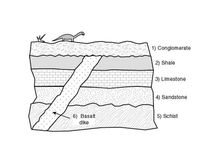
Law of Superposition

Flashcard
•
Science
•
8th Grade
•
Practice Problem
•
Hard

Wayground Content
FREE Resource
Student preview

15 questions
Show all answers
1.
FLASHCARD QUESTION
Front
What is the Law of Superposition?
Back
The Law of Superposition states that in any undisturbed sequence of rocks, the oldest layers are at the bottom and the youngest layers are at the top.
2.
FLASHCARD QUESTION
Front
What does relative age mean in geology?
Back
Relative age refers to the age of a rock or fossil in comparison to other rocks or fossils, determined by the layers surrounding it.
3.
FLASHCARD QUESTION
Front
What type of evidence did Alfred Wegener use to support his theory of continental drift?
Back
Wegener used evidence from fossils, landforms, and climate to support his theory of continental drift.
4.
FLASHCARD QUESTION
Front
What is an example of evidence from fossils supporting continental drift?
Back
Fossils of the same species, such as the Mesosaurus, found on different continents indicate that these continents were once connected.
5.
FLASHCARD QUESTION
Front
What is the significance of sedimentary rock layers in understanding Earth's history?
Back
Sedimentary rock layers provide a record of past environments, climate changes, and biological activity over time.
6.
FLASHCARD QUESTION
Front
What is an igneous rock?
Back
Igneous rock is formed from the cooling and solidification of molten rock (magma or lava).
7.
FLASHCARD QUESTION
Front
What is the difference between absolute age and relative age?
Back
Absolute age is the actual age of a rock or fossil, often determined by radiometric dating, while relative age is its age compared to other rocks or fossils.
Access all questions and much more by creating a free account
Create resources
Host any resource
Get auto-graded reports

Continue with Google

Continue with Email

Continue with Classlink

Continue with Clever
or continue with

Microsoft
%20(1).png)
Apple

Others
Already have an account?



