
Kepler's Third Law

Flashcard
•
Science
•
9th - 12th Grade
•
Practice Problem
•
Hard

Wayground Content
FREE Resource
Student preview

15 questions
Show all answers
1.
FLASHCARD QUESTION
Front
What is Kepler's Third Law?
Back
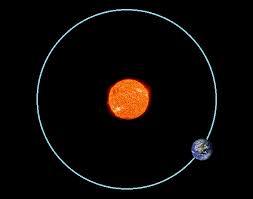
Kepler's Third Law states that the square of the orbital period of a planet is directly proportional to the cube of the semi-major axis of its orbit. This means that the farther a planet is from the Sun, the longer it takes to complete its orbit.
2.
FLASHCARD QUESTION
Front
What is the definition of Orbital Period?
Back
The orbital period is the time it takes for a celestial body to complete one full orbit around another body, such as the time it takes for Earth to orbit the Sun, which is 1 year.
3.
FLASHCARD QUESTION
Front
How does the distance from the Sun affect a planet's orbital period?
Back
The farther a planet is from the Sun, the more time it will take to revolve around the Sun, as described by Kepler's Third Law.
4.
FLASHCARD QUESTION
Front
What is an elliptical orbit?
Back
An elliptical orbit is an oval-shaped path that a celestial body follows around another body, where the distance between the two bodies varies throughout the orbit.
5.
FLASHCARD QUESTION
Front
What is the significance of the semi-major axis in Kepler's Third Law?
Back
The semi-major axis is the longest radius of an ellipse and is used in Kepler's Third Law to determine the relationship between a planet's distance from the Sun and its orbital period.
6.
FLASHCARD QUESTION
Front
Which planet has the shortest orbital period?
Back
Mercury has the shortest orbital period of all the planets in the solar system, taking about 88 Earth days to complete one orbit around the Sun.
7.
FLASHCARD QUESTION
Front
What happens to the distance between the Sun and Earth during its orbit?
Back
The distance between the Sun and Earth varies because Earth follows an elliptical orbit, resulting in changes in distance at different points in its orbit.
Access all questions and much more by creating a free account
Create resources
Host any resource
Get auto-graded reports

Continue with Google

Continue with Email

Continue with Classlink

Continue with Clever
or continue with

Microsoft
%20(1).png)
Apple

Others
Already have an account?
Similar Resources on Wayground

11 questions
Mostly Irrelevant Presidential Trivia
Flashcard
•
9th - 12th Grade
13 questions
Wives of Prophet Muhammad Flashcard
Flashcard
•
10th Grade - University
15 questions
Past Simple VS Prsent Perfect
Flashcard
•
KG - University
15 questions
LT 1.2-1.3 - Photosynthesis
Flashcard
•
11th - 12th Grade
9 questions
Advantages of Cloud Storage
Flashcard
•
9th - 10th Grade
15 questions
Honors Vocabulary Flashcard Week 15
Flashcard
•
8th Grade - University
10 questions
Newton's Third Law
Flashcard
•
7th - 11th Grade
Popular Resources on Wayground
15 questions
Fractions on a Number Line

Quiz
•
3rd Grade
10 questions
Probability Practice
Quiz
•
4th Grade
15 questions
Probability on Number LIne
Quiz
•
4th Grade
20 questions
Equivalent Fractions
Quiz
•
3rd Grade
25 questions
Multiplication Facts
Quiz
•
5th Grade
22 questions
fractions
Quiz
•
3rd Grade
6 questions
Appropriate Chromebook Usage

Lesson
•
7th Grade
10 questions
Greek Bases tele and phon
Quiz
•
6th - 8th Grade
Discover more resources for Science
25 questions
Naming Ionic and Covalent Compounds
Quiz
•
9th Grade
10 questions
Exploring Weathering, Erosion, and Deposition Processes

Interactive video
•
6th - 10th Grade
26 questions
Unit 8b Review
Quiz
•
9th Grade
14 questions
Natural Selection and Adaptation
Lesson
•
9th - 12th Grade
10 questions
Exploring Water Pollution and Conservation
Interactive video
•
6th - 10th Grade
10 questions
Exploring the Human Respiratory System
Interactive video
•
6th - 10th Grade
30 questions
Unit 2C Progress Check (Biosphere 3)
Quiz
•
9th - 12th Grade
14 questions
Genetics Practice (Mendelian & Non-mendelian)
Quiz
•
10th Grade