
Math Properties

Flashcard
•
Mathematics
•
8th Grade
•
Practice Problem
•
Hard
+2
Standards-aligned

Wayground Content
FREE Resource
Student preview

15 questions
Show all answers
1.
FLASHCARD QUESTION
Front
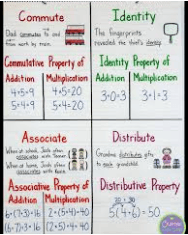
What is the Distributive Property?
Back
The Distributive Property states that a(b + c) = ab + ac. It allows you to multiply a number by a sum by distributing the multiplication to each addend.
Tags
CCSS.3.OA.B.5
2.
FLASHCARD QUESTION
Front
Give an example of the Commutative Property of Addition.
Back
3 + 5 = 5 + 3. This property states that changing the order of the addends does not change the sum.
Tags
CCSS.1.OA.B.3
3.
FLASHCARD QUESTION
Front
What does the Distributive Property distribute to each number?
Back
The Distributive Property distributes multiplication over addition or subtraction.
Tags
CCSS.3.OA.B.5
4.
FLASHCARD QUESTION
Front
What is the Associative Property of Addition?
Back
The Associative Property states that (a + b) + c = a + (b + c). It means that the way numbers are grouped does not change their sum.
Tags
CCSS.1.OA.B.3
5.
FLASHCARD QUESTION
Front
What is the Identity Property of Addition?
Back
The Identity Property states that a + 0 = a. Adding zero to a number does not change its value.
Tags
CCSS.1.OA.B.3
6.
FLASHCARD QUESTION
Front
What is the Commutative Property of Multiplication?
Back
The Commutative Property states that a × b = b × a. Changing the order of the factors does not change the product.
Tags
CCSS.3.OA.B.5
7.
FLASHCARD QUESTION
Front
What is the Associative Property of Multiplication?
Back
The Associative Property states that (a × b) × c = a × (b × c). The way numbers are grouped does not change their product.
Tags
CCSS.3.OA.B.5
Access all questions and much more by creating a free account
Create resources
Host any resource
Get auto-graded reports

Continue with Google

Continue with Email

Continue with Microsoft
or continue with

%20(1).png)
Apple

Others
By signing up, you agree to our Terms of Service & Privacy Policy
Already have an account?

