
Active and Passive Transport

Flashcard
•
Science
•
6th - 8th Grade
•
Practice Problem
•
Hard

Wayground Content
FREE Resource
Student preview

15 questions
Show all answers
1.
FLASHCARD QUESTION
Front
What is Active Transport?
Back
Active transport is the movement of molecules across a cell membrane from a region of lower concentration to a region of higher concentration, using energy in the form of ATP.
2.
FLASHCARD QUESTION
Front
What is Passive Transport?
Back
Passive transport is the movement of molecules across a cell membrane without the use of energy, moving from an area of higher concentration to an area of lower concentration.
3.
FLASHCARD QUESTION
Front
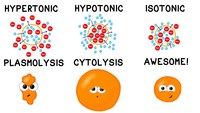
What happens to a cell in a Hypotonic solution?
Back
In a hypotonic solution, water moves into the cell, causing it to swell and potentially burst.
4.
FLASHCARD QUESTION
Front
What happens to a cell in a Hypertonic solution?
Back
In a hypertonic solution, water moves out of the cell, causing it to shrink.
5.
FLASHCARD QUESTION
Front
What is Isotonic solution?
Back
An isotonic solution has the same concentration of solute particles as the cell, resulting in no net movement of water.
6.
FLASHCARD QUESTION
Front
What is Osmosis?
Back
Osmosis is the diffusion of water molecules across a selectively permeable membrane from an area of lower solute concentration to an area of higher solute concentration.
7.
FLASHCARD QUESTION
Front
What is Facilitated Diffusion?
Back
Facilitated diffusion is a type of passive transport that uses protein channels to help move particles across the cell membrane.
Access all questions and much more by creating a free account
Create resources
Host any resource
Get auto-graded reports

Continue with Google

Continue with Email

Continue with Microsoft
or continue with

%20(1).png)
Apple

Others
By signing up, you agree to our Terms of Service & Privacy Policy
Already have an account?

