
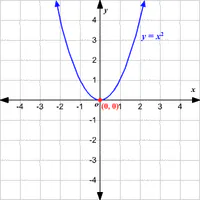
BW - 8.1-8.8 Review of Graphing & Solving Quadratics

Flashcard
•
Mathematics
•
9th - 12th Grade
•
Practice Problem
•
Hard

Wayground Content
FREE Resource
Student preview

15 questions
Show all answers
1.
FLASHCARD QUESTION
Front
What is the discriminant of a quadratic equation?
Back
The discriminant is given by the formula D = b² - 4ac, where a, b, and c are coefficients of the quadratic equation ax² + bx + c = 0. It determines the nature of the roots.
2.
FLASHCARD QUESTION
Front
What does a positive discriminant indicate?
Back
A positive discriminant indicates that the quadratic equation has two distinct real roots.
3.
FLASHCARD QUESTION
Front
What does a zero discriminant indicate?
Back
A zero discriminant indicates that the quadratic equation has exactly one real root (a repeated root).
4.
FLASHCARD QUESTION
Front
What does a negative discriminant indicate?
Back
A negative discriminant indicates that the quadratic equation has no real roots, but two complex roots.
5.
FLASHCARD QUESTION
Front
What is the vertex of a quadratic function in standard form?
Back
The vertex of a quadratic function in the form y = ax² + bx + c can be found using the formula: Vertex = ( -b/(2a), f(-b/(2a)) ).
6.
FLASHCARD QUESTION
Front
How do you find the axis of symmetry for a quadratic function?
Back
The axis of symmetry for a quadratic function y = ax² + bx + c is given by the line x = -b/(2a).
7.
FLASHCARD QUESTION
Front
What is the Quadratic Formula?
Back
The Quadratic Formula is used to find the roots of a quadratic equation and is given by: x = (-b ± √(b² - 4ac)) / (2a).
Access all questions and much more by creating a free account
Create resources
Host any resource
Get auto-graded reports

Continue with Google

Continue with Email

Continue with Classlink

Continue with Clever
or continue with

Microsoft
%20(1).png)
Apple

Others
Already have an account?


