Quadratic Review Questions

Flashcard
•
Mathematics
•
9th - 12th Grade
•
Practice Problem
•
Hard

Wayground Content
FREE Resource
Student preview

15 questions
Show all answers
1.
FLASHCARD QUESTION
Front
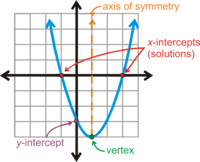
What is the y-value of the vertex in a quadratic function?
Back
The y-value of the vertex represents the maximum or minimum value of the quadratic function, depending on its orientation. It is the highest point for a downward-opening parabola and the lowest point for an upward-opening parabola.
2.
FLASHCARD QUESTION
Front
How do you find the maximum height of a projectile?
Back
The maximum height of a projectile can be found using the vertex of the quadratic equation that models its height over time. The vertex's y-value gives the maximum height.
3.
FLASHCARD QUESTION
Front
What is the formula for the axis of symmetry in a quadratic function?
Back
The formula for the axis of symmetry is x = -b / 2a, where a and b are coefficients from the quadratic equation in the form ax² + bx + c.
4.
FLASHCARD QUESTION
Front
What does the y-intercept represent in a quadratic function?
Back
The y-intercept is the point where the graph of the function crosses the y-axis, representing the value of the function when x = 0.
5.
FLASHCARD QUESTION
Front
How can you determine the lowest point of a quadratic function?
Back
The lowest point of a quadratic function (minimum) can be found at the vertex if the parabola opens upwards. The y-value of the vertex gives the minimum height.
6.
FLASHCARD QUESTION
Front
What is the standard form of a quadratic equation?
Back
The standard form of a quadratic equation is ax² + bx + c = 0, where a, b, and c are constants and a ≠ 0.
7.
FLASHCARD QUESTION
Front
How do you calculate the height of a projectile at a specific time?
Back
To calculate the height of a projectile at a specific time, substitute the time value into the height equation, which is typically in the form s(t) = -16t² + vt + h, where v is the initial velocity and h is the initial height.
Create a free account and access millions of resources
Create resources
Host any resource
Get auto-graded reports

Continue with Google

Continue with Email

Continue with Classlink

Continue with Clever
or continue with

Microsoft
%20(1).png)
Apple

Others
Already have an account?
Similar Resources on Wayground

12 questions
American Revolution
Flashcard
•
8th - 12th Grade
15 questions
Water Cycle
Flashcard
•
8th Grade - University
15 questions
Understanding SMART Goals Components
Flashcard
•
8th Grade - University
10 questions
English 10 (Final Round)
Flashcard
•
10th Grade
13 questions
7517 03 Basic Operations in Programming Languages
Flashcard
•
9th Grade - University
12 questions
Like to vs Would like to - course 6 (2H)
Flashcard
•
9th - 12th Grade
10 questions
Smart Online Shopper
Flashcard
•
KG - University
12 questions
Legal Writing Memo Flashcard
Flashcard
•
KG - University
Popular Resources on Wayground
25 questions
Multiplication Facts

Quiz
•
5th Grade
15 questions
4:3 Model Multiplication of Decimals by Whole Numbers
Quiz
•
5th Grade
10 questions
The Best Christmas Pageant Ever Chapters 1 & 2
Quiz
•
4th Grade
12 questions
Unit 4 Review Day
Quiz
•
3rd Grade
20 questions
Christmas Trivia
Quiz
•
6th - 8th Grade
18 questions
Kids Christmas Trivia
Quiz
•
KG - 5th Grade
14 questions
Christmas Trivia
Quiz
•
5th Grade
15 questions
Solving Equations with Variables on Both Sides Review
Quiz
•
8th Grade
Discover more resources for Mathematics
5 questions
Triangle Congruence Theorems

Interactive video
•
9th - 12th Grade
20 questions
Triangle Congruence Theorems
Quiz
•
9th Grade
20 questions
Solving One-Step Equations
Quiz
•
6th - 9th Grade
15 questions
Graphing Systems of Equations
Quiz
•
8th - 9th Grade
20 questions
Function or Not a Function
Quiz
•
8th - 9th Grade
14 questions
Model and Solve Linear Equations
Quiz
•
9th - 12th Grade
10 questions
Test Your Christmas Trivia Skills
Interactive video
•
6th - 10th Grade
17 questions
Identify Linear and Nonlinear Functions
Quiz
•
8th - 12th Grade