

Astronomy

Flashcard
•
Science
•
6th - 8th Grade
•
Hard

Barbara White
FREE Resource
Student preview

10 questions
Show all answers
1.
FLASHCARD QUESTION
Front
Geocentric Adjective
[jee-oh-sen-trik]
Back
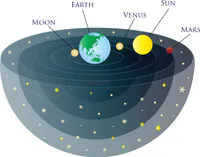
Geocentric
A model of the universe in which a stationary Earth is at the center of all celestial bodies.
Example: This diagram shows the geocentric model, an early theory where the Earth is at the center of the universe, and the Sun, Moon, and planets orbit it.
2.
FLASHCARD QUESTION
Front
Heliocentric Adjective
[hee-lee-oh-sen-trik]
Back
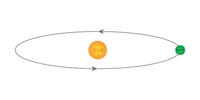
Heliocentric
A model of the universe in which the Sun is at the center and planets revolve around it.
Example: This diagram shows the heliocentric model, where the Earth follows an orbital path around the Sun, which is at the center.
3.
FLASHCARD QUESTION
Front
Rotation Noun
[roh-tey-shuhn]
Back
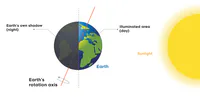
Rotation
The spinning motion of a planet or other celestial body on its own axis, which causes day and night.
Example: This diagram shows the Earth spinning on its tilted axis, which is called rotation. Sunlight illuminates one side, creating day, while the other side is in shadow, creating night.
4.
FLASHCARD QUESTION
Front
Revolution Noun
[rev-uh-loo-shuhn]
Back
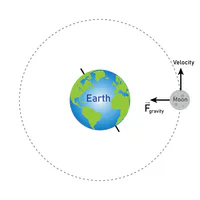
Revolution
The orbital motion of one celestial body around another, which determines the length of a year for a planet.
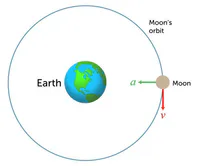
Example: The Moon revolves around the Earth in a path called an orbit, held in place by the balance between its forward velocity and Earth's gravity.
5.
FLASHCARD QUESTION
Front
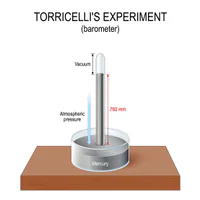
Quantitative Data Noun
[kwon-ti-tey-tiv dey-tuh]
Back
Quantitative Data
Information that can be measured and written down with numbers, such as astronomical observations of planetary positions.
Example: This diagram shows a barometer measuring atmospheric pressure, resulting in a specific number (760 mm), an example of quantitative data used in astronomy.
6.
FLASHCARD QUESTION
Front
Orbit Noun
[awr-bit]
Back
Orbit
The curved, repeating path that a celestial object takes around another object due to gravitational attraction.
Example: An orbit is the curved path an object in space takes around another due to gravity, like the Moon's path around the Earth.
7.
FLASHCARD QUESTION
Front
Ellipse Noun
[ih-lips]
Back
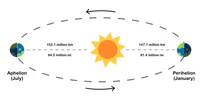
Ellipse
A regular oval shape, which Johannes Kepler discovered is the true shape of a planet's orbit around the sun.
Example: This diagram shows Earth's orbit around the Sun is not a perfect circle but an oval shape called an ellipse, causing its distance to vary.

Access all questions and much more by creating a free account
Create resources
Host any resource
Get auto-graded reports

Continue with Google

Continue with Email

Continue with Microsoft
or continue with

%20(1).png)
Apple

Others
Already have an account?

