

Inner and Outer Planets

Flashcard
•
Science
•
6th - 8th Grade
•
Hard

Barbara White
FREE Resource
Student preview

14 questions
Show all answers
1.
FLASHCARD QUESTION
Front
Terrestrial Planets Noun
[tuh-res-tree-uhl plan-its]
Back
Terrestrial Planets
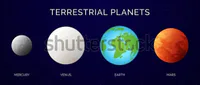
The four inner planets characterized by their solid, rocky surfaces, which are smaller and denser than the outer planets.
Example: This image shows the four terrestrial (or inner) planets of our solar system: Mercury, Venus, Earth, and Mars, which are the planets closest to the Sun.
2.
FLASHCARD QUESTION
Front
Gaseous Planets Noun
[gas-ee-uhs plan-its]
Back
Gaseous Planets
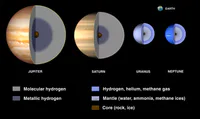
The four outer planets composed primarily of gases and lacking solid surfaces; they are also known as Jovian planets.
Example: This diagram shows the four gaseous planets with cutaway views of their interiors, revealing they are made mostly of gas and ice around a small core.
3.
FLASHCARD QUESTION
Front
Jovian Planets Noun
[joh-vee-uhn plan-its]
Back
Jovian Planets
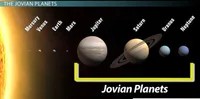
A term for the large, gaseous outer planets, named after Jupiter, the largest planet in our solar system.
Example: The image groups the four outer gas giants—Jupiter, Saturn, Uranus, and Neptune—with a bracket, identifying them as the Jovian planets in our solar system.
4.
FLASHCARD QUESTION
Front
Atmosphere Noun
[at-muh-sfeer]
Back
Atmosphere
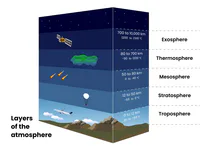
The layer of gases surrounding a planet or other celestial body, which is held in place by its gravity.
Example: This diagram shows Earth's atmosphere is a layer of gases divided into five distinct levels, each with unique characteristics like temperature and altitude.
5.
FLASHCARD QUESTION
Front
Natural Satellite Noun
[nach-er-uhl sat-uh-lite]
Back
Natural Satellite
An astronomical body, also known as a moon, that orbits a planet or another smaller body in space.
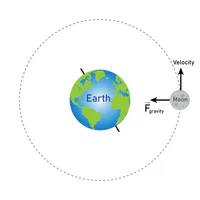
Example: The Moon is a natural satellite because it orbits a larger body, the Earth, held in its path by the force of gravity.
6.
FLASHCARD QUESTION
Front
Planetary Rings Noun
[plan-i-ter-ee rings]
Back
Planetary Rings
Thin discs composed of small particles of rock and ice that orbit a planet, such as those around gas giants.
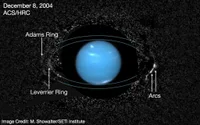
Example: This image shows Neptune, an outer planet, and labels its faint planetary rings, including specific features like arcs, which are clumps of dust and ice.
7.
FLASHCARD QUESTION
Front
Great Red Spot Noun
[greyt red spot]
Back
Great Red Spot
A giant, persistent high-pressure storm system in Jupiter's atmosphere, characterized by high-speed winds like a terrestrial hurricane.
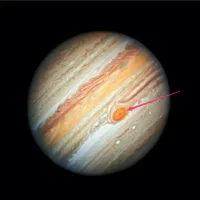
Example: This image shows the planet Jupiter, an outer planet, with an arrow pointing to the Great Red Spot, a massive, long-lasting storm in its atmosphere.
Access all questions and much more by creating a free account
Create resources
Host any resource
Get auto-graded reports

Continue with Google

Continue with Email

Continue with Microsoft
or continue with

%20(1).png)
Apple

Others
Already have an account?

