

Vector Addition

Flashcard
•
Science
•
6th - 8th Grade
•
Hard

Barbara White
FREE Resource
Student preview

14 questions
Show all answers
1.
FLASHCARD QUESTION
Front
Vector Noun
[vek-ter]
Back
Vector
A physical quantity that is defined by possessing both a specific magnitude (size) and a particular direction in space.
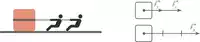
Example: This image shows two forces (vectors) pulling a box in the same direction. The diagram shows how these force vectors, F1 and F2, add together to create a larger resultant force, FR.
2.
FLASHCARD QUESTION
Front
Scalar Quantity Noun
[skay-ler kwon-ti-tee]
Back
Scalar Quantity
A physical quantity that is fully described by its magnitude or numerical value alone, without any associated direction.
Example: Using the formula F=ma, this image shows that mass (m) is a scalar quantity, meaning it only has magnitude (like 5 kg).

3.
FLASHCARD QUESTION
Front
Magnitude Noun
[mag-ni-tood]
Back
Magnitude
The size, length, or amount of a vector quantity, which is always a positive scalar value independent of direction.
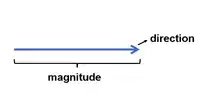
Example: This diagram shows a vector, which has both size and direction. The length of the arrow represents its magnitude (how big it is).
4.
FLASHCARD QUESTION
Front
Direction Noun
[di-rek-shun]
Back
Direction
The orientation of a vector in space, indicating the path along which it is aligned or pointing.
Example: A compass illustrates direction using cardinal points (N, S, E, W) and degrees. Direction is a crucial component of a vector, specifying its orientation.

5.
FLASHCARD QUESTION
Front
Displacement Noun
[dis-pleys-muhnt]
Back
Displacement
A vector quantity representing the shortest distance and direction from an object's initial position to its final position.
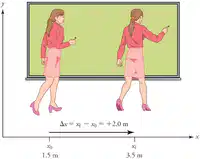
Example: A person moves from an initial position (1.5 m) to a final position (3.5 m), resulting in a displacement of +2.0 meters.
6.
FLASHCARD QUESTION
Front
Distance Noun
[dis-tuhns]
Back
Distance
A scalar quantity that represents the total path length an object has traveled, regardless of its starting or ending point.
Example: This diagram shows that distance is the total length of the path traveled (the winding 8 km road), not the straight-line path between start and end.

7.
FLASHCARD QUESTION
Front
Vector Components Noun
[vek-ter kom-poh-nents]
Back
Vector Components
The projections of a vector onto a set of axes, typically perpendicular, that sum together to form the original vector.
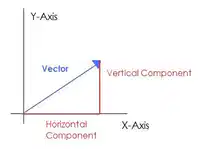
Example: This diagram shows how a single vector (blue arrow) can be split into its horizontal and vertical parts, called components (red arrows).

Access all questions and much more by creating a free account
Create resources
Host any resource
Get auto-graded reports

Continue with Google

Continue with Email

Continue with Classlink

Continue with Clever
or continue with

Microsoft
%20(1).png)
Apple

Others
Already have an account?



