

Carbohydrates

Flashcard
•
Science
•
6th - 8th Grade
•
Hard

Barbara White
FREE Resource
Student preview

15 questions
Show all answers
1.
FLASHCARD QUESTION
Front
Macromolecule Noun
[mak-roh-mol-i-kyool]
Back
Macromolecule
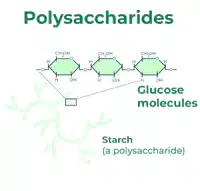
A large organic molecule, such as a carbohydrate or protein, formed by the joining of many smaller organic molecules.
Example: This diagram shows a large starch macromolecule is broken down by digestion into many smaller glucose molecules, its building blocks.

2.
FLASHCARD QUESTION
Front
Polymer Noun
[pol-uh-mer]
Back
Polymer
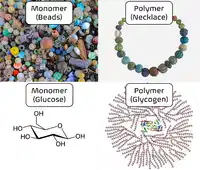
A long molecule consisting of a chain of many repeating smaller units, called monomers, joined together by covalent bonds.
Example: A polymer (necklace, glycogen) is a large molecule made by linking many small, repeating units called monomers (beads, glucose) together.
3.
FLASHCARD QUESTION
Front
Monomer Noun
[mon-uh-mer]
Back
Monomer
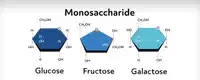
The smaller, repeating molecular unit that serves as the fundamental building block of a much larger molecule called a polymer.
Example: This image shows the chemical structures of glucose, fructose, and galactose, which are all examples of simple sugar monomers, the basic building blocks of carbohydrates.

4.
FLASHCARD QUESTION
Front
Dehydration Synthesis Noun
[dee-hai-dray-shun sin-thuh-sis]
Back
Dehydration Synthesis
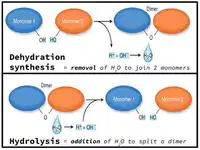
A chemical reaction in which two molecules are joined together by the removal of a single water molecule.
Example: This diagram shows two simple molecules (monomers) joining together to form a larger molecule (a dimer) by removing a water molecule (H2O).
5.
FLASHCARD QUESTION
Front
Hydrolysis Noun
[hai-drol-uh-sis]
Back
Hydrolysis
A chemical reaction that breaks down a polymer by adding a water molecule to split the bond between its monomers.
Example: A large sucrose carbohydrate molecule reacts with a water molecule (hydrolysis) and breaks apart into two smaller sugar molecules, glucose and fructose.

6.
FLASHCARD QUESTION
Front
Carbohydrate Noun
[kar-boh-hai-drayt]
Back
Carbohydrate
A class of macromolecule composed of carbon, hydrogen, and oxygen that serves as a primary source of energy for organisms.
Example: This image shows common foods like bread, rice, pasta, and sugar, which are all examples of carbohydrates, a major source of energy for the body.

7.
FLASHCARD QUESTION
Front
Macronutrient Noun
[mak-roh-noo-tree-ent]
Back
Macronutrient
A type of food, such as a carbohydrate, that is required in large amounts in the diet and must be obtained through food.
Example: Macronutrients are the main nutrients our bodies need in large amounts, categorized into three groups: carbohydrates (carbs), proteins, and fats, found in different foods.


Access all questions and much more by creating a free account
Create resources
Host any resource
Get auto-graded reports

Continue with Google

Continue with Email

Continue with Classlink

Continue with Clever
or continue with

Microsoft
%20(1).png)
Apple

Others
Already have an account?


