

Diffusion and Osmosis

Flashcard
•
Science
•
6th - 8th Grade
•
Hard

Barbara White
FREE Resource
Student preview

18 questions
Show all answers
1.
FLASHCARD QUESTION
Front
Homeostasis Noun
[ho-mee-o-stay-sis]
Back
Homeostasis
The maintenance of a relatively stable internal environment necessary for an organism to survive and function correctly.
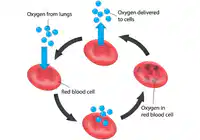
Example: This diagram shows how red blood cells maintain homeostasis by using diffusion to pick up oxygen from the lungs and deliver it to body cells.
2.
FLASHCARD QUESTION
Front
Selectively Permeable Adjective
[suh-lek-tiv-lee pur-mee-uh-bul]
Back
Selectively Permeable
A property of a membrane that allows only certain molecules or ions to pass through it via active or passive transport.
Example: A selectively permeable membrane acts like a filter, allowing small particles (like water) to pass through its pores while blocking larger particles.

3.
FLASHCARD QUESTION
Front
Concentration Gradient Noun
[kon-sen-tray-shun gray-dee-ent]
Back
Concentration Gradient
The difference in the concentration of a substance between two areas, which dictates the direction of passive transport.
Example: The beakers show a gradual change in the concentration of a substance, from high (dark purple liquid) on the left to low (light purple liquid) on the right.

4.
FLASHCARD QUESTION
Front
Equilibrium Noun
[ee-kwuh-lib-ree-um]
Back
Equilibrium
The state where particle concentration is the same inside and outside a cell, resulting in no net movement across the membrane.
Example: In a solution at equilibrium, solute particles are spread out evenly among the solvent particles, resulting in a uniform concentration throughout.

5.
FLASHCARD QUESTION
Front
Passive Transport Noun
[pas-iv trans-port]
Back
Passive Transport
The movement of molecules across a cell membrane from a high to low concentration without requiring the use of energy.
Example: This diagram shows molecules moving from a high concentration area (extracellular fluid) to a low concentration area (cytoplasm) directly across the cell membrane.

6.
FLASHCARD QUESTION
Front
Diffusion Noun
[di-fyoo-zhun]
Back
Diffusion
The passive movement of particles from an area of higher concentration to an area of lower concentration until equilibrium is reached.
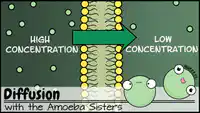
Example: This diagram shows particles moving from an area of high concentration to an area of low concentration across a cell membrane, illustrating the process of diffusion.
7.
FLASHCARD QUESTION
Front
Osmosis Noun
[oz-mo-sis]
Back
Osmosis
The passive diffusion of water molecules across a selectively permeable membrane from a region of high to low water concentration.
Example: This diagram shows osmosis by illustrating how red blood cells change shape. Water moves out of the cell in a hypertonic solution, stays balanced in an isotonic solution, and moves into the cell in a hypotonic solution.


Access all questions and much more by creating a free account
Create resources
Host any resource
Get auto-graded reports

Continue with Google

Continue with Email

Continue with Classlink

Continue with Clever
or continue with

Microsoft
%20(1).png)
Apple

Others
Already have an account?



