
Search Header Logo
Unit 3: Chemical Bonds

Unit 3: Chemical Bonds

Assessment

Presentation

Chemistry

10th Grade

Practice Problem

Easy

NGSS
HS-PS1-1, HS-PS1-2

Standards-aligned

Created by

Marcela Diaz

Used 20+ times

FREE Resource

37 Slides • 21 Questions

1

Unit 3: Chemical Bonds
Slide image

2

Open Ended

9/23/2020

What are the 3 subatomic particles found in an atom? what are the charges of these particles?

3

Why do atoms form bonds?

  • To complete their outer shell (octet: 8 valence electrons)

  • To become more stable

Slide image

4

Multiple Choice

Which family on the periodic table has a complete octet?

1

Alkali Metals

2

Alkaline Earth Metals

3

Transition Metals

4

Halogens

5

Noble Gases

5

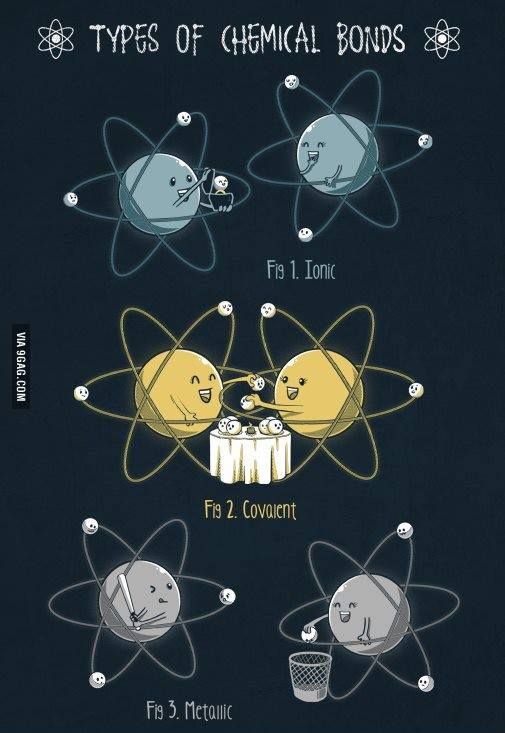
How are bonds formed?

  • A chemical bond forms when atoms transfer or share e-

  • Three Types: 

  • ionic, covalent, metallic

6

Ionic Bond

  • e- are transferred

  • involves ions (metal and nonmetal elements)

Slide image

7

Ionic Bond

  • Metals lose their valence e- and become cations (+)

  • Nonmetals gain those e- and become anions (-)

Slide image

8

Ionic Bond

  • Metals lose their valence e- and become cations (+)

  • Nonmetals gain those e- and become anions (-)

Slide image

9

Multiple Choice

Which of the following elements would LOSE electrons?

1

Na

2

Cl

3

F

4

S

10

Multiple Choice

Which of the following elements would GAIN electrons?

1

Be

2

Cl

3

Li

4

K

11

NaCl

  • Na is a metal therefore it's going to LOSE its outer e-

  • Cl is a nonmetal therefore it's going GAIN the e-

Slide image

12

NaCl

  • Na LOST its 1 e- and became a cation (+)

  • Cl GAINED 1 e- and became an anion (-)

Slide image

13

Why do atoms become cations when they LOSE e-?

  • More protons (+) than e- (-)

Slide image

14

Why do atoms become anions when they GAIN e-?

  • More e- (-) than protons (+)

Slide image

15

Metals lose however many valence e- they have

  • e- in the outermost shell

Slide image

16

Multiple Choice

How many e- will Sodium lose?

1

1

2

2

3

3

4

4

5

5

17

Multiple Choice

How many e- will Aluminum lose?

1

1

2

2

3

3

4

4

5

5

18

Multiple Choice

How many e- will Magnesium lose?

1

1

2

2

3

3

4

4

5

5

19

Nonmetals GAIN however many valence e- they need to get to 8 

  • Complete their octect (outermost shell)

Slide image

20

Multiple Choice

How many e- does Fluoride gain?

1

1

2

2

3

3

4

5

5

7

21

Multiple Choice

How many e- does Oxygen gain?

1

1

2

2

3

3

4

5

5

7

22

Multiple Choice

How many e- does Phosphorus gain?

1

1

2

2

3

3

4

5

5

7

23

Complete Ions Table assignment

24

Open Ended

Phosphorus

(valence e-, metal or nonmetal, gain or lose e-, cation/anion, symbol and charge)

25

Lewis Dot Structures

LDS

26

For today you need...

  • Paper/ notebook

  • Writing utensil

  • Periodic Table

Slide image

27

LDS

  • show only the valence e- (outer e-)

  • Begin on the right and go counterclockwise

  • Each side gets 1 valence e- before doubling up

Slide image

28

Draw the LDS for the following elements:

  • 1. Helium

  • 2. Fluorine

  • 3. Nitrogen

Slide image

29

LDS for ionic compounds

metal (+) and nonmetal (-)

30

Multiple Choice

What is happening to the electrons in an ionic bond?

1

They are being transferred

2

They are being shared

31

Multiple Choice

In an ionic compound, do metal elements lose or gain e-?

1

Metals lose e-

2

Metals gain e-

32

Multiple Choice

When metals LOSE e-, they become...

1

negative ions called anions

2

positive ions called cations

3

negative ions called cations

4

positive ions called anions

33

Multiple Choice

In an ionic bond, nonmetal elements...

1

lose e- and become cations

2

gain e- and become anions

34

LDS for ionic compounds


35

  • Draw LDS for each atom 

  • Metal element(s) will lose valence-e

  • Nonmetal element(s) will gain those e- to complete their octet

  • Redraw LDS showing the transfer of e- and the ion charge

36

Ex 1)

  • Draw the lewis dot structure for NaCl

Slide image

37

Ex 2) MgO

Slide image

38

Ex 3) 
Potassium Sulfide (K2S)

Slide image

39

Open Ended

Exit Ticket: Using the whiteboard app, draw the following LDS:

1) LiF

2) Na2O

3) BaO

40

How are bonds formed?

  • A chemical bond forms when atoms transfer or share e-

  • Three Types: 

  • ionic, covalent, metallic

41

Covalent Bonds

  • e- are SHARED (no ions or charges)

  • nonmetal elements only

Slide image

42

Covalent Bond

  • nonmetal elements ONLY

  • Ex: CO, H2O

Slide image

43

Multiple Choice

Which of the following is covalent?

1

KF

2

NO2

44

Multiple Choice

Which of the following is covalent?

1

MgCl2

2

NH3

45

Multiple Select

Select all of the COVALENT bonds

1

NaCl

2

CH4

3

CO2

4

Al2O3

5

SF6

46

LDS for covalent bonds

nonmetals share e-

47

  • e- sharing is represented using a dash

  • each dash represents 2 e- being shared

Slide image

48

  • Single bond: 2 e- shared

  • Double Bond: 4 e- shared

  • Triple bond: 6 e- shared

Slide image

49

  • Atoms will share e- in a way that completes their octet (8 valence e-)

  • *EXCEPTION: H and He, they only need 2 valence e- to be stable!

Slide image

50

Ex1) Draw the LDS for water

51

Step 1: Draw skeleton structure

  • The atom that needs the MOST e- goes in the center

  • *Hydrogen is never the central atom

52

Step 2: Draw each atom's LDS

  • Pro-tip: use a pencil

53

Step 3: Connect (pair up) electrons

  • Use a dash to indicate e- being shared

54

Step 4: Check octets

  • All atom's should have a complete octet (8)

  • e- being shared count for both elements

  • *H and He (only need 2)

55

Open Ended

Draw the LDS for O2

56

Metallic Bonds

  • Metals ONLY

  • e- are mobile 

Slide image

57

  • e- move freely through metal

  • This is how electricity is conducted

  • e- carry electric current when they move

Slide image

58

Open Ended

Exit Ticket: Draw the LDS for the following:

CO2

F2

NH3

Unit 3: Chemical Bonds

Slide image

Show answer

Auto Play

Slide 1 / 58

SLIDE
