

Rivers Year 10

Presentation
•
Geography
•
10th Grade
•
Practice Problem
•
Medium

KEVIN OUKO
Used 17+ times
FREE Resource
14 Slides • 11 Questions
1
Rivers Year 10
2
3
River characteristics
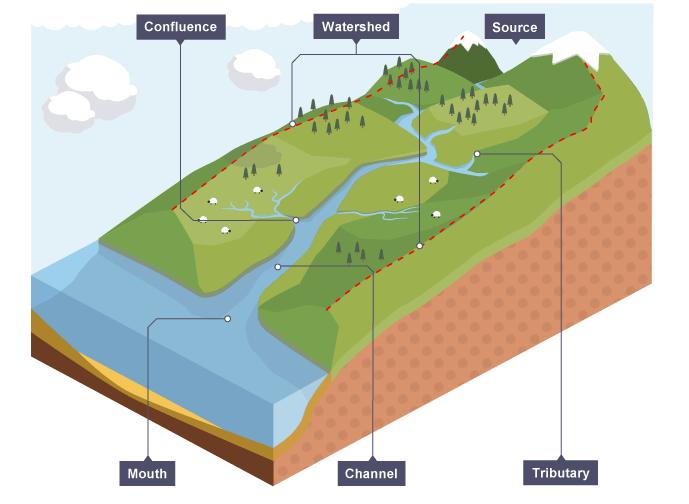
A river basin or drainage basin is an area of land drained by a river and its tributaries. The edge of the drainage basin is known as the watershed. This can be compared to a sink or basin, which catches the water falling into it. The water travels towards the centre and leaves the sink through a plug hole. In a similar way, the water flowing through the river will eventually leave the river basin through its mouth and enter the sea or a lake.
4
The drainage basin system
Inputs: How water is introduced into the drainage basin system. This is known as precipitation.
Stores: How water is stored or held for a period of time within the drainage basin system - interception (by vegetation), soil moisture, surface storage (lakes), groundwater
Transfers: A process or flow of water from one place to another in the drainage basin system - surface run-off/overland flow, infiltration, percolation, through-flow, groundwater flow
Outputs: How the water is released either back to the sea or back into the atmosphere - river discharge, evapotranspiration

5
6
Drainage basins
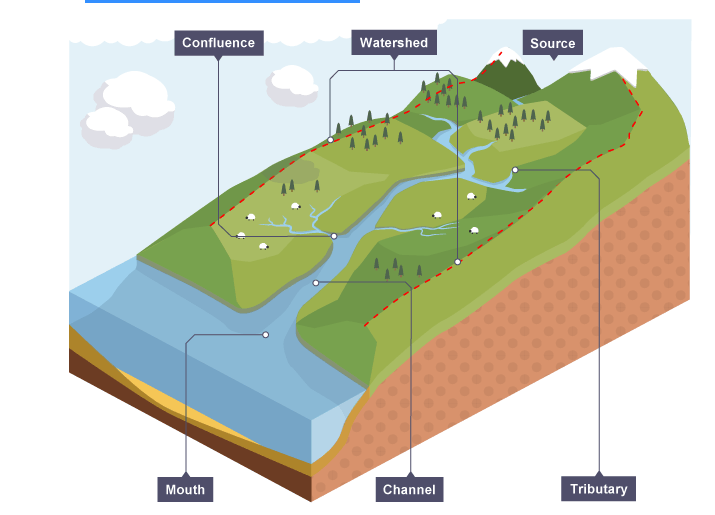
A drainage basin is the area of land around the river that is drained by the river and its tributaries
watershed – the area of high land forming the edge of a river basin
source – where a river begins
mouth – where a river meets the sea
confluence – the point at which two rivers meet
tributary – a small river or stream that joins a larger river
channel – this is where the river flows
7
Key terms:
Infiltration - Water soaks or filters into the soil.
Surface runoff - Water moves across the surface of the earth becoming a stream, tributary or river
Precipitation - An input where water is introduced to the drainage basin system.
Evapotranspiration - Water vapour is evaporated from the trunk and leaves of trees and other vegetation, back into the atmosphere.
Groundwater flow - Water moving slowly through the soil and porous rocks to move back towards the sea.
Percolation - Water moving from the soil into the spaces (pores) in the rock.

8
River erosion
As the river moves from the source to the mouth – both the depth of the river and the width of the river will both increase.
Erosion is the process that wears away the river bed and banks. Erosion also breaks up the rocks that are carried by the river.

9
Transport
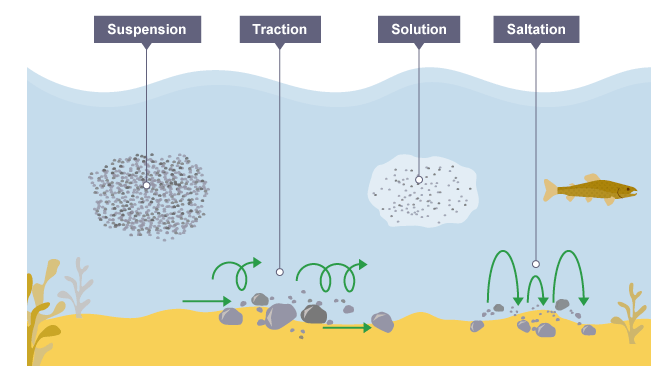
Rivers pick up and carry material as they flow downstream.
Solution - minerals are dissolved in the water and carried along in solution.
Suspension - fine light material is carried along in the water.
Saltation - small pebbles and stones are bounced along the river bed.
Traction - large boulders and rocks are rolled along the river bed.
10
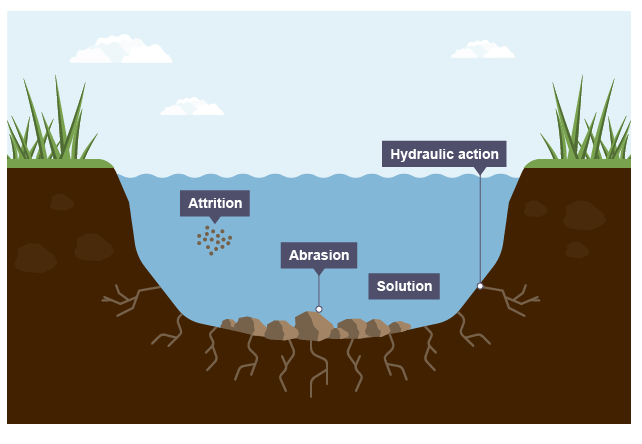
There are four types of erosion:
Hydraulic action – this is the sheer power of the water as it smashes against the river banks. Air becomes trapped in the cracks in the rock of the river bank and bed, and causes the rock to break apart.
Abrasion – when pebbles are picked up by the flowing water and smash against the river bank and bed, wearing it away.
Attrition – when rocks that the river is carrying knock against each other. They break apart to become smaller and more rounded
Solution – when the water dissolves certain types of rock, eg limestone
11
River landforms
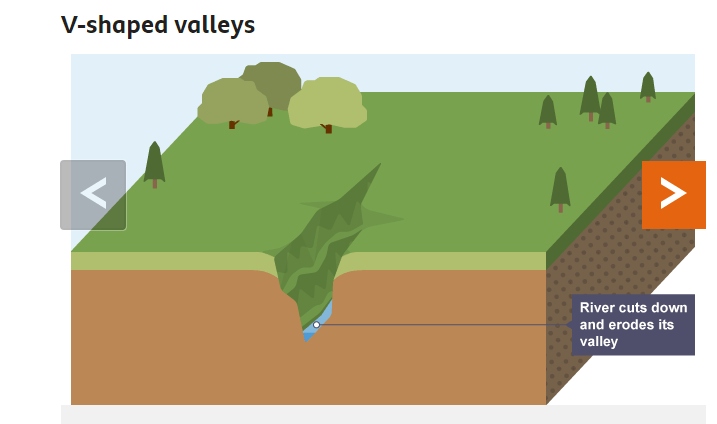
V-shaped valley Rivers begin high up in the mountains so they flow quickly downhill eroding the landscape vertically.
The river cuts a deep notch down into the landscape using hydraulic action, when the sheer force of the water gets into small cracks and breaks down the sides of the river valley. Corrasion (abrasion) also occurs which is when the river bed and banks are eroded by the load hitting against them. Another type of erosion that happens is corrosion (solution), when the river water dissolves minerals from the rocks and washes them away.
12
Waterfalls
The river flows over bands of less resistant (softer) and resistant (harder) rocks.
The less resistant rock is more quickly worn away due to differential erosion.
The river undercuts the harder rock leaving an overhang which becomes unsupported and collapses into the plunge pool below.

13
gorges
A steep-sided valley is left where the waterfall once was.
This is called a gorge. can be formed when a waterfall retreats upstream.

14
Multiple Choice
15
Multiple Choice
16
Multiple Choice
17
Multiple Choice
18
Multiple Choice
19
Multiple Choice
20
Transport
Rivers pick up and carry material as they flow downstream
Solution - minerals are dissolved in the water and carried along in solution.
Suspension - fine light material is carried along in the water.
Saltation - small pebbles and stones are bounced along the river bed.
Traction - large boulders and rocks are rolled along the river bed.

21
Multiple Choice
22
Multiple Choice
23
Multiple Choice
24
Multiple Choice
25
Multiple Choice
Rivers Year 10
Show answer
Auto Play
Slide 1 / 25
SLIDE

