Search Header Logo
  1. Resource Library
  2. Science
  3. Chemistry
  4. Atomic Models
  5. Apex 3.2 Atomic Models
Apex 3.2 - Atomic Models

Apex 3.2 - Atomic Models

Assessment

Presentation

Science

7th Grade

Practice Problem

Medium

NGSS
MS-PS1-1, MS-PS1-5

Standards-aligned

Created by

Bernardo Moyza

Used 61+ times

FREE Resource

17 Slides • 6 Questions

1

Apex 3.2 Review -

Atomic Models

Please follow along and participate in the questions!

Slide image

2

Learning Objectives: I can...

  • Summarize the history of atomic models.

  • Identify the differences between the various atomic models.

  • Develop and use a model which shows that electrons orbit outside the center of the atom.

3

Slide image

4

Multiple Choice

Why are models useful in the study of atoms?

1

Atoms are too dangerous to handle.

2

Atoms are too big too fit in a lab.

3

Atoms are too small to see with our eyes.

4

Atoms are too rare and valuable to use in lab studies.

5

Slide image

6

Slide image

7

Slide image

8

Slide image

9

Multiple Select

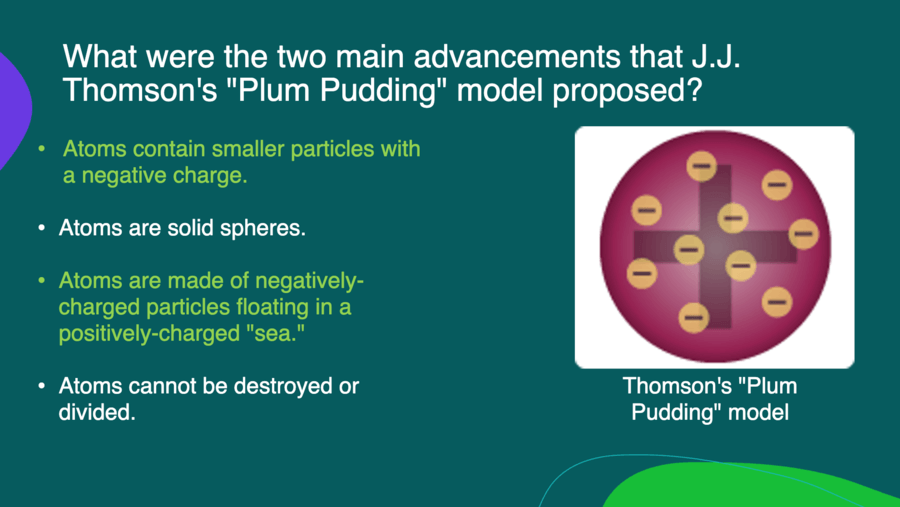
What were the two main advancements that J.J. Thomson's "Plum Pudding" model proposed?

1

Atoms contain smaller particles with a negative charge.

2

Atoms are solid spheres.

3

Atoms are made of negatively-charged particles floating in a positively-charged "sea."

4

Atoms cannot be destroyed or divided.

10

Slide image

11

Slide image

12

Slide image

13

Multiple Choice

In the Rutherford model, where can the atom's positive charge be found?

1

In the electrons.

2

In the nucleus.

3

In the orbits.

4

In the plum pudding.

14

Slide image

15

Slide image

16

Slide image

17

Slide image

18

Slide image

19

Multiple Choice

Question image

Match the atomic model in the picture with the scientist who developed it.

1

John Dalton (1808)

2

Ernest Rutherford (1909)

3

Erwin Shrödinger (1926)

4

JJ Thomson (1897)

20

Multiple Choice

Question image

Match the atomic model in the picture with the scientist who developed it.

1

JJ Thomson (1897)

2

John Dalton (1808)

3

Niels Bohr (1913)

4

Erwin Shrödinger (1926)

21

Slide image

22

Learning Objectives: I can...

  • Summarize the history of atomic models.

  • Identify the differences between the various atomic models.

  • Develop and use a model which shows that electrons orbit outside the center of the atom.

23

Open Ended

Closing: With the objectives in mind, what are the important takeaways from this lesson that you should remember when we come back from Fall Break?

Apex 3.2 Review -

Atomic Models

Please follow along and participate in the questions!

Slide image

Show answer

Auto Play

Slide 1 / 23

SLIDE