

Future Perfect and Perfect Infinitives

Presentation
•
English
•
University
•
Practice Problem
•
Hard

Erick Márquez
Used 47+ times
FREE Resource
9 Slides • 5 Questions
1
Future Perfect and Perfect Infinitives

2
Use
The future perfect is a verb tense used for actions that will be completed before some other point in the future.
The parade will have ended by the time Chester gets out of bed.
At eight o’clock I will have left.
3
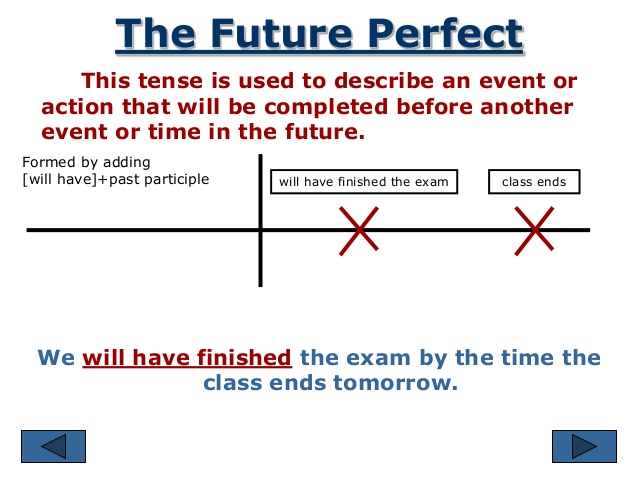
4
FORMULA
The formula for the future perfect tense is pretty simple: will have + [past participle].
It doesn’t matter if the subject of your sentence is singular or plural. The formula doesn’t change.
5
When Not to Use the Future Perfect Tense
The future perfect tense is only for actions that will be complete before a specified point in the future. In other words, the action you’re talking about must have a deadline. If you don’t mention a deadline, use the simple future tense instead of the future perfect tense.
CORRECT Linda will leave.
INCORRECT Linda will have left.
The deadline can be very specific (eight o’clock) or it can be vague (next week). It can even depend on when something else happens (after the parade ends). It just has to be some time in the future.
6
Phrases that Often Go With the Future Perfect
By this time next week, Linda will have left for her trip.
Three days from now, we will have finished our project.
At midnight, the party will have ended.
Will you have eaten already?
Chester will not have arrived by the time the parade is over.
When I travel to France, I will have been to ten countries.
My sister will have cleaned the bathroom before the party.
As soon as someone buys this chair, I will have sold all the furniture I wanted to get rid of.
7

8
Fill in the Blanks
I
Type answer...
9
Fill in the Blanks
Type answer...
10
Fill in the Blanks
When
Type answer...
11
Fill in the Blanks
She
Type answer...
12
Fill in the Blanks
She
Type answer...
13
PERFECT INFINITIVES
When we talk about a plan, an expectation, a hope or an intention to complete an action before a specified time in the future, we use perfect infinitives.
I hope to have answered all your questions by the end of this class.
14
MEANING
An expectation is something we are almost sure will happen. We use the verb expect.
I expect to have finished all my homework by 9.
A hope is something we can completely control and we are not sure will happen. We use the verb hope
I hope to have finished all my homework by 9.
For an intention or plan we use the verbs plan or intend.
I intend to have finished all my homework by 9.
Future Perfect and Perfect Infinitives
Show answer
Auto Play
Slide 1 / 14
SLIDE
Similar Resources on Wayground

10 questions
Adverbs of frequency
Presentation
•
University
14 questions
Third Conditional
Presentation
•
University
10 questions
PRESENT SIMPLE
Presentation
•
University
10 questions
WRITING PARAGRAPHS
Presentation
•
University
10 questions
TOEFL Listening - inferences
Presentation
•
University
12 questions
Linguistics
Presentation
•
University
10 questions
Future will
Presentation
•
Professional Development
12 questions
Billing and farewel
Presentation
•
KG - University
Popular Resources on Wayground
10 questions
Safety Day 2026 – Student Review

Quiz
•
9th Grade
21 questions
Continents and Oceans
Quiz
•
6th Grade
20 questions
Parts of Speech
Quiz
•
5th Grade
16 questions
Subject & Predicate
Quiz
•
5th Grade
25 questions
Multiplication Facts
Quiz
•
5th Grade
12 questions
Map Skills
Quiz
•
3rd Grade
22 questions
Continents and Oceans
Quiz
•
5th Grade
15 questions
Rounding Decimals
Quiz
•
5th Grade
Discover more resources for English
20 questions
Disney Trivia
Quiz
•
University
10 questions
Spanish Greetings and Goodbyes!
Presentation
•
6th Grade - University
20 questions
Physical or Chemical Change/Phases
Quiz
•
8th Grade - University
39 questions
Unit 7 Key Terms
Quiz
•
11th Grade - University
25 questions
SER and Subject Pronouns
Quiz
•
8th Grade - University
38 questions
Unit 6 Key Terms
Quiz
•
11th Grade - University
19 questions
Key Concepts in Buddhism
Quiz
•
University
0 questions
Cell Domain Basic Review (Biology)
Quiz
•
University