

Chapter 3 Review

Presentation
•
Science
•
8th Grade
•
Hard

Christiaan Heunis
Used 5+ times
FREE Resource
14 Slides • 19 Questions
1
Chapter 3 Review
- Physical and Chemical Changes
- Chemical Reactions
- Balancing Chemical Equations
- Types of Chemical Reactions
- Endo- and Exothermic Reactions
- Rates of Chemical Reactions
2
3
Physical and Chemical Change
A physical change occurs when matter changes its physical properties but not its chemical composition.
A chemical change occurs whenever matter changes into new substances with different chemical properties.

4
Multiple Choice

Can you identify the type of Change?
5
Multiple Choice
6
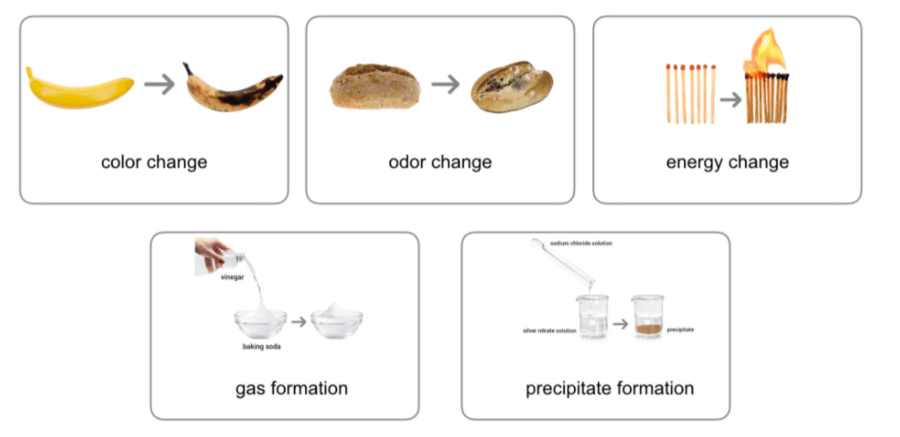
Signs of a Chemical Reaction occurring
7
Multiple Select
8
Fill in the Blanks
9
Chemical Reactions
A chemical reaction is a process by which chemical bonds between atoms are broken and new ones are formed. In chemical reactions, substances change into different substances.
A chemical equation is a statement , used to show changes during a specific chemical reaction.
A chemical equation involves:
- the chemical formula of each substance in the reaction
- an arrow that indicates the process of change, it can be read as "yields" or "reacts to form"

10
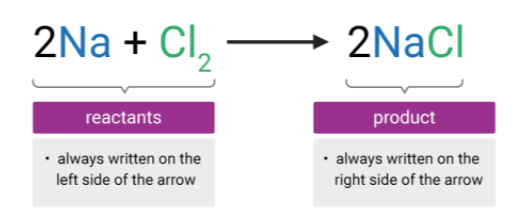
Look at the description of REACTANTS and PRODUCTS
11
Multiple Choice
12
Multiple Choice
13
New Substances
ATOM ARRANGEMENT: The atoms of iron and sulfur are rearranged and new bonds can form to produce iron sulfide.
BOND BREAKING: Each water molecule is made up of two hydrogen atoms joined to one oxygen atom which can decompose by breaking the bonds.
BOND FORMATION: In a compound, the atoms are joined together by strong forces called chemical bonds.

14
Multiple Select
15
Multiple Choice
16
Multiple Choice
17
Fill in the Blanks
18
Balancing Chemical Equations
The law of conservation of mass states that mass is never lost or gained in chemical reactions. The total mass of products at the end of the reaction is equal to the total mass of the reactants at the beginning. This is because no atoms are created or destroyed during chemical reactions.

19
How to Balance an equation
In a balanced chemical equation, the total number of atoms remains the same before and after the reaction.
How does a chemical equation for any reaction model that mass is conserved during a chemical reaction?
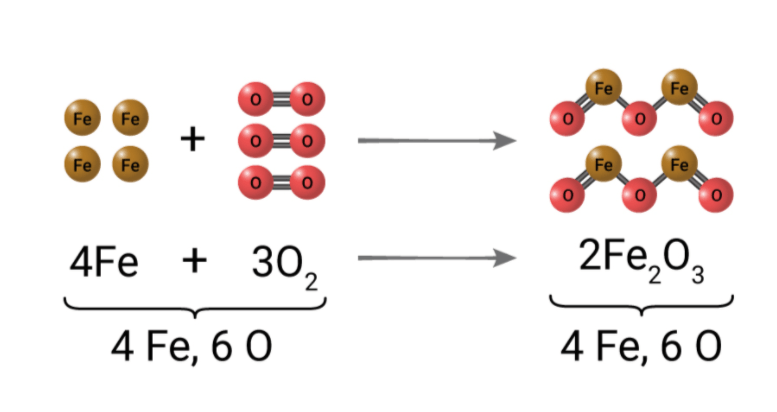
20
STEP 1: Determine the number of atoms of each element in the reactants and in the products.
STEP 2: Count the number of atoms on each side of the equation.
- If the numbers are equal, then the equation is balanced and if they are not equal, the equation is not balanced.
STEP 3: Add coefficients to the chemical formulas to balance the equation.
STEP 4: Write the balanced chemical equation.

21
Multiple Choice
22
Multiple Choice
23
Multiple Choice
24
Types of Chemical Reactions
Synthesis Reaction: A synthesis reaction occurs when two elements or compounds combine to form one new compound.
Decomposition Reaction: A decomposition reaction occurs when one reactant breaks down into two or more products.

25
Types of Chemical Reactions
Single-replacement Reaction: In a single replacement reaction, one element replaces another element in a compound.
Double-replacement Reaction: In a double replacement reaction, the two negative ions of two compounds switch places.

26
Types of Chemical Reactions
Combustion Reaction: In a combustion reaction, a substance reacts with oxygen and releases energy in the form of heat and light.

27
Multiple Choice
28
Multiple Choice
29
Multiple Choice
30
Exothermic and Endothermic Reactions
An exothermic reaction is a chemical reaction that releases thermal energy.
An endothermic reaction is a chemical reaction that absorbs thermal energy.

31
Fill in the Blanks

Complete the Energy Diagram for an Exothermic Reaction.
Type answer...
32
Fill in the Blanks

Complete the Energy Diagram for an Exothermic Reaction.
Type answer...
33
Poll
Chapter 3 Review
- Physical and Chemical Changes
- Chemical Reactions
- Balancing Chemical Equations
- Types of Chemical Reactions
- Endo- and Exothermic Reactions
- Rates of Chemical Reactions
Show answer
Auto Play
Slide 1 / 33
SLIDE


