

Membrane Transport Review

Presentation
•
Science
•
9th - 10th Grade
•
Practice Problem
•
Medium
+3
Standards-aligned

Amanda Johnson
Used 8+ times
FREE Resource
11 Slides • 23 Questions
1
Cell Membrane Transport
Structure, Passive, and Active Tranport

2
Passive Transport
Passive transport occurs without energy
Substances move from a high concentration to a low concentration across the membrane.
There are 3 main examples of passive transport: Simple Diffusion, Facilitated Diffusion, and Osmosis.

3
Multiple Select
4
Simple Diffusion
During simple diffusion items move from high concentration to low concentration across the membrane by traveling between the phospholipids
This can only occur for molecules that are SMALL and UNCHARGED.
Examples of molecules that move by simple diffusion are: OXYGEN (O2), and CARBON DIOXIDE (CO2)

5
Facilitated Diffusion
Facilitated diffusion is diffusion that also moves things from a high to a low concentration but with the help from a protein channel.
Things that move via facilitated diffusion are molecules that are LARGE or CHARGED.
Examples include: Glucose, Amino Acids, Ions

6
Multiple Choice
7
Multiple Choice
8
Multiple Choice
9
Multiple Select
10
Multiple Choice
11
Multiple Choice
12
Multiple Select
13
OSMOSIS
Osmosis is the movement of water from where there is a high concentration of water and low concentration of solute to where there is a low concentration of water and a high concentration of solute.
Solute remember, is the molecule that is being dissolved into the water. For example, in salt water, the SALT is the SOLUTE.

14
HYPERTONIC
When a cell is in a HYPERTONIC environment there is MORE SOLUTE on the OUTSIDE of the cell than on the inside.
This means there is more water INSIDE the cell and that will mean the water will leave the cell.
This can cause the cell to lose volume and shrivel up. We call this plasmolysis.

15
HYPOTONIC
When a cell is in a HYPOTONIC enviornment there is LESS SOLUTE on the OUTSIDE of the cell than on the inside.
This means there is more water OUTSIDE the cell and the water will rush into the cell.
This can cause the cell to gain volume and get bigger or even burst.
If a cell bursts, we call that lysis.

16
ISOTONIC
When a cell is in an ISOTONIC solution, there are equal concentrations of solute on the outside and inside of the cell
This means the cell is at equilibrium.
The water will continue to move in both directions evenly.
This results in no change to the size of the cell and the cell remains normal.

17
Multiple Choice
18
Multiple Choice
19
Multiple Choice
20
Multiple Choice
21
Multiple Choice
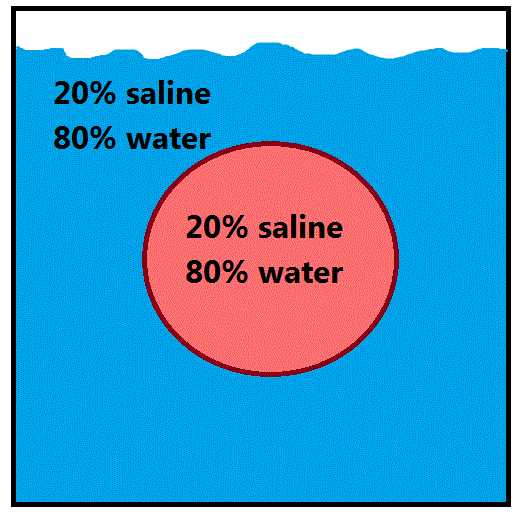
A blood cell is placed into the jar, as seen. Where will the water go?
22
Multiple Choice
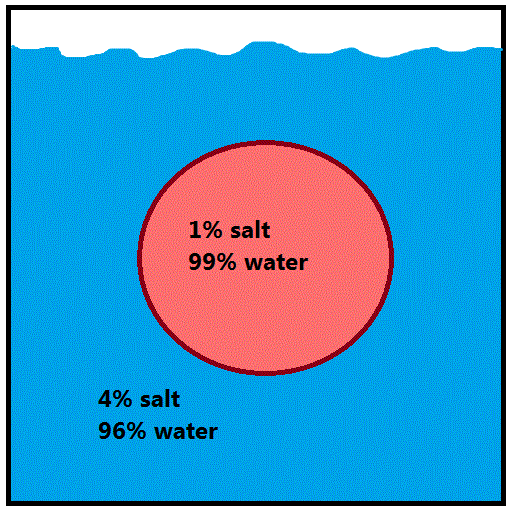
Where will the water go?
23
Multiple Choice
24
Multiple Choice
25
Multiple Choice
26
ACTIVE TRANSPORT
Sometimes particles need to move from a LOW concentration to a HIGH concentration AGAINST the CONCENTRATION GRADIENT
This process ALWAYS REQUIRES ENERGY
There are two types of Active Transport: DIRECT ACTIVE TRANSPORT and BULK ACTIVE TRANSPORT

27
DIRECT ACTIVE TRANSPORT
This is when smaller things are brought into the cell from a low concentration to a high concentration.
Movement of the particles occurs through a membrane protein
ATP (Cell Energy) is directly used to provide energy for this process.

28
BULK ACTIVE TRANSPORT
This is when large items or large amounts of items are moved into or out of the cell. This still occurs from an area of low concentration to an area of high concentration.
Materials are brought in and out with vacuoles.
Bringing something in using a vacuole is called ENDOCYTOSIS.
Pushing something out using a vacuole is called EXOCYTOSIS.

29
Multiple Choice

30
Multiple Choice

What type of transport is this?
31
Multiple Choice
32
Multiple Choice
33
Multiple Choice
34
Multiple Choice

Cell Membrane Transport
Structure, Passive, and Active Tranport
Show answer
Auto Play
Slide 1 / 34
SLIDE


