

CHAPTER 15 LESSON 1

Presentation
•
History
•
10th Grade
•
Easy

Richard Orton
Used 2+ times
FREE Resource
29 Slides • 9 Questions
1
CHAPTER 15 LESSON 1
The Italian States
2
ESSENTIAL QUESTION
How can trade lead to economic prosperity and political power?

3

4

5

6

7
Multiple Choice
8

9
Italy enjoyed economic prosperity
• This trade gave energy to Italy’s urban environment and encouraged the exchange of ideas, but no centralized monarchy developed.
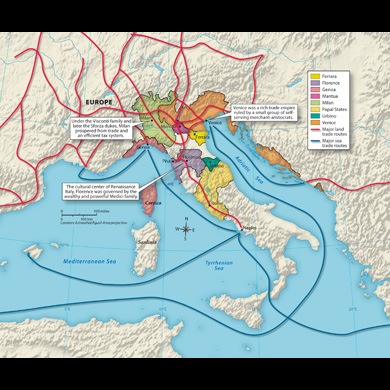
• In the early fifteenth century, five major territorial states came to dominate Italy.

10
Italy enjoyed economic prosperity
• The five major states, which were controlled by dynastic families, were: Milan, Venice, Florence, the Papal State of Rome, and the Kingdom of Naples.

11
Open Ended

What were the benefits of Venice’s location?
12
Open Ended

What were the benefits of Naples’s location?
13

14

15

16
Multiple Choice
17
Rome was sacked by Spanish merrcenaries in 1527
Spain remained a dominate force in Italy as a result
The Italian Wars lasted from 1494-1559

18
Multiple Choice
19

20

21
Multiple Choice
22

23

24

25

26

27
Multiple Choice
28

29

30

31

32

33

34
The marriage contracts would include a dowry that would be given to the husband
The father-husband was the center of the Italian family, making all decisions

35
The mother’s role was to run the household and raise children
Children were to be subservient to their fathers

36
Males became adults when they reached a certain age, left home, or were emancipated
Women never became legal adults while their father was alive unless they were emancipated

37
Multiple Choice
38
Open Ended

How can trade lead to economic prosperity and political power?
CHAPTER 15 LESSON 1
The Italian States
Show answer
Auto Play
Slide 1 / 38
SLIDE


