
Volume Wrap Up
Presentation
•
Physics, Science
•
6th - 8th Grade
•
Practice Problem
•
Medium
Standards-aligned
Jawara Senghor
Used 95+ times
FREE Resource
6 Slides • 16 Questions
1
Volume Wrap Up
2
What is Volume in science?
Volume is the quantity of three-dimensional space occupied by a liquid, solid, or gas. Although many other units exist (like gallons, ounces and teaspoons), the International System of Units (SI) standard unit of volume is the cubic meter (m3) for solids and milliliters (mL) for irregular solids and liquids.
3
Calculating Volume of regular solids
For three-dimensional shapes like cubes and rectangular prisms, we can find the volume by measuring its dimensions; using a unit of length (e.g. meters or centimeters) and then applying the formula L x W x H to determine its volume. The unit of measurement would be the cubic value of the unit used for length.
4
Multiple Select
What is volume?
The amount of matter in an object
Something that has matter
The amount of space an object takes up
The button on my phone
5
Multiple Choice
What is the volume?
12
23
15
60
6
Multiple Choice
What is the formula for finding the volume of a regular solid?
Mass x Weight
(Length + Width) x 2
Length2 x Height2 = Width2
Length x Width x Height
7
Multiple Choice
What is the volume of a object that has a length of 25 cm, a height of 10 cm and a width of 18 cm?
4,500 cm3
53 cm3
450 cm3
328 cm3
8
Multiple Choice
Kayla found two boxes in her storeroom. Box 1 has the dimensions 6 x 2 x 3. Box 2 has the dimensions 2 x 3 x 6. Which box holds more baseballs?
Box 1
Box 2
Neither, they both hold the same amount.
9
Calculating Volume of liquids
To measure the volume of a liquid, it can be poured into a graduated measuring vessel of some kind. Its volume can then be seen by looking at the graduations on the side of the measuring vessel. Volume of a liquid is usually expressed in terms of milliliters (mL), or submultiples of a liter (L).
10
Calculating Volume of liquids
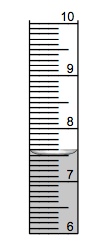
Measuring liquid volume requires a certain method. Vessels used to measure the volume of a liquid should always be placed on a flat surface. The surface of liquids have a tendency to form a curve (called the meniscus) which should be read at the lowest level of the surface of the liquid, making sure that the eye is level with the surface of the liquid.
11
Multiple Choice
12
Multiple Choice
13
Multiple Choice
The volume of this liquid is
50 ml
51 ml
52 ml
55 ml
14
Multiple Choice
15
Multiple Choice
What is the volume of the liquid in the picture
35 mL
35 grams
35 cm3
35 L
16
Calculating volume of irregular solids
We can find the volume of an irregular solid object using a method called fluid displacement. Step 1 is to fill the cylinder with enough water to immerse the object and measure the volume. Next you would add the object to the water until it is totally submerged and measure the new volume of the water. Subtract the first reading from the second to get the volume, in milliliters, of the object.
17
Multiple Choice
Which of the following is NOT a step in finding the volume of an irregular shaped solid object?
Measure and record an amount of water in a graduated cylinder
Add the object to a graduate cylinder with a known amount of water and record the new water level
Use the formula to multiply the length by the width by the height
Subtract the water level of the with the object in it from the amount of water before the object was introduced
18
Multiple Choice
What do you call the curve in the surface of a liquid in a graduated cylinder that we use to measure the volume of an irregular object?
a measurement curve
menicus
eclipsis
19
Multiple Choice
20
Multiple Choice
21
Fill in the Blank
What is the volume of the object?
22
Poll
How do you feel about your understanding of Volume?
I pretty much understand everything
I need little bit of help with some things
Man! This is difficult for me
Huh???
Volume Wrap Up
Show answer
Auto Play
Slide 1 / 22
SLIDE

Similar Resources on Wayground
19 questions
Photosynthesis and Cellular Respiration
Lesson
•
6th - 8th Grade
19 questions
Motion Graphs
Lesson
•
6th - 8th Grade
16 questions
Body Organization
Lesson
•
6th - 8th Grade
18 questions
Plants
Lesson
•
6th - 8th Grade
16 questions
Greenhouse Effect
Lesson
•
6th - 8th Grade
19 questions
Potential Energy
Lesson
•
6th - 8th Grade
19 questions
Periodic Table
Lesson
•
6th - 8th Grade
19 questions
Energy Transfer and Transformation
Lesson
•
6th - 8th Grade
Popular Resources on Wayground
10 questions
5.P.1.3 Distance/Time Graphs
Quiz
•
5th Grade
10 questions
Fire Drill
Quiz
•
2nd - 5th Grade
20 questions
Equivalent Fractions
Quiz
•
3rd Grade
15 questions
Hargrett House Quiz: Community & Service
Quiz
•
5th Grade
20 questions
Main Idea and Details
Quiz
•
5th Grade
20 questions
Context Clues
Quiz
•
6th Grade
20 questions
Inferences
Quiz
•
4th Grade
15 questions
Equivalent Fractions
Quiz
•
4th Grade
Discover more resources for Physics
17 questions
Newtons Laws
Quiz
•
8th Grade
20 questions
Measuring Speed, Distance, and Time Learning Check
Quiz
•
6th - 8th Grade
20 questions
Friction and Gravity
Quiz
•
6th - 8th Grade
32 questions
Quiz#2 Optics/EMS study guide
Quiz
•
8th Grade
20 questions
S8P5 Review
Quiz
•
8th Grade
14 questions
Work and Energy intro
Interactive video
•
8th - 10th Grade
28 questions
Newton's Laws of Motion with Balanced and Unbalanced Forces
Quiz
•
8th Grade