

Sonnet 18

Presentation
•
English
•
7th - 8th Grade
•
Medium
+8
Standards-aligned

Jennifer Tanner
Used 89+ times
FREE Resource
9 Slides • 8 Questions
1
Sonnet 18
Shakespeare

2
What is a Sonnet?
A sonnet is written in iambic pentameter.
An “iamb” is two syllables. The first syllable is unstressed and the second syllable is stressed. (The opposite of iambic is trochaic.)
When they are sounded together you get a fall and a rise.
Penta means five, so iambic pentameter is five iambs strung together.
This is what it looks like:

3
Multiple Choice

What is an IAMB?
4
Multiple Choice

What does PENTA mean?
5
Multiple Choice

What does IAMBIC PENTAMETER mean?
6
What is a sonnet?
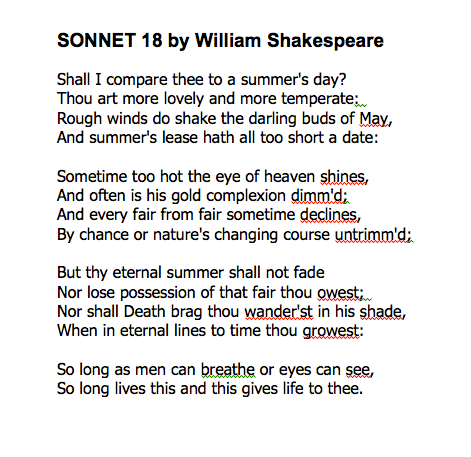
A sonnet has fourteen lines.
A traditional Shakespearean sonnet has three QUATRAINS
Quatrains: group of four lines
followed by a COUPLET
Couplet: a group of two lines
In the image, your see the three quatrains, and the last two lines are the couplet.
7
Multiple Choice

QUATRAIN means....?
8
Multiple Choice

A sonnet has how many lines?
9
What is a sonnet?
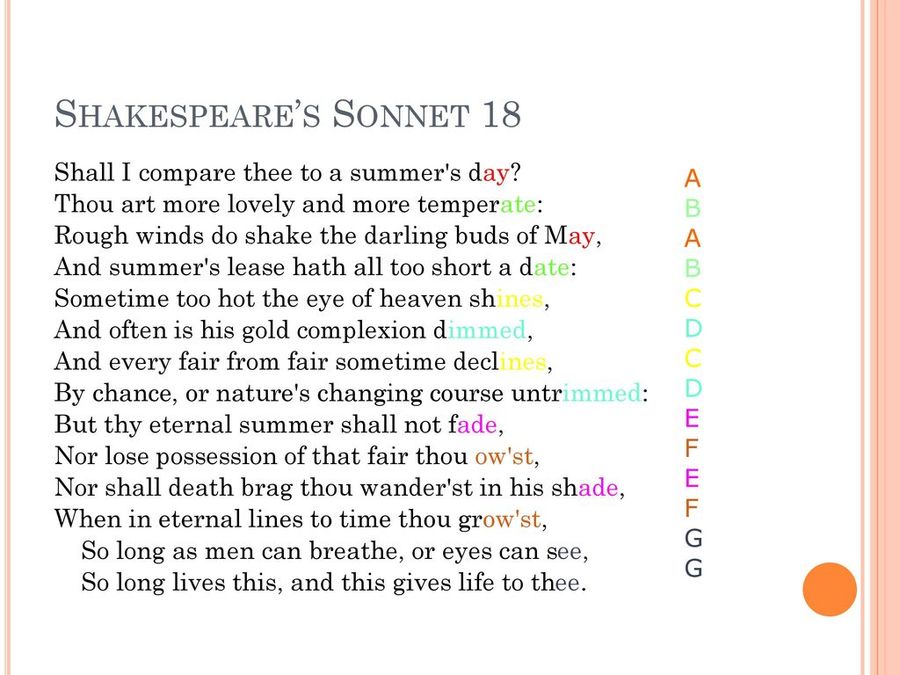
Most sonnets have a set rhyme scheme: abab cdcd efef gg
Another might be: ab ab cd cd ef ef gg.
Yet another might be: abba cddc effe gg
10
Multiple Choice

What is rhyme scheme?
11
What is a sonnet?
All sonnets feature a TURN.
TURN: The turn could be a change in tone, a change in subject, or a change in theme.
The turn generally occurs between the second and fourth quatrains.
An easy example of a turning point you might see in a sonnet would be that lines 1-8 ask a question or series of questions and lines 9- 14 answer the question or questions.
In Sonnet 18, it is indicated with the word BUT

12
Multiple Choice

What is the TURN in a poem?
13
Multiple Choice

When does the TURN happen?
14
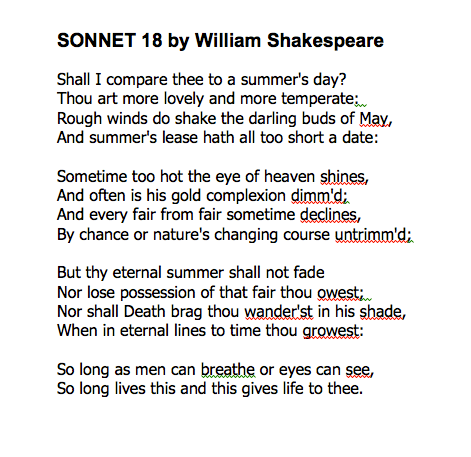
Why would you write something this structured?
For one, humans are hardwired for poetry. We like rhythm and we like rhyme.
Sonnets give us repetition and variety, both of which we like when they are paired together.
It gives you a set of boundaries or rules to work with, which we also like.
This isn’t to say that we always have to follow the rules, some poets like to change up the form a bit.
15
16
17
Now, it is your turn!
Click open the KAMI document on google classroom and analyze this sonnet!

Sonnet 18
Shakespeare
Show answer
Auto Play
Slide 1 / 17
SLIDE


