
Search Header Logo
  1. Resource Library
  2. Science
  3. Biology
  4. Cell Structure And Process
  5. Cells To Systems
Cells to Systems

Cells to Systems

Assessment

Presentation

Science

7th Grade

Practice Problem

Medium

NGSS
MS-LS1-3, MS-LS1-2, MS-LS1-1

Standards-aligned

Created by

Brandon Thompson

Used 70+ times

FREE Resource

10 Slides • 14 Questions

1

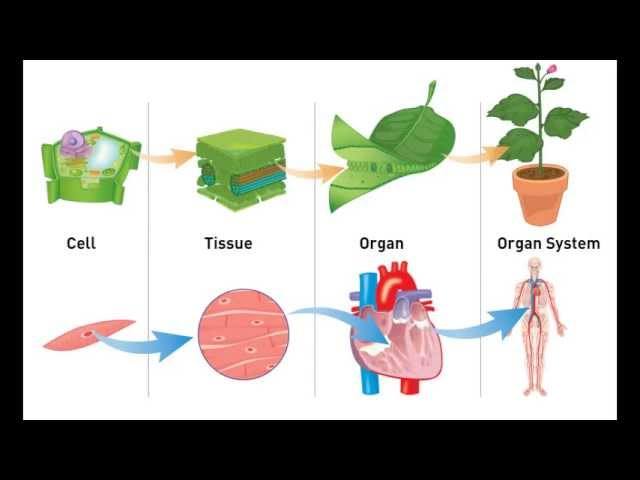
Cells to Body Systems

S7L2 b&c
Slide image

2

Fill in the Blank

Your body has many organs, such as a heart and a(n)_______

3

Fill in the Blank

Plant organs include stems and_______

4

Open Ended

Animal and plant organs are organized into organ systems, thus resembling the way you organize your homework in_________

5

Open Ended

Unicellular organisms are made up of just one cell that performs all of the functions necessary for life. What are some advantages and disadvantages of being unicellular?

6

Cells

  • The smallest living unit

  • Specialized for specific functions

Slide image

7

Multiple Choice

Specialized cells have different structure because they have different ___________.

1

functions

2

organelles

3

genetic material

4

cytoplasm

8

Tissues

  • Made of similar cells that work together

Slide image

9

Open Ended

Plants have three types of tissue. Name them and their function.

10

Organs

  • A collection of tissues that carries out a specialized function

Slide image

11

Multiple Choice

Plants are made of organs

1

True

2

False

12

Open Ended

How do organs relate to cells and tissues

13

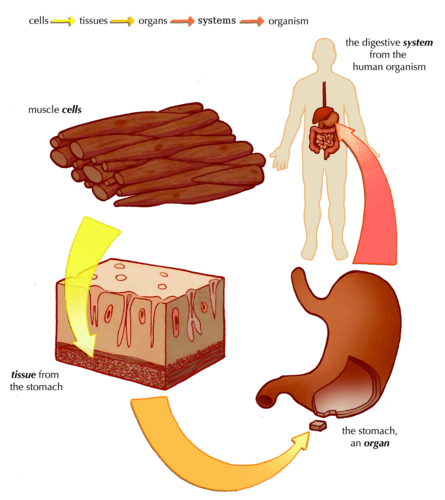
Organ Systems

  • A group of organs that work together to perform body functions
Slide image

14

Multiple Choice

It is responsible for the control of the body and communication among its parts. Main organs - brain, spinal cord, and nerves.

1

Digestive System

2

Nervous System

3

Muscular System

4

Respiratory System

15

Structure Determines Function

  • Cells, tissues, and organs are specialized to perform specific functions

Slide image

16

Systems at work

  • Digestive System

  • Respiratory System

  • Excretory System

  • Circulatory System

17

Delivering Nutrients

  • The digestive system breaks down food

  • The nutrients are absorbed into the blood

  • Once in the blood, the nutrients are delivered to cells throughout the body


Slide image

18

Delivering Oxygen

  • Oxygen is taken into an organisms by the respiratory system

  • The circulatory system then carries the oxygen throughout the body


Slide image

19

Removing Wastes

  • Skin, lungs, the digestive system, and the kidneys all have process for removing waste products from the body


Slide image

20

Multiple Choice

Which choice below shows the order of organization in an animal from simplest to most complex?
1
organ system, organ, tissue, cell
2
cell, tissue, organ, organ system
3
tissue, cell, organ system, organ
4
tissue, cell, organ system, organ

21

Multiple Choice

It transports oxygen, waste, nutrients, hormones, heat, etc... around the body. Main organs - heart, blood, blood vessels, and lymphatics.

1

Respiratory System

2

Endocrine System

3

Circulatory System

4

Excretory System

22

Multiple Choice

A group of similar cells that perform the same function.

1

Cell

2

Tissue

3

Organ

4

Body System

23

Multiple Choice

The basic unit of structure and function in a living thing.

1

Body System

2

Organ

3

Tissue

4

Cell

24

Multiple Choice

Which example best shows structures that make up the digestive system in the human body?

1

heart, blood, vessels

2

nose, trachea, lungs

3

brain, spinal cord, nerves

4

esophagus, stomach, intestines

Cells to Body Systems

S7L2 b&c

Slide image

Show answer

Auto Play

Slide 1 / 24

SLIDE
