Search Header Logo
  1. Resource Library
  2. Math
  3. Probability And Statistics
  4. Tree Diagrams
  5. Tree Diagram And Probability
Tree Diagram and Probability

Tree Diagram and Probability

Assessment

Presentation

•

Mathematics

•

11th - 12th Grade

•

Medium

•
CCSS
7.SP.C.8B

Standards-aligned

Created by

Diane Tucker

Used 128+ times

FREE Resource

8 Slides • 6 Questions

1

Tree Diagram and Probability

Slide image

2

Objectives:

Learning Objective:Students will construct tree diagrams and determine the probability of the events.

Language Objective:Students express their reasoning in written form.

3

Tree Diagram

A tree diagram is a branching structure that maps the outcomes of chances/probabilities.

The more branches, the more outcomes.

Example:

Take flipping a coin. Your only outcomes are heads and tails. So your tree would look like:

Slide image

4

Flipping a Coin Twice:

If you flip the coin a second time you still only have the outcomes heads and tails but this time they branch out from you previous outcome. So your tree diagram looks like this:


Notice: The Sample Space. {HH, HT, TH, TT}

Slide image

5

Example: Sample Space

You are trying to decide what to eat for lunch. The cafeteria offers a ham, turkey or peanut butter sandwich and cool ranch or nacho

cheese Doritos. What is the sample space?

6

Multiple Choice

Question image

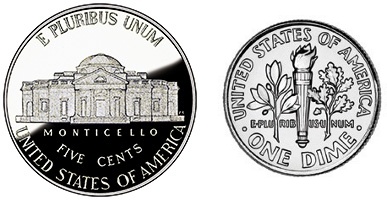
Which shows the sample space for flipping two coins?

1

H, T

2

HH, HT, TH, TT

3

HH, TT

4

Dime, Nickel

7

Multiple Choice

Question image

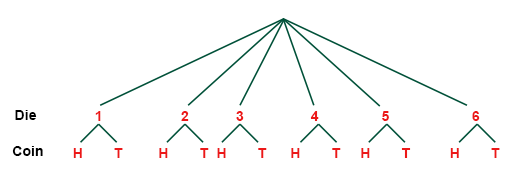
What is the sample space when you roll a die and then flip a coin?

1

1H, 2H, 3H, 4H, 5H, 6H, 1T, 2T, 3T, 4T, 5T, 6T

2

2

3

1,2,3,4,5,6,H,T

4

12

8

Multiple Choice

The cafeteria is serving three kinds of sandwiches: tuna (T), chicken, (C), and peanut butter (P). They are also serving a choice of two drinks: milk (M) or water (W). Which shows the sample space of possible combinations?

1

TW, CW, PW

2

TW, TM, TC, CW, PW

3

TW, TM, CW, CM, PW, PM

4

TCP, MW

9

Find Probabilities:

To calculate the overall probabilities:

- We multiply probabilities along branches.

- We add probabilities down columns.


We can now see things like:

• The probability of getting heads then heads is 25%.

• All the probabilities add up to 1 or 100% .

• The probability of getting AT LEAST one head from two tosses is 0.25 + 0.25+ 0.25 = 0.75

Slide image

10

Example: Tree Diagram

You go to a restaurant where you are able to create your own Pizza. Use the following to create your own pizza options: Crust {Thin, Stuffed}, Size {Medium. Large, X-Large}, 1-Topping {Pepperoni, Cheese, Buffalo chicken}

Create a tree diagram illustrating all the possible pizzas that can be made.

1. P(thin, medium, cheese)

2. P(stuffed, large, pepperoni)

3. P(thin, large, pepperoni or cheese)

4. P(stuffed, X-large, cheese or buffalo chicken)

11

Multiple Choice

Question image

What is the probability of randomly choosing a breakfast with a bagel and coffee?

1

1/8 because there is only 1 outcome out of the 8 possible choices that include both a bagel and coffee.

2

1/2 because there is only cereal and a bagel to choose from

3

1/4 because there is only one out of the four choices that include coffee

4

3 because the words "coffee" and "bagel" are on the diagram a total of 3 times.

12

Multiple Choice

Question image

Use the tree chart to find the probability of randomly picking an outfit with a white shirt and jeans.

1

There are 6 outfits

2

2/6, or 2 out of the 6 outfits have a white shirt with jeans

3

3/6, or 3 out of the 6 outfits have a white shirt with jeans

4

1/6, or 1 out of the 6 outfits has a white shirt with jeans.

13

Multiple Choice

Question image

The tree diagram shows the outcomes of rolling a die and flipping a coin.

What is the probability of rolling an even number and flipping a head?

1

3/12

2

1/2

3

4/12

4

0/12

14

Lesson is done.

Remeber Homework is due on Friday.

Slide image
pattern-tertiary

Tree Diagram and Probability

Slide image

Show answer

Auto Play

Slide 1 / 14

SLIDE