

The Inner Planets / Study Guide

Presentation
•
Science
•
4th - 6th Grade
•
Practice Problem
•
Medium
+8
Standards-aligned

Keenan Hart
Used 5+ times
FREE Resource
43 Slides • 35 Questions
1
The Inner Planets / Study Guide

2
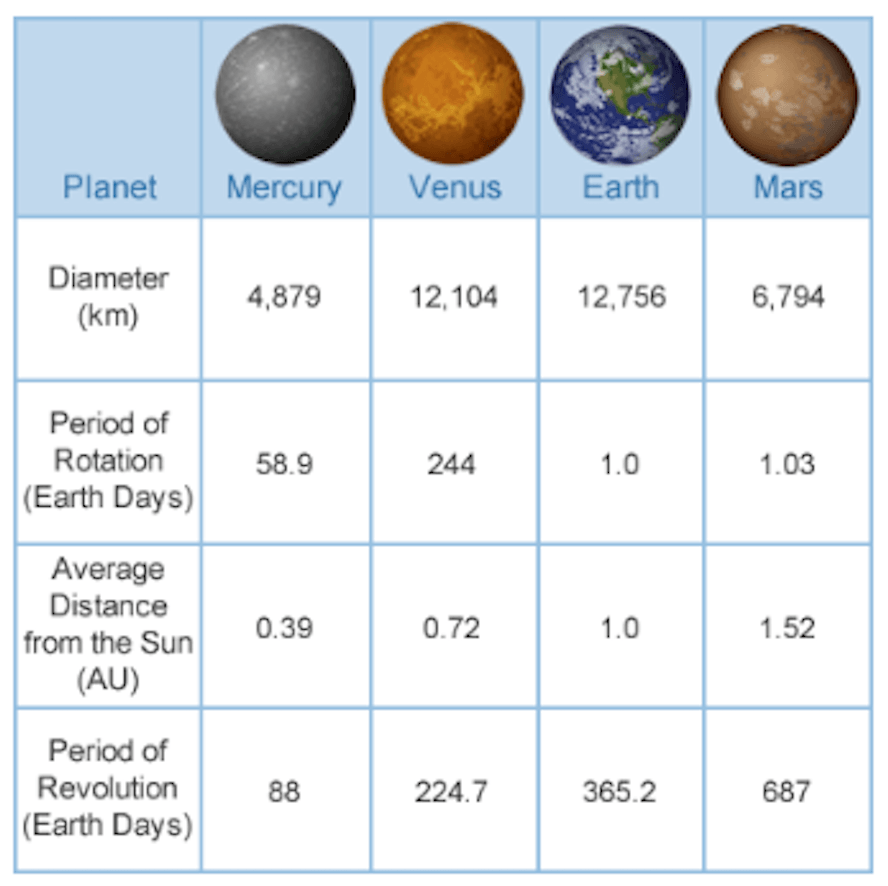
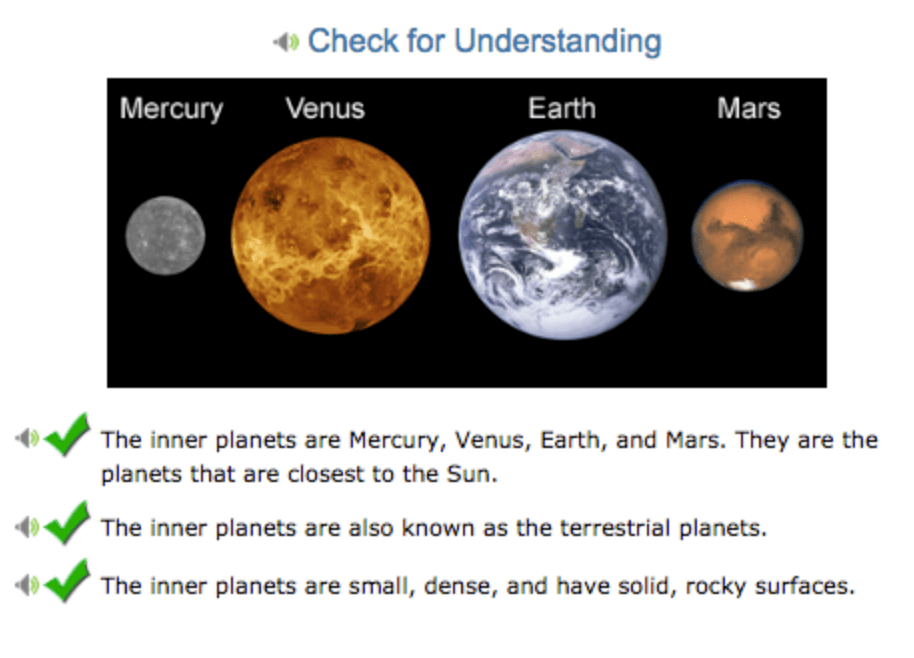
The inner planets are Mercury, Venus, Earth, and Mars. They are small and dense with solid, rocky surfaces. The inner planets are also known as the terrestrial planets. This table below contains more detailed information about each of the inner planets.
3
Multiple Choice
4

5
Multiple Choice

Which of the inner planets is marked "A" on the diagram at left?
6
Multiple Choice
Which of the inner planets is marked "B" on the diagram at left?
7
Multiple Choice
Which of the inner planets is marked "C" on the diagram at left?
8
Multiple Choice
Which of the inner planets is marked "D" on the diagram at left?
9

10
Multiple Choice

According to the table at left (click to enlarge), _______ has the shortest period of rotation.
11
Multiple Choice
According to the table at left (click to enlarge), _______ has the longest period of rotation.
12
Multiple Choice
According to the table at left (click to enlarge), _______ has the shortest period of revolution.
13
Multiple Choice
According to the table at left (click to enlarge), _______ has the longest period of revolution.
14

15
16
Mercury
Mercury is the smallest planet in the solar system and is not much larger than Earth's Moon. Because Mercury is so small, its gravity is too weak to maintain an atmosphere. Therefore, Mercury has virtually no atmosphere. Mercury is also one of the two planets that do not have any moons.

17
Mercury's surface is similar in appearance to Earth's Moon. Its surface is covered by many craters, which were formed by meteoroid and asteroid impacts. Volcanoes on Mercury's surface also left behind craters and plains. Mercury has a very slow rotation and little atmosphere, which cause extreme temperature ranges on its surface.

18
A day on Mercury lasts about 59 Earth days. This means that part of Mercury is facing the sun for almost 29 days, allowing the temperatures to rise to 430 degrees Celsius during the day. Because Mercury has relatively little atmosphere, the heat from the day escapes the planet at night, causing temperatures to drop as low as -170 degrees Celsius.

19
Multiple Select
20

21
Multiple Select
22

23
Multiple Select
24

25

26
Venus
Venus is sometimes called "Earth's twin," because Venus is similar in size and mass to Earth. Venus is about 87% of the volume of Earth.

27
The similarities between Earth and Venus end with their sizes. Like Mercury, Venus does not have any moons. Venus as a very thick and cloudy atmosphere that is made up of mostly carbon dioxide. The clouds are made up of sulfur dioxide and drops of sulfuric acid. Venus's atmosphere is extremely heavy. In fact, the pressure of the atmosphere on Venus is about 90 times greater than the atmosphere on Earth. This means that a human standing on Venus's surface would be quickly crushed.

28
Venus has the hottest surface of any planet. Venus has a greenhouse effect similar to that of Earth. The greenhouse effect is a process in which carbon dioxide in Venus's atmosphere traps infrared heat fom the Sun. This leads to an average surface temperature of about 465 degrees Celsius, which is hot enough to melt lead!

29
Scientists have learned that the surface of Venus is covered in craters and volcanoes. Space probes that landed on the surface of Venus took pictures of the planet, which showed over 1,600 volcanoes covering its surface. Scientists are still debating whether or not there are active (or erupting) volcanoes on Venus.

30
Multiple Choice
31
Multiple Choice
32
Multiple Choice
33
Multiple Choice
34

35
Multiple Select
36

37

38
Earth is different from the other terrestrial planets. As far as scientists know, Earth is the only planet in the solar system with the combination of factors known to support life. Life as we know it requires liquid water and an energy source, and Earth has both.

39
The average temperature on Earth is around 16 degrees Celsius, which allows liquid water to exist. Earth is located in what is known as the "Goldilocks Zone", a zone which is at a distance from the Sun where the temperature is "just right" for liquid water to be present. If Earth were closer to the Sun, it would raise Earth's temperatures and cause the liquid water to evaporate. If it were farther away, it would be so cold that the liquid water would freeze and turn to ice.

40
Earth is the largest of the inner, terrestrial planets. Seventy percent of Earth's surface is covered in liquid water. Earth's crust and its continents are made up of different types of rocks. Earth has the most surface gravity of the inner planets, so it is able to hold in more types of gases than the other inner planets. These gases make up Earth's atmosphere.

41
Seventy-eight percent of Earth's atmosphere is oxygen, which animals depend on to breath. The remaining one percent of Earth's atmosphere is a mixture of gases such as carbon dioxide and water vapor. Plants depend on the carbon dioxide in the atmosphere, as it allows them to produce energy through photosynthesis.

42
Multiple Select
43

44
Multiple Choice
45

46
Multiple Choice

Scientists have discovered another solar system that contains planets that may be located in a habitable zone. In this solar system, the planets orbit around a star known as Gliese 581. According to the image at left (click to enlarge), which of the following determines if a planet is in a habitable zone?
47

48

49

50
Aside from Earth, scientists have explored Mars than any other planet. They have discovered that there is frozen water in Mars's polar ice caps. Their observations have also led them to believe that there is liquid water beneath Mars's surface that sometimes leaks out onto the surface.

51
The Martian surface is covered mostly in dark, volcanic rock. Mars is known as the red planet because it is covered in a powdery red dust. This dust is produced from chemical reactions in rocks that are rich in iron. Mars also has many mountains, volcanoes, and craters on its surface. Scientists are still searching for clues as to whether there could be microscopic life on Mars.

52
Mars has about 10% of the mass of Earth, and is a little over 50% of the diameter of Earth. It is much farther from the Sun than Earth and is therefore much colder. The temperature ranges from -140 degrees Celsius to 20 degrees Celsius.

53
Mars has a very thin atmosphere made of mostly carbon dioxide. Scientists believe the atmosphere of Mars may be thin due to the solar wind of the Sun. In the winter, the temperatures at Mars's poles become so cold that the carbon dioxide in the atmosphere actually freezes. Mars has two very small moons. They are both covered in craters like Earth's Moon.

54
Multiple Choice
55
Multiple Choice
56

57
Multiple Choice
58
Multiple Select
59

60

61

62
Multiple Choice
63

64
Multiple Choice
65
Multiple Choice
66

67
Multiple Select

Planets that are closer to the Sun have shorter orbits than planets that are farther than the Sun. Which of the following conclusions about the terrestrial planets can be drawn based on the table at left? (click to enlarge). Select all that apply.
68

69
Multiple Choice
70
Multiple Choice
71
Multiple Choice
72

73
Multiple Select
74
Multiple Choice
75

76
Multiple Select
77

78
Multiple Choice
The Inner Planets / Study Guide
Show answer
Auto Play
Slide 1 / 78
SLIDE


