

Magnetism (Phys. Sci. 7.1)

Presentation
•
Physics, Science
•
11th - 12th Grade
•
Easy
Standards-aligned

Rachel Rapp
Used 26+ times
FREE Resource
13 Slides • 4 Questions
1
Magnetism (Phys. Sci. 7.1)
Main Idea: A magnet is surrounded by a magnetic field that exerts a force on magnetic materials.
2
3
4
Magnetic Fields
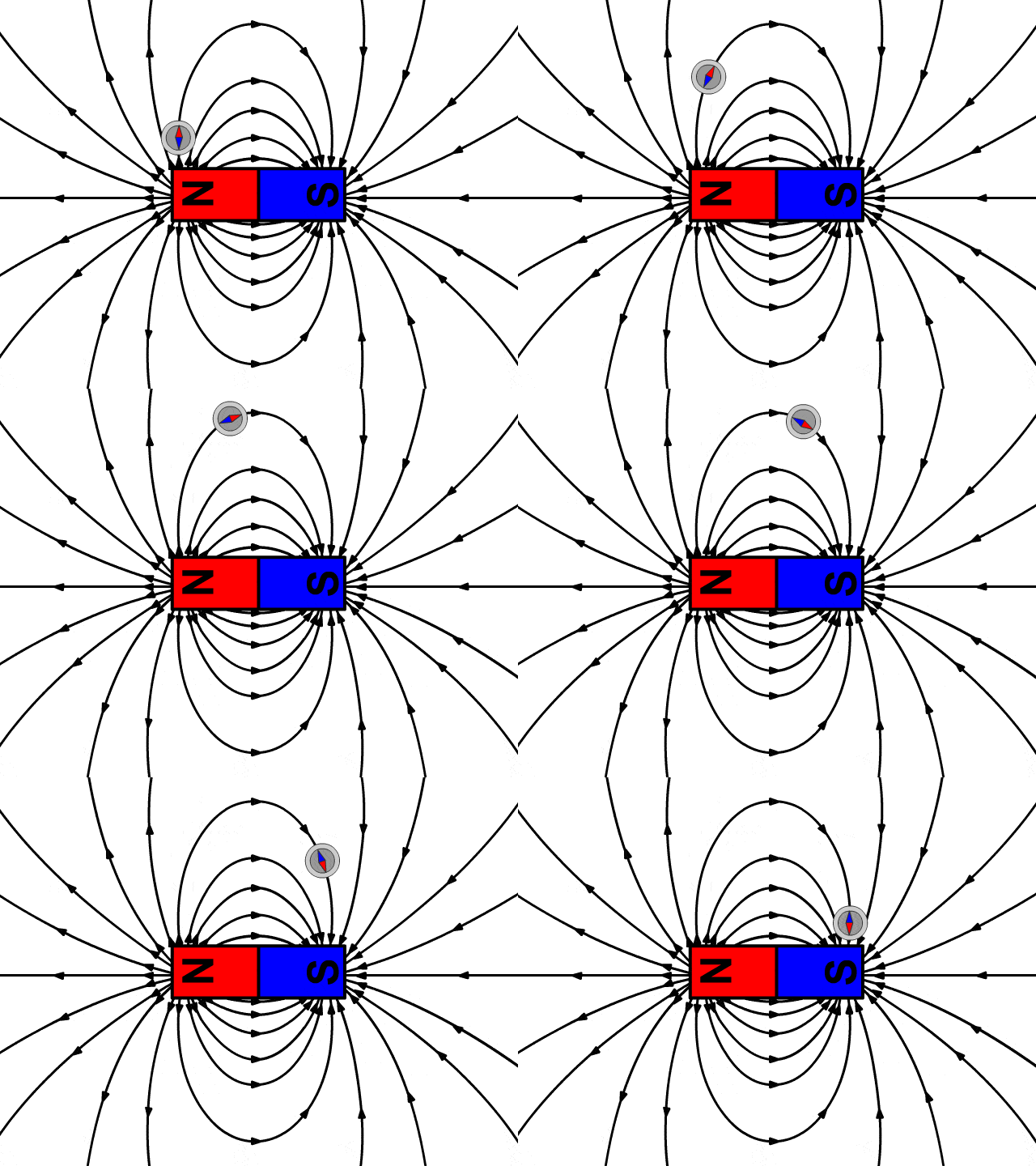
A magnet can exert a force on a distant object because of its magnetic field. A MAGNETIC FIELD is a region of space that surrounds a magnet and exerts a force on other magnets and objects made of magnetic materials. The magnetic field and the magnetic force are related. A stronger field means that a magnetic object placed in the field will experience a stronger magnetic force. In other words, stronger magnets have stronger fields.
5
Magnetic Field Lines
The magnetic field can be represented by lines of force called magnetic field lines. This photo shows iron filings lined up along the magnetic field lines of a bar magnet. The closer together the field lines are, the stronger the magnetic field is at that point. Field lines are closer together near the magnet. This agrees with our observation that the magnetic force and the magnetic field are strongest close to the magnet.

6
Magnetic Poles
You also might have noticed in this photo that the magnetic field lines are closest together at the ends of the bar magnet. This means that the magnetic field is strongest at the ends. The regions of a magnet that exert the strongest force are called MAGNETIC POLES. All magnets have a north pole and a south pole. For a bar magnet, the north and south poles are at opposite ends.

7
Pole Interactions
Whether two magnets attract or repel each other depends on which poles are brought close together. Two north poles or two south poles repeal each other, but a N and a S pole will attract each other. When two magnets are brought close to each other, their magnetic fields combine to make a new magnetic field. If you look at this photo, you will see iron filings illustrating the fields that result when like and unlike poles of bar magnets are brought together.

8
Earth's Magnetic Field
A compass can help determine direction because the needle's north pole points to a location near Earth's geographic north pole. Earth acts like a giant bar magnet with a magnetic field that extends into space. A compass needle will align with Earth's magnetic field lines. Earth's magnetic field is not very strong in comparison to common magnets. A fridge magnet is about about 100x stronger than Earth's field.

9
Earth's Magnetic Poles
The north pole of a magnet is defined as the end of the magnet that points toward Earth's geographic north pole. Opposite magnetic poles attract, so the north pole of a compass needle is attracted to a south magnetic pole. Therefore, Earth's south magnetic pole is near its geographic north pole. However, Earth's magnetic poles move with time and switch places.

10
The Source
No one is certain what produces Earth's magnetic field, but many scientists think that it is generated by Earth's core. Earth's core is thought to be made of iron and nickel. The solid inner core is surrounded by a liquid outer core. The circulation of molten iron and nickel in Earth's outer core is believed to produce Earth's magnetic field.

11
Magnetic Domains
In magnetic materials such as iron, the magnetic field created by each atom exerts a force on other nearby atoms. These forces cause large groups of neighboring atoms to align, meaning that almost all north magnetic poles in the group point in the same direction. These groups of atoms with aligned magnetic poles are called MAGNETIC DOMAINS. Because the poles of individual atoms are aligned, the domain itself behaves like a large magnet.

12
Permanent Magnets
When domains align, their magnetic fields add together and create a magnetic field inside the material. In a permanent magnet, this field is strong enough to prevent the constant motion of the atoms from bumping the domains out of alignment. A permanent magnet is any magnet whose domains remain aligned without an external field.

13
Can a Pole Be Isolated?
If you break a magnet in two, is one piece a north pole and one a south pole? Look at the broken magnet in the photo. Recall that even individual atoms of magnetic materials act as tiny magnets. Because every magnet is made of many aligned smaller magnets, even the smallest pieces have both a north and a south pole.

14
Multiple Choice
15
Multiple Choice
16
Multiple Choice
17
Multiple Choice
Magnetism (Phys. Sci. 7.1)
Main Idea: A magnet is surrounded by a magnetic field that exerts a force on magnetic materials.
Show answer
Auto Play
Slide 1 / 17
SLIDE


