Search Header Logo
IPC Solutions Vocabulary

IPC Solutions Vocabulary

Assessment

Presentation

•

Chemistry

•

9th - 12th Grade

•

Medium

•
NGSS
HS-PS1-1, HS-PS1-3

Standards-aligned

Created by

Derek Mauldin

Used 3+ times

FREE Resource

20 Slides • 15 Questions

1

IPC Solutions Vocabulary

Use this lesson to study the vocabulary for our solutions unit.

Slide image

2

Solute

The substance being dissolved in a solution.

Slide image

3

Solvent

The substance that is the dissolving medium in a solution.

Slide image

4

Cohesion

The attractive force between two molecules of the same substance (like water).

Slide image

5

Polar Molecule

A molecule that has a positive and negative end because of an unequal sharing of electrons.

Slide image

6

Hydrogen Bond

The attractive force between molecules (compounds) caused by hydrogen protons being attracted to a more negative non-metal.

Slide image

7

Dissociation

When the polarity of water separates ionic compounds into to their separate cations and anions and the ionic substance dissolves.

Slide image

8

Factors the affect solubility of a solute:

  • Crush it (make solid particles smaller) - powders dissolve faster than large crystals

  • Stir it (agitation) - speeds up how fast the solute touches the solvent

  • Change the Temperature - heat makes solids dissolve faster, cold makes gases dissolve better.

  • Change Pressure for gases only - high pressure holds gases in liquid solutions. (like coca-cola)

9

Surface Tension

The cohesion of water molecules creates a strong force on the surface of water that allows insects to walk on the surface of water.

Slide image

10

Capillary Action

The ability of water to move up straws or plant roots.

Slide image

11

Multiple Choice

What property of water enables a water strider (bug) to stand on the surface of the water?

1

Adhesion

2

Cohesion

3

Surface Tension

4

None of the above

12

Multiple Choice

The ability of water to move through and around substances is called? (Examples: Water moving through a paper towel; water being transported from the roots to the leaves of a tree, water moving through a straw.)

1

Capillary action

2

Cohesion action

3

Concave action

4

None of the above

13

Multiple Choice

Polar compounds are 2 or more nonmetals covalently bonded that ________________ share valence electrons.

1

Evenly

2

Unevenly

3

Quickly

4

Relatively

14

Multiple Choice

When solute dissolves into a solvent the mixture is called a _____________.

1

mixture

2

solution

3

element

15

Multiple Choice

The substance that dissolves into another substance is called a _____________.

1

solution

2

solute

3

solvent

4

saturated

16

Multiple Choice

Water and Kool-Aid are mixed together. Hot water, coffee and sugar are mixed together. Which substance is the solvent in both?

1

Water

2

Coffee

3

Kool-aid

4

Sugar

17

Homogeneous Mixture

A mixture that looks uniform (the same) throughout and you cannot see the separate parts. (also known as a solution)

Slide image

18

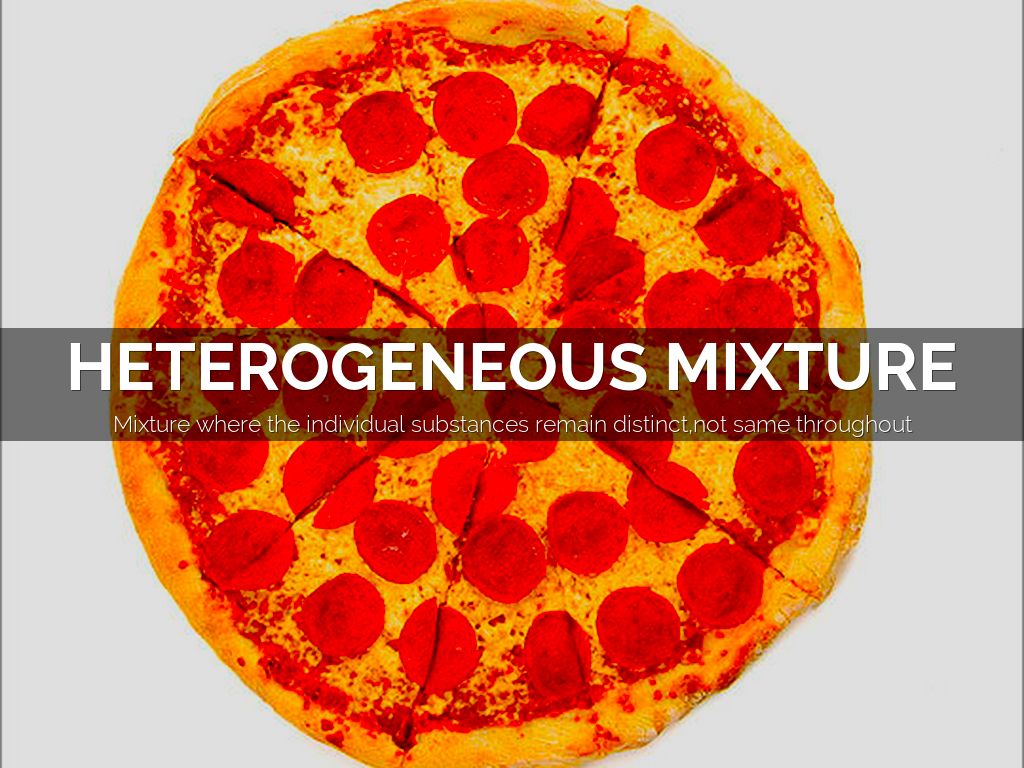
Heterogeneous Mixtures

A mixture in which you can see the separate parts.

Slide image

19

Suspension

A heterogeneous mixture in which the solid will settle out away from the liquid.

Slide image

20

Colloid

A homogeneous mixture that has large particles that do not settle out and do not allow light to pass through.

Slide image

21

Alloy

A homogeneous mixture of metals

Slide image

22

Saturated Solution

A solution that has dissolved the maximum amount of solute.

Slide image

23

Unsaturated Solution

A solution that will dissolve more solute.

Slide image

24

Supersaturated Solution

A saturated solution that when heated to high temperatures dissolves additional solute causing the solute to crystallize (like rock candy).

Slide image

25

Soluble

A substance that will dissolve in a solution.

Slide image

26

Insoluble

A substance that will not dissolve in a solution.

Slide image

27

Multiple Choice

Which is NOT one of the factors that affect how fast a solid solute will dissolve in a solvent?

1

crush it

2

compress it

3

stir it

4

heat it up

28

Multiple Choice

Solutions that have been heated so a very high amount of solute will dissolve then cooled so that there is more solute dissolved than what should be possible at a given temperature.

1

Saturated

2

Unsaturated

3

Supersaturated

29

Multiple Choice

Solutions that hold as much solute as the solvent can dissolve at a given temperature.
1
Saturated
2
Unsaturated
3
Supersaturated

30

Multiple Choice

Solutions that will allow more solute to be dissolved in the solvent at a given temperature.

1

Saturated

2

Unsaturated

3

Supersaturated

31

Multiple Choice

Question image
What does it mean if a mixture is homogeneous?
1
you can see the different parts of the mixture
2
cannot see the different parts of the mixture
3
you can see particles floating in the mixture

32

Multiple Choice

Question image
What does it mean if a mixture is heterogeneous?
1
you can see the different parts of the mixture
2
cannot see the different parts of the mixture
3
a solute dissolves in a solvent

33

Multiple Choice

Question image
What type of mixture is this?
1
heterogeneous 
2
homogeneous

34

Multiple Choice

Question image

This is similar to a solution, but the particles that are in it are able to be seen by the naked eye and will settle to the bottom of a container. For example, orange juice with pulp is a ____________.

1

saturated

2

suspension

3

catalyst

4

solution

35

Multiple Choice

Question image

This is similar to a solution, but the particles that are in it are unable to be seen by the naked eye and you cannot see through the mixture because it will not allow light to pass through. For example, milk is a ___________.

1

saturated

2

suspension

3

colloid

4

solution

IPC Solutions Vocabulary

Use this lesson to study the vocabulary for our solutions unit.

Slide image

Show answer

Auto Play

Slide 1 / 35

SLIDE