

Electricity & Magnetism (Phys. Sci. 7.2)

Presentation
•
Physics, Science
•
11th - 12th Grade
•
Practice Problem
•
Medium
+1
Standards-aligned

Rachel Rapp
Used 28+ times
FREE Resource
18 Slides • 5 Questions
1
Electricity & Magnetism (Phys. Sci. 7.2)
Main Idea: An electric current in a wire is surrounded by a magnetic field.
2
Current & Magnetism
In 1820, Danish physics teacher Hans Christian Oersted found that electricity and magnetism are related. While doing a demonstration involving electric current, he happened to have a compass near an electric circuit. He noticed that the current affected the direction of the compass needle, and hypothesized that the current must produce a magnetic field around the wire, and the direction of the field depends on the direction of the current.

3
Current & Magnetism
Oersted's hypothesis that an electric current creates a magnetic field was correct. It is now known that all moving charges (like those in a current) produce magnetic fields. Around a current-carrying wire, the magnetic field lines form circles, as seen in this picture. The direction of the field around the wire reverses when the current reverses. The strength of the field can increase if the current increases. The further from the wire you move, the weaker the field is.

4
Electromagnetism
Moving electric charges are surrounded by a magnetic field. As a result, there is a force between the moving charge and magnets. these interactions led scientists to the realization that the electric force adn teh magnetic force are parts of the same force. This ELECTROMAGNETIC FORCE is the attractive or repulsive force between electric charges and magnets. Like gravity, electromagnetic force is a fundamental force.

5
Electromagnetism
The interaction between electric charges and magnets is called ELECTROMAGNETISM. Electromagnetism is what makes magnets so useful. Many devices, including MP3 players, operate because of these interactions. Electromagnetism is also essential in producing, transmitting, and using electricity.

6
Electromagnets
The magnetic field around a current-carrying wire can be made stronger by changing the shape of the wire. When there is a current in a wire loop, such as the one shown on the photo to the right, the magnetic field inside the loop is stronger than the field around a straight wire.

7
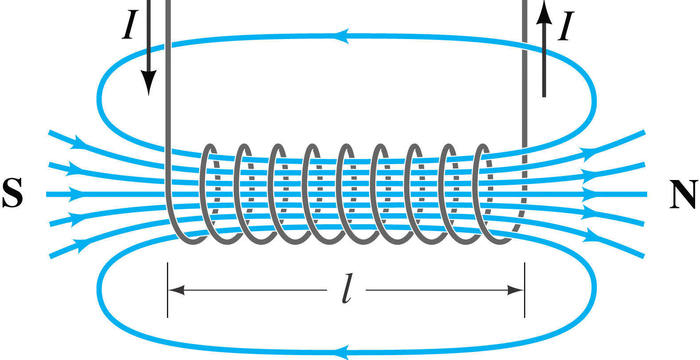
Solenoid
A single wire wrapped into a cylindrical wire coil is called a SOLENOID. The magnetic field inside a solenoid is stronger than the field in a single loop. The magnetic field around each loop in the solenoid adds together to form the field shown in this photo. This is why you can wrap a wire around an iron nail, attach it to a battery, and create a temporary magnet.
8
Electromagnets
An ELECTROMAGNET is a temporary magnet created when there is a current in a wire coil. Often, the current-carrying coil is wrapped around an iron core, as shown in this photo. The coil's magnetic field temporarily magnetizes the iron core. As a result, the electromagnet's field can be more than 1,000 times greater than the field of the solenoid.

9
Properties of EMs
an electromagnet behaves like any other magnet when there is a current in the solenoid. One end is a north pole, and the other is a south pole. If placed in a magnetic field, the EM will also exert a magnetic force on other magnets/magnetic materials. EMs are useful because the user can control their magnetic properties. One can increase the strength of the field by increasing current, or turning it off by stopping the current.

10
Making an EM Rotate
The forces exerted on an EM by another magnet can be used to make the EM rotate. This photo shows an EM suspended between poles of a permanent magnet. The poles of the EM are repelled by the poles of the magnet, causing it to spin away from it. As it spins, the opposite pole on the EM is attracted to the magnet, pulling it towards it. The magnet on the opposite side does the same thing, keeping the EM in rotation. ex. compass needle

11
Using EMs
When an EM rotates, electrical energyis converted into mechanical energy to do work. EMs do work in a bunch of devices, such as stereo speakers and electric motors.

12
Speakers
How does musical information stored on an MP3 player become sound that you can hear? The sound is produced by a speaker, which is an electromagent connected to a flexible speaker cone. The EM changes electrical energy into mechanical energy that vibrates the cone to produce sound that you can hear. The varying electrical current in the music causes the speaker to vibrate at different frequencies, changing the pitch that you hear.

13
Galvanometers
You probably have seen gauges in the dashboard of a car. One gauge shows how much gas you have. How does a change in gas level make a needle move in the gauge on the dashboard? The fuel gauge is called a galvanometer. A GALVANOMETER is a device that uses an EM to measure electric current.

14
How?
A diagram of a galvanometer is shown here. The EM is connected to a small spring. When there is current in the EM, it will rotate until the force exerted by the spring is balanced by the magnetic force on the EM. Changing the amount of current changes the strength of teh force between the EM and the perm. magnet. So, the amount that the needle rotates is related to the amount of current. If the galvanometer is marked with a scale, it can be used to measure the current in a circuit.

15
Back to the car...
In a car, a float in the fuel tank is attached to a sensor. The sensor sends a current to the fuel gauge galvanometer. As the level in the fuel tank changes, the amount of current sent to the galvanometer changes. When the amount of current changes, the rotation of the needle changes. The gauge is calibrated so that the current sent when the tank is full causes the needle to rotate to the full mark on the scale.

16
Electric Motors
Do you ever use an electric fan, like in the photo? Or a ceiling fan? A fan uses an electric motor to turn the blades. An ELECTRIC MOTOR is a device that changes electrical energy into mechanical energy. Electric motors are used in all types of industry, agriculture, and transportation. If you look carefully, you may find an electric motor in every room in your home. For example, they are used in DVD players, game consoles, computers, and hair dryers.

17
Simple Electric Motors
The main parts of a very simple electric motor include a wire coil, a permanent magnet, and a source of electric current, like a battery. The current makes the coil an electromagnet.

18
Making the Motor Spin
When there is a current in the coil, the forces between the coil and the magnet cause the coil to rotate. The coil rotates until it rotates enough to create a full circuit. When it hasn't reached that point, there is no current in the coil, so no magnetic field coming from the electromagnet. Once it rotates far enough, the current activates and switches direction.

19
Multiple Choice
20
Multiple Choice
21
Multiple Choice
22
Multiple Choice
23
Multiple Choice
Electricity & Magnetism (Phys. Sci. 7.2)
Main Idea: An electric current in a wire is surrounded by a magnetic field.
Show answer
Auto Play
Slide 1 / 23
SLIDE

