

Articles of Confederation

Presentation
•
History, Social Studies
•
8th Grade
•
Practice Problem
•
Medium

Michael Gossett
Used 56+ times
FREE Resource
24 Slides • 11 Questions
1
Articles of Confederation
2

3
Multiple Choice
•Why did slaves first start being transported across the Atlantic to the Americas?
To work on cash crop plantations in the 13 Colonies
To work on sugar plantations in the West Indies/Caribbean Islands
To create a debtor colony in Georgia
To free them from slavery in Arica
4

5
Multiple Choice
•Why did slaves start being more important to the 13 Colonies as they grew?
they were mostly used in the Middle Colonies
so we would have more voters in each colony
they were needed for the New England industries
they were needed for the plantation economy
6

7

8
Multiple Choice
What is due process?
the right to freedom of religion
the right to freedom of speech
the right to know your charges and have a jury trial
no cruel or unusual punishment allowed
9

10

11
Multiple Select
What do the Mayflower Compact and the Fundamental Orders of Conn. have in common (choose two)
both are elected groups of people
both are documents of self-government
both were for the same colonies
both served as models for others
12

13
Multiple Choice
Which group holds most of the power in a confederation?
states
central government
federal government
all groups have equal power
14
15

16

17
Multiple Choice
What was the goal of the Land Ordinance of 1785?
to reserve lands for the Indians
to expand westward to the pacific
to divide up the lands of the Northwest Territory
to find a way to givr land back to England
18

19

20
21
Multiple Choice
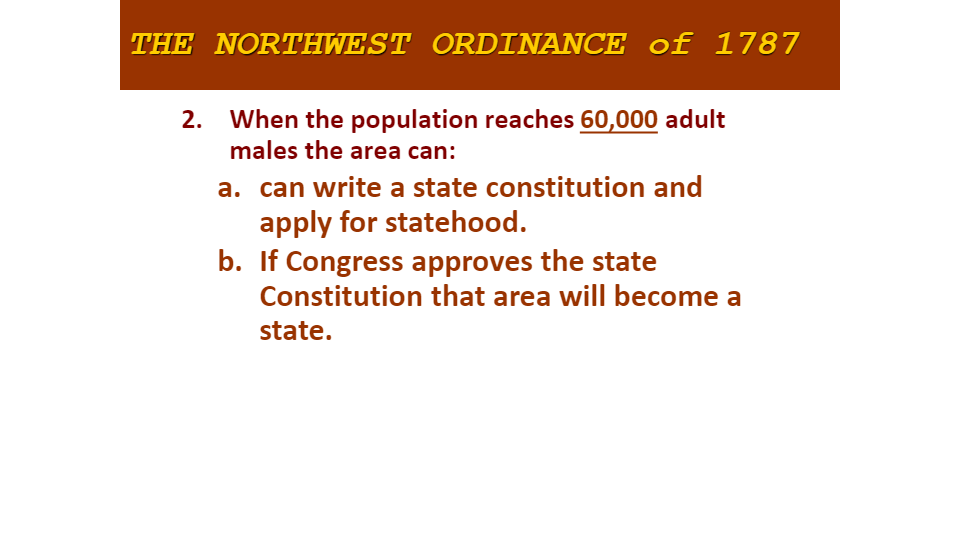
What was created by the Northwest Ordinance of 1787?
A method for new states to be created
A process to sell the new lands
A method for new slave states to be created
A process to allow old states to add more land
22

23

24

25

26
Multiple Choice
The strengths list in the last three slides were
not really strengths of the national government, because states actually had these powers
really strengths of the national government, because people wanted the government to be like England's
actually stronger than the powers King George and parliament had
not really strengths of the national government, because there was no power to actually enforce them
27

28

29
Multiple Choice
What does a unanimous vote mean?
2/3 of the states must agree
3/4 of the states must agree
the majority of states must agree
all of the states must agree
30

31

32
Multiple Choice
What do you notice about the strengths and weaknesses for the national government, under the Articles?
there were many more strengths than weaknesses for the national government, because people wanted another monarchy
there were many more weaknesses than strengths for the national government, because people feared a tyrannical government
there was a balance of strengths and weaknesses under the Articles
there were many more strengths than weaknesses for the national government, because people feared a tyrannical government
33

34

35
Multiple Choice
What was the outcome of Shays' Rebellion?
The colonies called for a convention to revise the Articles of Confederation
The colonies called for a convention to request to re-join England as colonies
The Articles of Confederation were immediately revised by 1/2 of the states
Each states began to rule itself, since the Articles were such a failure
Articles of Confederation
Show answer
Auto Play
Slide 1 / 35
SLIDE
Similar Resources on Wayground

26 questions
Jackson's Presidency
Presentation
•
8th Grade
29 questions
Colonization Era Review
Presentation
•
8th Grade
26 questions
The Constitutional Convention of 1787
Presentation
•
8th Grade
29 questions
8.5 Resolution: The Great Compromise
Presentation
•
8th Grade
29 questions
Rise of the Pharaohs - Egypt 3A
Presentation
•
8th Grade
29 questions
Manifest Destiny - Live Lesson
Presentation
•
8th Grade
27 questions
Causes of the Civil War
Presentation
•
8th Grade
26 questions
Principles of Government: Part 1
Presentation
•
8th Grade
Popular Resources on Wayground
21 questions
Continents and Oceans

Quiz
•
6th Grade
20 questions
Parts of Speech
Quiz
•
5th Grade
16 questions
Subject & Predicate
Quiz
•
5th Grade
25 questions
Multiplication Facts
Quiz
•
5th Grade
12 questions
Map Skills
Quiz
•
3rd Grade
22 questions
Continents and Oceans
Quiz
•
5th Grade
15 questions
Rounding Decimals
Quiz
•
5th Grade
20 questions
Brand Labels
Quiz
•
5th - 12th Grade
Discover more resources for History
31 questions
Foundations of GA's Gov't
Quiz
•
8th Grade
15 questions
Unit 3 - Part 1 Road to Revolution
Quiz
•
8th Grade
10 questions
Exploring the Causes of the American Revolution

Interactive video
•
6th - 10th Grade
20 questions
The Early Colonies
Quiz
•
7th - 11th Grade
25 questions
The American Revolution
Quiz
•
7th - 10th Grade
10 questions
Recap on Mesopotamia: Key Concepts and Facts
Interactive video
•
6th - 10th Grade
16 questions
Government Unit 2
Quiz
•
7th - 11th Grade
34 questions
Judicial Branch and Juvenile Justice
Quiz
•
8th Grade