Search Header Logo
6NS4 GCF/LCM/Distributive Property Review

6NS4 GCF/LCM/Distributive Property Review

Assessment

Presentation

Mathematics

6th Grade

Practice Problem

Medium

CCSS
4.OA.B.4, 6.NS.B.4

Standards-aligned

Created by

Elianna Castro

Used 72+ times

FREE Resource

15 Slides • 5 Questions

1

6NS4 GCF/LCM/Distributive Property Review
Slide image

2

Multiples

  • Multiples are when you count by a number

  • Example: the first 5 multiples of 5 are 5, 10, 15, 20, 25

Slide image

3

Multiple Choice

What are the first 5 multiples of 11?

1

11, 12, 13, 14, 15

2

11, 22, 33, 44, 55

3

11, 20, 31, 40, 51

4

Factors

  • Factors are numbers we multiply to get another number.

  • Example: The first 5 factors of 12 are 1, 2, 3, 4, 6 because 1x12 = 12, 2x6 = 12, 3x4 = 12

Slide image

5

Multiple Choice

What are the first 5 factors of 36?

1

36, 72, 108, 144, 180

2

2, 3, 9, 12, 15

3

1, 2, 3, 4, 6

6

Greatest Common Factor (GCF)

  • The Greatest Common Factor (GCF) of a set of numbers is the largest number that divides evenly into each number in the set.

Slide image

7

GCF Steps

  • Step 1 - Find the prime factors of both numbers by using a prime factor tree.

  • Step 2 - Line up the prime factors horizontally.

  • Step 3 - Circle the prime factors that both numbers have in common (hence, greatest COMMON factor). The common prime factor is the GCF.

  • Step 4 - If there is more than one common prime factor, take one number from each of those common pairs and multiply them together to get your GCF. If there is no common factor, the GCF of the two numbers is 1.

8

Slide image

9

Slide image

10

Multiple Choice

What is the GCF of 24 and 36?

1

12

2

6

3

4

11

Least Common Multiple (LCM)

  • The Least Common Multiple (LCM) is the smallest multiple of two numbers.


Slide image

12

LCM Steps

  • Step 1 - Find the prime factors of both numbers by using a prime factor tree.

  • Step 2 - Line up the prime factors horizontally.

  • Step 3 - Circle the prime factors that both numbers have in common and box the remaining numbers.

  • Step 4 - To calculate the LCM, take one number from the common pairs and multiply them with the box numbers.

13

Slide image


14

Slide image

15

Multiple Choice

What is the LCM of 14 & 6?

1

28

2

42

3

20

16

Distributive Property

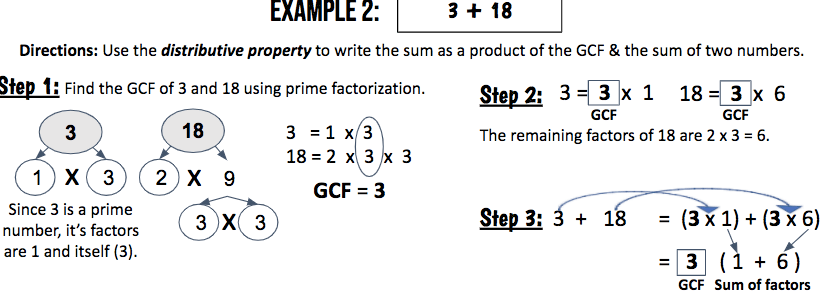
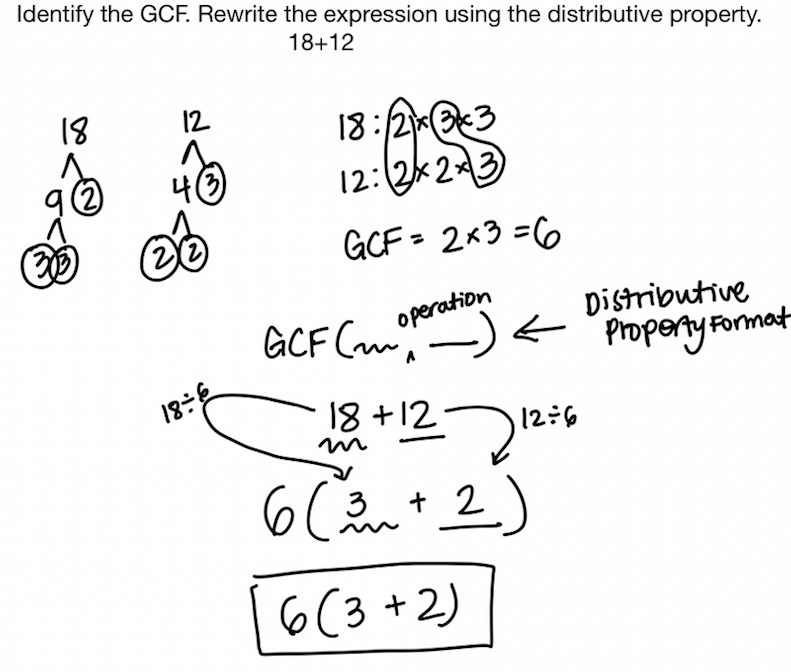
  • When you distribute something, you are dividing it into parts. In math, the distributive property helps simplify difficult problems because it breaks down expressions into the sum or difference of two numbers.

Slide image

17

Slide image

18

Slide image

19

Multiple Choice

Identify the GCF. Rewrite the expression using the distributive property. 20 + 35

1

5(4+7)

2

55

3

5(6+5)

20

The End

Now that you've done a full review of standard 6.NS.4, go back and review the lessons that you struggled with. Great job today!

6NS4 GCF/LCM/Distributive Property Review

Slide image

Show answer

Auto Play

Slide 1 / 20

SLIDE