Language Arts First Semester Study Guide
Presentation
•
English
•
6th Grade
•
Medium
Dawn Kirk
Used 14+ times
FREE Resource
18 Slides • 51 Questions
1
Language Arts First Semester Study Guide
Hello Grade 6 Kirk. Please use the slides below to prepare for your upcoming Language Arts Semester Exam.
Remember to pause the videos where necessary as you review the concepts.
Please note the topics for study and refer to your notebook for additional information.
2
Topics to Study
Types of Pronouns (Subject, Object & Possessive Pronouns)
Central Idea of a Paragraph
Text Structure: Cause/ Effect; Probelm/ Solution; Compare/ Contrast; Sequence; Description
Central Idea or Theme of a Story
Elements/ Components (parts) of a Plot or Story
The Point of View in a Story ( Speaker/ Narrator, First Person, Third Person)
3
4
Multiple Choice
Which word in the following sentence is an antecedent for the pronoun “it”?
All afternoon, the phone rang, but Robert didn’t hear it.
All
phone
Robert
hear
5
Multiple Choice
What is an antecedent?
a punctuation mark after a pronoun
the verb directly before the pronoun
the word a pronoun replaces or refers to
an adjective that describes a noun
6
7
Multiple Choice
What type of pronoun is highlighted in blue in the sentence below?
Valery told them that she was sick yesterday.
Subject
Object
8
Multiple Choice
What type of pronoun is highlighted in blue in the sentence below?
John sold him a bicycle.
Subject
Object
9
Multiple Choice
What type of pronoun is highlighted in blue in the sentence below?
She baked a cake for the class.
Subject
Object
10
Multiple Choice
Mrs. Hunter told her to listen.
Does this sentence have a subject or object pronoun?
Subject Pronoun
Object Pronoun
11
Multiple Choice
We enjoyed ourselves at the National Museum of Art.
Identify the subject pronoun in the sentence.
enjoyed
we
ourselves
the
12
Multiple Choice
13
Multiple Choice
I want to go in ............. car
your
yours
14
Multiple Choice
This pencil case is Helen's. It's .................
his
hers
her
its
15
Multiple Choice
The book is _____________________ but you’re welcome to read it.
mine
yours
my
16
Multiple Choice
The dog wagged _______________ tail to show how happy he was.
its
it's
its'
17
Multiple Choice
Read the sentence below. Name the nouns.
Michael really wanted to visit his grandma in New York.
really, wanted, grandma
Michael, grandma, New York
Michael, wanted, New York
visit, grandma, New York
18
Multiple Choice
Read the sentence below. Name the verb.
The scruffy dog barked loudly.
dog
scruffy
barked
loudly
19
Multiple Select
Select the adjectives to describe this cat.
cute
soft
striped
whiskers
20
Multiple Choice
What is an adjective?
an interrupting word
a word that connects words, phrases, and clauses
a word that is a person, place, thing or idea
a word that desribes nouns and pronouns
21
Multiple Choice
Which part of speech expresses an action or a state of being?
adverb
verb
interjection
adjective
22
23
Points to Remember-Main Idea in Writing
The Main Idea is the most important thought /point about the topic.
It identifies the topic. The topic is the person, place or thing being written about.
Supporting details explains, defines or proves the main idea.
The Main Idea is mostly found in the first sentence, but can also be found in the middle or end of the paragraph.
The Main Idea can also be referred to as the Central Idea.
24
25
Multiple Choice
Select the supporting detail that doesn't fit.
Topic Sentence: My cat is afraid of everything.
He hides under the couch when you turn the microwave on.
He sleeps all day long.
He runs away when you sweep the floor.
He jumps every time the doorbell rings.
26
Multiple Choice
What are supporting details?
Words, phrases, or sentences that tell more about the main idea.
Words, phrases or sentences that tell you the main idea
Descriptive words that provide imagery.
27
Multiple Choice
Which supporting detail best supports this topic sentence?
Dora the Explorer is an educational show for kids.
She has a really cute monkey named Boots.
Dora's purple backpack holds all of her tools.
Dora helps teach kids Spanish words.
She usually stops Swiper from swiping.
28
Multiple Choice
Niagra Falls is one of the most beautiful sights in North America. It is on the Niagra River halfway between Lake Ontario and Lake Erie. Niagra Falls is located on the American and Canadian border. The American Falls is 167 feet high. On the Canadian side, the Horseshoe Falls is 161 feet high.
Which of the following is NOT a supporting detail?
The American Falls is 167 feet high
The Horseshoe Falls is 161 feet high
Niagra Falls is one of the most beautiful sights in North America
It is located between Lake Ontario and Lake Erie
29
Multiple Choice
Porpoises live in the earth's oceans and sometimes in bays and rivers near oceans. Porpoises are mammals. Their babies get their food from their mother's body. These animals live in the water, but they must come up for air. Porpoises are very interesting animals.
What is the main idea?
Porpoises live in the ocean
Porpoises are mammals
Porpoises must come up for air
Porpoises are very interesting animals
30
Multiple Choice
Dolphins are very smart animals. They even have their own language. They talk to each other with clicks, whistles, and grunts. Scientists have been studying this dolphin language. They hope that in the future, people and dolphins will be able to talk to each other.This paragraph mainly tells:
How dolphins communicate with people
How intelligent dolphins are
How dolphins are like humans
Which scientists study languages
31
Multiple Choice
Benjamin Franklin loved to write. When he was twenty-two, he set up his own printing shop and started a newspaper. He also printed a book called Poor Richard’s Almanac. It had funny stories, information about the weather, and wise sayings.
Benjamin Franklin loved to write stories and books.
Benjamin Franklin worked very hard when he was young.
Benjamin Franklin knew a lot about the weather.
Benjamin Franklin was very poor.
32
Multiple Choice
There are many fun things to do at the beach. Swimming is one thing that can be done at the beach. Snorkeling is another thing that can be enjoyed. Playing beach volleyball can be a lot of fun. It is also fun to look for shells. Some people simply like to sunbathe.
What is the main idea?
There are many fun things to do at the beach.
It is also fun to look for shells.
Some people simply like to sunbathe.
Going to the beach to swim can be fun.
33
Points to Remember
The Central Idea is also the MAIN IDEA of a paragraph or story.
It has many supporting details that are important to understanding it better.
The Central Idea can be summarised into a small number of words.
34
35
Multiple Choice
What is the central idea of the passage?
Origami is the Japanese art of paper folding. Many beautiful three-dimensional creations are made with this art. Starting with only one square of paper, you can fold and fold and fold, until you’ve created amazing models. With practice, you can learn to make abstract designs or recognizable animals such as cranes (a type of bird) or even dinosaurs.
Origami is an interesting and beautiful art form
The art of origami came from Japan
Origami is three-dimensional art
Origami is a good way to show creativity
36
Multiple Choice
What is the central idea of the passage?
The law was not exactly fair in the Middle Ages in Europe. Back then, you could blame someone in your town for committing a crime. The “criminal” could then challenge you to a fight to prove his guilt or innocence. If you lost the fight, you were charged as a liar and the criminal was believed to be innocent. If you won, the criminal was believed to be guilty.
Laws were unfair in the Middle Ages
Fighting is a good way to decide guilt or innocence.
Most people lied about crime in the Middle Ages.
Those who were innocent of crimes often won
37
Multiple Choice
Do you ever wonder how you taste things? You owe your sense of taste to your taste buds. We have 9,000 taste buds just on the tongue alone. There are also taste buds on the roof of your mouth. You even have taste buds on the back of your throat.
What does the author want you to learn about the passage?
Why we can taste only sweet things.
that we taste through our nose
Taste buds are found in different places.
38
Multiple Choice
Microchips provide the power for wristwatches. They are also the brains in our computers, and they control robots. These chips are used in video games and space shuttles. They make our cameras, radios, and televisions small and light.
What is the story mainly about?
How computers work
Why televisions are small
How microchips are used
39
Multiple Choice
The main idea is supported by what?
concluding sentences
details
a chair
reliable resources
40
Multiple Choice
Most people think that gorillas are mean, but actually they are shy. It seems that such a huge animal with very large teeth would be aggressive. Hollywood movies help convey this image of the scary, ferocious gorilla. In fact, gorillas only attack if they are provoked.
This author belives that:
Gorillas are misunderstood as vicious animals.
Gorillas are mean animals
Gorillas don't like other animals.
41
Multiple Choice
What is the best question to ask yourself when you are trying to find the main idea?
Who is the main character?
What is the main event?
What is one important detail?
What point is the author trying to make?
42
Multiple Choice
What does the central idea of a story tell the reader?
a specific detail from the story
The conflict of the story
What the story is about
The universal truth, moral, or idea the author wants to express
43
44
45
46
Multiple Choice
Choose the correct text structure.
compare and contrast
problem and solution
sequence
description
47
Multiple Choice
Choose the correct text structure.
compare and contrast
problem and solution
cause and effect
description
48
Multiple Choice
Choose the correct text structure.
compare and contrast
problem and solution
cause and effect
description
49
Multiple Choice
Choose the correct text structure.
compare and contrast
problem and solution
cause and effect
sequence
50
51
52
53
Multiple Choice
The author's central message about life or how people behave
Theme
Rising Action
Setting
Resolution
54
Multiple Choice
A theme should be a statement, not just one word.
TRUE
FALSE
55
Multiple Choice
What is the main difference between THEME and MAIN IDEA.
Theme is a universal lesson and main idea is what a story is about.
Theme is what a story is about and main idea is the universal lesson it teaches.
56
Multiple Choice
In a piece of narrative text, what is the "theme"?
What the story is about
The topic of the text
A message the author is trying to get across to the reader
Where and when the story happens
57
Multiple Choice
What is the theme of this story?
Slowly but surely wins the race.
Don't be lazy.
We are stronger together than we are apart.
If you try to go on your own, you will get eaten by a big fish.
58
Multiple Choice
What is the theme of this story?
Respect your elders.
Don't steal.
Don't be lazy.
Help others because what goes around comes around.
59
Multiple Choice
What is the theme of this story?
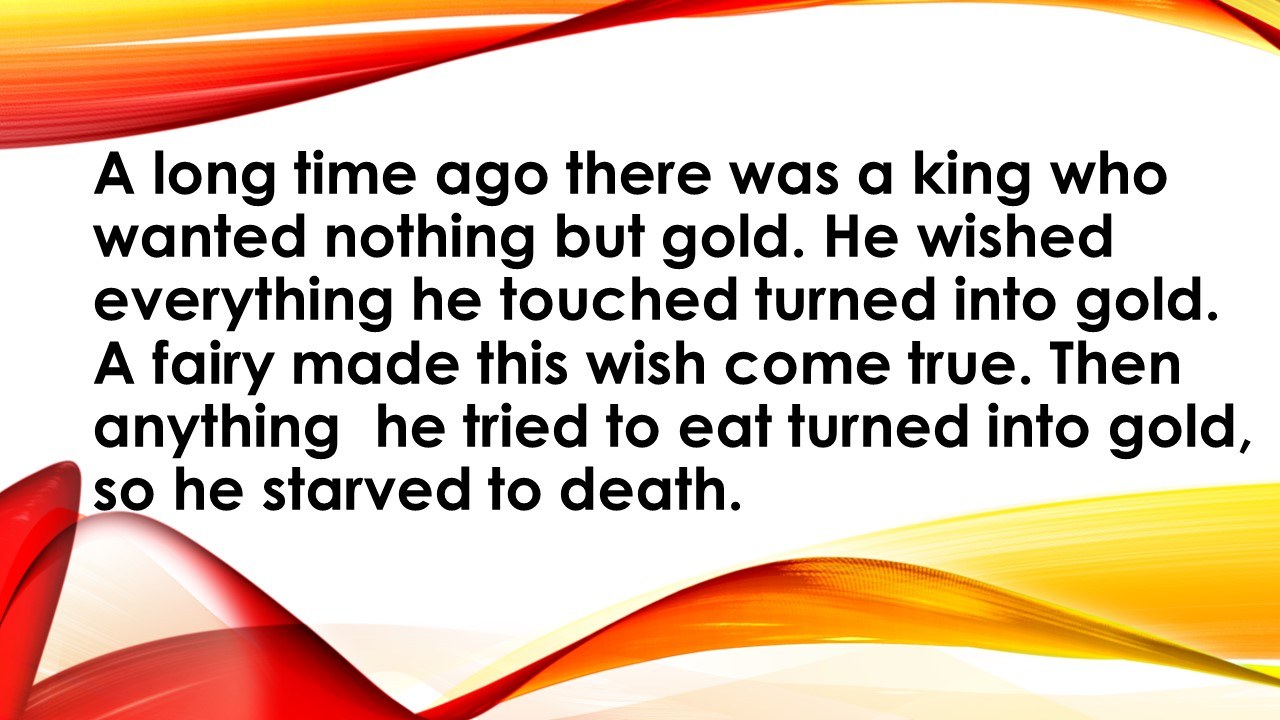
Don't be greedy.
Work together.
Respect your elders.
Don't steal.
60
Multiple Choice
What is the theme of this story?
Eat your vegetables.
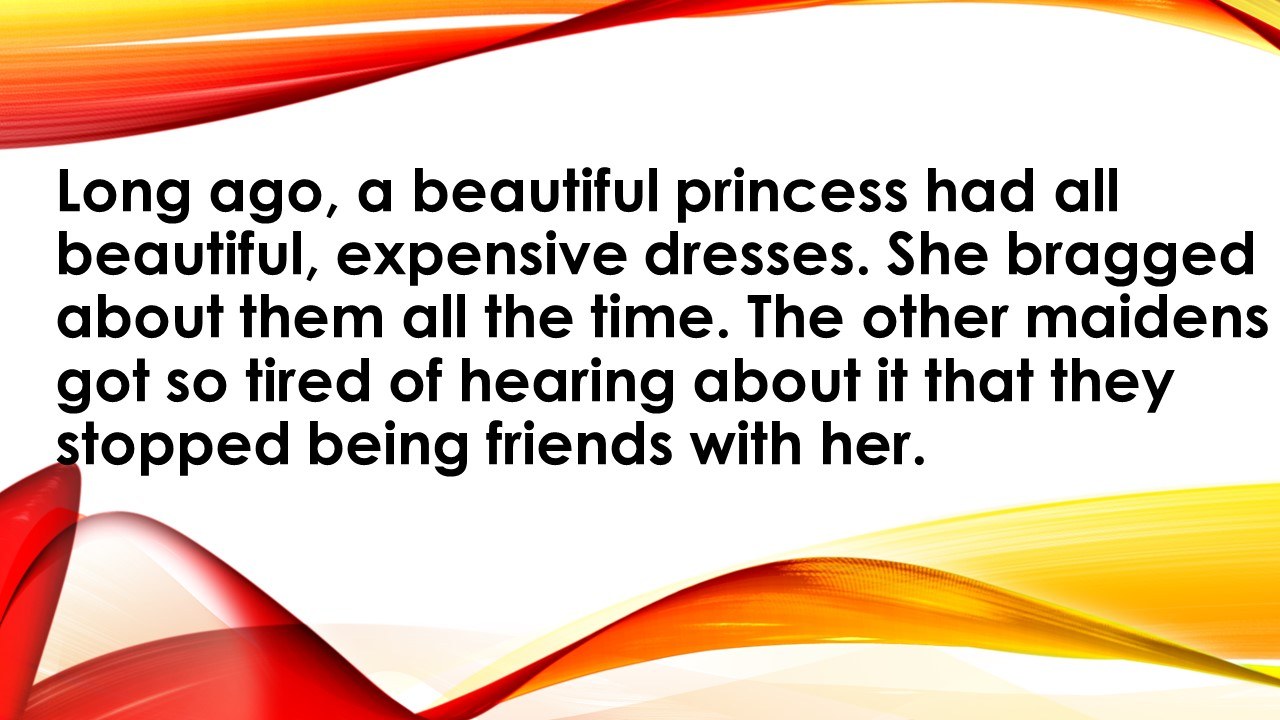
Don't brag. Be modest.
Don't talk to strangers.
Necessity is the mother of invention.
61
62
63
Multiple Choice
What is the point of view based off the passage below?
I couldn’t help but think something was going on. Beth was acting strange, making weird excuses why I needed to be out of the house. She had me run to the store for scissors. I knew we had scissors. When I returned to the house and walked through the door I had the biggest surprise of my life! All of my friends and family were in my house yelling “Surprise!” and “Happy birthday!”
The passage is written in third person limited.
The passage is written in second person point of view.
The passage is written in third person objective.
The passage is written in first person point of view.
64
Points to Remember
Point of View: The perspective of the narrator in the story
Third Person is a Narrator telling the Story: Speaker telling the story. Uses words like he, she, they.
First Person Point of View/ Perspective: The narrator is a person or character in the story using words like I, Me or We.
Second Person: The "You" Point of view /Perspective. It uses the word "You". You are the character in the story. Sounds as though the story is giving directions to you.
65
Multiple Choice
What is the essential question when trying to determine the POV of a text?
Who is telling the story?
Whose thoughts do we know?
Which pronouns are being used?
Is the main character the narrator?
66
Multiple Choice
What is the time and location where a story takes place?
exposition
setting
rising action
falling action
67
Multiple Choice
Complete the sentence.
A narrator is...
who tells the story
how they tell the story
the story
68
Multiple Choice
Read the short story and tell which point of view it is.
You are going to a party with your friends. You're nervous because there is someone you like there. You never told your friend because you don't want them to tell your crush.
Second person
Third person
First person
69
Multiple Choice
Read the short story below and tell which point of view it is.
James, Lisa, and Terrance have a party. James was so nervous to go because he has a crush on Lisa. He never told Terrance because he is afraid that Terrance will get angry at him.
Third person
Second person
First person
Language Arts First Semester Study Guide
Hello Grade 6 Kirk. Please use the slides below to prepare for your upcoming Language Arts Semester Exam.
Remember to pause the videos where necessary as you review the concepts.
Please note the topics for study and refer to your notebook for additional information.
Show answer
Auto Play
Slide 1 / 69
SLIDE

Similar Resources on Wayground
61 questions
Background WOBBP
Presentation
•
6th Grade
59 questions
Summary DI ELA 6 22-23
Presentation
•
6th Grade
65 questions
Wonders 5 · Grammar · U2W1 · Singular and Plural Nouns
Presentation
•
5th Grade
68 questions
NJSLA Practice (ELA: Literary Analysis Task Unit 1)
Presentation
•
6th Grade
63 questions
Run-ons and Fragments
Presentation
•
7th Grade
64 questions
IREADY RI.KID.3
Presentation
•
5th Grade
63 questions
Evaluates Narratives
Presentation
•
6th Grade
65 questions
Perfect Tenses
Presentation
•
6th Grade
Popular Resources on Wayground
20 questions
"What is the question asking??" Grades 3-5
Quiz
•
1st - 5th Grade
20 questions
“What is the question asking??” Grades 6-8
Quiz
•
6th - 8th Grade
10 questions
Fire Safety Quiz
Quiz
•
12th Grade
20 questions
Equivalent Fractions
Quiz
•
3rd Grade
34 questions
STAAR Review 6th - 8th grade Reading Part 1
Quiz
•
6th - 8th Grade
20 questions
“What is the question asking??” English I-II
Quiz
•
9th - 12th Grade
20 questions
Main Idea and Details
Quiz
•
5th Grade
47 questions
8th Grade Reading STAAR Ultimate Review!
Quiz
•
8th Grade
Discover more resources for English
20 questions
“What is the question asking??” Grades 6-8
Quiz
•
6th - 8th Grade
34 questions
STAAR Review 6th - 8th grade Reading Part 1
Quiz
•
6th - 8th Grade
20 questions
Context Clues
Quiz
•
6th Grade
20 questions
Figurative Language Review
Quiz
•
6th Grade
20 questions
6th Grade Reading Vocabulary STAAR Review
Quiz
•
6th Grade
76 questions
STAAR Mixed Review (Print Review)
Quiz
•
3rd - 7th Grade
29 questions
6th Grade STAAR Reading Vocabulary Review
Quiz
•
6th Grade
30 questions
Sunscreen in the winter?
Passage
•
6th - 8th Grade