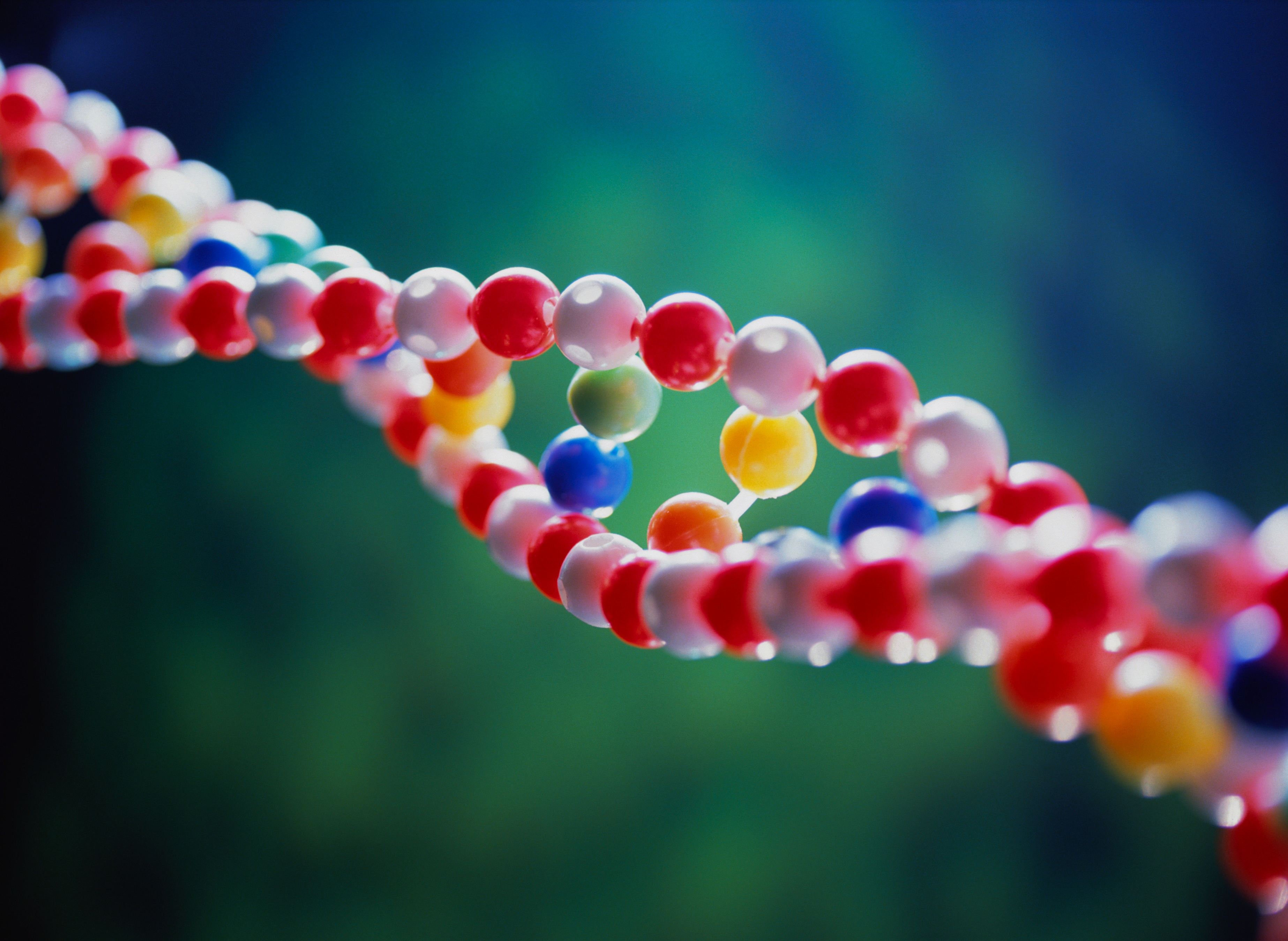
DNA and Mitosis Review 22-23
Presentation
•
Biology
•
9th Grade
•
Practice Problem
•
Medium
+4
Standards-aligned
Stacy King
Used 21+ times
FREE Resource
20 Slides • 27 Questions
1
​
2
Multiple Choice
The smallest unit of all living things
cells
matter
mass
Nucleotides
3
Phosphate
Sugar
Nitrogen base pairs
4
Multiple Choice
STRUCTURE: Nucleotides monomers are made up of a sugar, a phosphate, and a:
nitrogenous base
nucleic acid
cholesterol
fatty acid
5
Multiple Choice
Sugar, Phosphate, nitrogen base
Phosphate, Adenine, nitrogen base
Thymine, Adenine, Cytomine
Phosphate, Nitrogen, Adenine
6
found only in the nucleus
forms a double helix
bases are bonded by hydrogen bonds
7
deoxyribose
8
Adenine pairs with Thymine
Guanine pairs with Cytosine
9
Multiple Choice
Eight components present in nucleic acids are listed in the box.
Which components bond with adenine in a section of double-stranded DNA?
A 1,3,5, and 6 only
B 3 and 5 only
C 2 and 4 only
D 3,4,7, and 8 only
10
Multiple Choice
Which part of a DNA molecule is responsible for the direct coding of specific traits in an organism?
F The number of hydrogen bonds that hold the strands of DNA together.
G The number of carbons in the DNA molecule.
H The sequence of nucleotide bases in the DNA molecule
J The sequence of phosphates along each DNA strand.
11
Multiple Choice
Guanine
Thymine
Cytosine
Adenine
12
Multiple Choice
In Texas Longhorn cattle, coat coloration is an inherited trait. What is the genetic basis of coat-color variation in Texas Longhorn cattle?
F Differences in the nucleotide sequences of genes
G Differences in the numbers of chromosomes in cells
H Differences in the diets of individual cattle
J Differences in the environmental conditions of different geographic areas
13
Multiple Choice
Nitrogenous bases are located on both strands of the DNA double helix. What is the significance of the nitrogenous bases?
A The number of adenines and cytosines determines the type of RNA that will be produced.
B The order of nitrogenous bases determines the order of amino acids in the proteins synthesized.
C The amount of thymine and guanine in the DNA molecules determines the length of the genes.
D The type of hydrogen bonding between the nitrogenous bases determines which amino acid will be added to the peptide chain.
14
Multiple Choice
it is very small and very complicated
it's in everything
it serves as the blueprint for traits of all living things
because we eat it every day for energy
15
16
G1- cell growth (longest stage)
S- synthesis (DNA replication)
G2- organelle replication
17
DNA is Chromatin
18
S- synthesis (DNA replication)
19
Poll
Which part of the cell cycle is best described as separation of DNA into 2 sets, followed by division of the cytoplasm?
Mitotic (M) Phase
Interphase
G2 Phase
G1 Phse
20
21
Enzyme - Helicase unzips double-stranded DNA helix by breaking hydrogen bonds between complementary base pairs, separating into single strands
22
DNA polymerase builds new DNA strands by adding new nucleotides. Can only build in the 5′ to 3′ direction.
23
Multiple Choice
In which phase of the cell cycle is DNA replicated?
Mitosis
G1 phase
G2 phase
S phase
24
Multiple Choice
What do the 2 arrows represent in this diagram?
arrow 1 is prophase; arrow 2 is interphase
arrow 1 is mitosis; arrow 2 is meiosis
arrow 1 is interphase; arrow 2 is mitosis
arrow 1 is meiosis; arrow 2 is prophase
25
Multiple Choice
This occurs in which phase
anaphase
synthesis
G2
transcription
26
Multiple Choice
The cell remains in this phase for the longest period of time
G2
G1
synthesis
prophase
27
DNA exists as chromosomes with sister chomatids
are bond by centromeres
28
chromosomes are visible
29
Multiple Choice
A student is looking for evidence that spindle fibers are separating the chromosomes to ensure that each new nucleus has one copy of each chromosome. Which diagram is the student looking for?
Cell 1
Cell 2
Cell 3
Cell 4
30
chromosomes align in the middle
31
Multiple Choice
This part of the cell cycle is best described as the process that —
duplicates the DNA
completes cell division
maintains genetic homeostasis
synthesizes new molecules
32
sister chromatids are separated at the centromere
33
the two daughter cells begin rebuilding nuclear membrane
34
Multiple Choice
chromosome
chromatid
centromere
35
Multiple Choice
36
Multiple Choice
37
Multiple Choice
38
Multiple Choice
39
Multiple Choice
40
final separation of cytoplasm
41
cell plate and cell membrane form
42
prokaryotic cells (bacteria)
43
Multiple Choice
What forms to separate plant cells?
Cell Wall
Cell Separator
Cell Cap
Cell Plate
44
Multiple Choice
Which of the following is the correct order of the Cell Cycle?
Interphase, Mitosis, Cytokinesis
Mitosis, Cytokinesis, Mitosis, Interphase
Prophase, Metaphase, Anaphase, Telophase
Interphase, Prohase, Cytokinesis
45
Multiple Choice
Bacteria reproduce asexually by a process called
replication
meiosis
mitosis
binary fission
46
Multiple Choice
Interphase
Prophase
Metaphase
Anaphase
47
Multiple Choice
This model of the cell cycle includes two arrows that each represent a process in the cycle. What do the two arrows represent?
Arrow 1 represents prophase, and Arrow 2 represents interphase.
Arrow 1 represents mitosis, and Arrow 2 represents meiosis.
Arrow 1 represents interphase, and Arrow 2 represents mitosis.
Arrow 1 represents meiosis, and Arrow 2 represents prophase.
​
Show answer
Auto Play
Slide 1 / 47
SLIDE

Similar Resources on Wayground
42 questions
Europe Map 2
Presentation
•
9th Grade
39 questions
DNA and Protein Synthesis STAAR Review lesson HONORS
Presentation
•
9th Grade
43 questions
3.1 Introduction to Global Systems
Presentation
•
9th Grade
40 questions
Concordância verbal
Presentation
•
KG
42 questions
Prokaryotic Cells
Presentation
•
9th Grade
42 questions
Eukaryotic Organelles
Presentation
•
9th Grade
42 questions
Eukaryotes vs Prokaryotes and Organelles
Presentation
•
9th Grade
40 questions
If - Joseph Rudyard Kipling
Presentation
•
9th Grade
Popular Resources on Wayground
10 questions
How much do you know about our Portrait of an Eagle?
Quiz
•
10th Grade
10 questions
Fast Food Slogans
Quiz
•
6th - 8th Grade
21 questions
Continents and Oceans
Quiz
•
6th Grade
20 questions
Parts of Speech
Quiz
•
5th Grade
16 questions
Subject & Predicate
Quiz
•
5th Grade
25 questions
Multiplication Facts
Quiz
•
5th Grade
12 questions
Map Skills
Quiz
•
3rd Grade
22 questions
Continents and Oceans
Quiz
•
5th Grade
Discover more resources for Biology
20 questions
Characteristics of Life
Quiz
•
9th - 10th Grade
10 questions
Exploring the 4 Major Macromolecules and Their Functions
Interactive video
•
9th - 12th Grade
20 questions
Cell Transport
Quiz
•
9th - 12th Grade
25 questions
photosynthesis and cellular respiration
Quiz
•
9th Grade
16 questions
Population Ecology
Quiz
•
9th - 12th Grade
20 questions
Cell Organelles
Quiz
•
9th Grade
18 questions
Water Properties
Quiz
•
9th Grade
36 questions
U3 Review Cell Cycle and Specialization Quiz
Quiz
•
9th Grade