

Enzymes

Presentation
•
Biology
•
9th - 10th Grade
•
Easy
Standards-aligned

Lkhagvajargal Sanjsuren
Used 44+ times
FREE Resource
14 Slides • 7 Questions
1
Grade 9

2
Many chemical reactions can be speeded up by substances called catalysts. A catalyst alters the rate of a chemical reaction, without being changed itself.

3
For example, inside the alimentary canal, large molecules are broken down to smaller ones in the process of digestion. These reactions are speeded up by enzymes. A different enzyme is needed for each kind of food. For example, starch is digested to the sugar maltose by an enzyme called amylase. Protein is digested to amino acids by protease.

4
These enzymes are also found in plants - for example, in germinating seeds, where they digest the food stores for the growing seedling. Many seeds contain stores of starch. As the seed soaks up water, the amylase is activated and breaks down the starch to maltose. The maltose is soluble, and is transported to the embryo in the seed. The embryo uses it to provide energy for growth, and also to provide glucose molecules that can be strung together to make cellulose molecules, for the cell walls of the new cells produced as it grows.

5
Another enzyme which speeds up the breakdown of a substance is catalase. Catalase works inside the cells of living organisms - both animals and plants - for example, in liver cells or potato cells. It breaks down hydrogen peroxide to water and oxygen. This is necessary because hydrogen peroxide is produced by many of the chemical reactions which take place inside cells. Hydrogen peroxide is a very dangerous substance, and must be broken down immediately.

6
Not all enzymes help to break things. Many enzymes help to make large molecules from small ones. One example of this kind of enzyme is starch phosphorylase, which builds starch molecules from glucose molecules inside plant cells.

7
Enzymes are named according to the reaction that they catalyse. For example, enzymes which catalyse the breakdown of carbohydrates are called carbohydrases.
If they break down proteins, they are proteases. If they break down fats (lipids) they are lipases.
Sometimes, they are given more specific names than this. For example, we have seen that the carbohydrase that breaks down starch is called amylase. One that breaks down maltose is called maltase. One that breaks down sucrose is called sucrase.

8
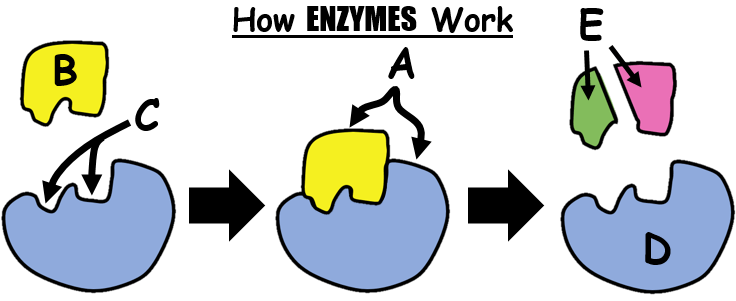
An enzyme works by allowing the molecule of the substance on which it is acting to fit into it. The fit has to be perfect. The enzyme is like a lock, into which another molecule fits like a key. We say that the shape of the enzyme and the shape of the substrate are complementary to one another.

9
The substance which is present at the beginning of the reaction is called the substrate. The substance which is made by the reaction is called the product.
For example, in saliva there is an enzyme called amylase. It catalyses the breakdown of starch to the complex sugar maltose. In this reaction, starch is the substrate, and maltose is the product.
amylase
starch ------------- ► maltose

10
1. All enzymes are proteins. This may seem rather odd, because some enzymes actually digest proteins.
2. Enzymes are made inactive by high temperature. This is because they are protein molecules, which are damaged by heat.
3. Enzymes work best at a particular temperature. Enzymes which are found in the human body usually work best at about 37 °

11
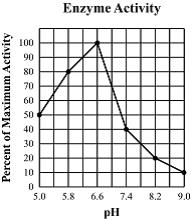
4. Enzymes work best at a particular pH Some enzymes work best in acid conditions (low pH). Others work best in neutral or alkaline conditions (high pH)
5. Enzymes are catalysts They are not changed in the chemical reactions which they control. They can be used over and over again, so a small amount of enzyme can change a lot of substrate into product.
6. Enzymes are specific This means that each kind of enzyme will only catalyse one kind of chemical reaction.

12
Enzymes are damaged by high temperatures. For most human enzymes, this begins to happen from about 40 °C upwards. As the temperature increases beyond this, the enzyme molecules start to lose their shape. The active site no longer fits perfectly with the substrate. The enzyme is said to be denatured. It can no longer catalyse the reaction.

13
The temperature at which an enzyme works fastest is called its optimum temperature. Different enzymes have different optimum temperatures. For example, enzymes from the human digestive system generally have an optimum of around 37 °C. Enzymes from plants often have optimums around 28 °C to 30 °C. Enzymes from bacteria that live in hot springs may have optimums as high as 75 °C.

14
Most enzymes are their correct shape at a pH of about 7 - that is, neutral. If the pH becomes very acidic or very alkaline, then they are denatured. Some enzymes have an optimum pH that is not neutral. For example, there is a protease enzyme in the human stomach that has an optimum pH of about 2.
This is because we have hydrochloric acid in our stomachs. This protease must be able to work well in these very acidic conditions.

15
Multiple Choice
16
Multiple Choice
17
Multiple Choice
18
Multiple Choice
What is a substance called if it speeds up a chemical reaction?
reusable
catalyst
specific
fragile
19
Multiple Choice
Where do substrates bind to an enzyme?
calcium channels
active site
receptor molecules
voltage-gated channels
20
Multiple Choice
21
Poll

How well did you understand the enzymes?
I GOT IT
I ALMOST GOT IT
I NEED HELP
Grade 9
Show answer
Auto Play
Slide 1 / 21
SLIDE
Similar Resources on Wayground

20 questions
Photosynthesis
Presentation
•
9th - 10th Grade
19 questions
6A: Components of DNA and DNA Replication
Presentation
•
9th Grade
15 questions
Passive Transport
Presentation
•
8th - 9th Grade
16 questions
Quotation Marks/Dialogue
Presentation
•
9th - 10th Grade
16 questions
G9 Chap 7.1 Cell Discovery and Theory
Presentation
•
9th Grade
17 questions
Protists
Presentation
•
9th Grade
18 questions
Biogeochemical Cycles
Presentation
•
9th Grade
15 questions
Food Chain and Food Webs
Presentation
•
9th Grade
Popular Resources on Wayground
10 questions
How much do you know about our Portrait of an Eagle?

Quiz
•
10th Grade
10 questions
Fast Food Slogans
Quiz
•
6th - 8th Grade
21 questions
Continents and Oceans
Quiz
•
6th Grade
20 questions
Parts of Speech
Quiz
•
5th Grade
16 questions
Subject & Predicate
Quiz
•
5th Grade
25 questions
Multiplication Facts
Quiz
•
5th Grade
12 questions
Map Skills
Quiz
•
3rd Grade
22 questions
Continents and Oceans
Quiz
•
5th Grade
Discover more resources for Biology
20 questions
Characteristics of Life
Quiz
•
9th - 10th Grade
10 questions
Exploring the 4 Major Macromolecules and Their Functions

Interactive video
•
9th - 12th Grade
20 questions
Cell organelles and functions
Quiz
•
10th Grade
20 questions
Cell Transport
Quiz
•
9th - 12th Grade
25 questions
photosynthesis and cellular respiration
Quiz
•
9th Grade
20 questions
Macromolecules
Quiz
•
10th Grade
16 questions
Population Ecology
Quiz
•
9th - 12th Grade
20 questions
Cell Organelles
Quiz
•
9th Grade