
Search Header Logo
Montesquieu and Voltaire

Montesquieu and Voltaire

Assessment

Presentation

Social Studies

6th Grade

Medium

Created by

Andrea Peters

Used 11+ times

FREE Resource

18 Slides • 5 Questions

1

Montesquieu and Voltaire

Chapter 5

Slide image

2

Lesson Objectives

  • Characterize the ideas of Montesquieu and Voltaire

  • Explain how the French ruling class tried to keep the message of the Enlightenment from reaching most French people

  • Explain the importance of the Encyclopedia

3

1700s France

  • Freedom of speech was not allowed

  • Citizens who spoke out against the monarch or his court could be sent to Bastille

  • Enlightenment thinkers still persisted

Slide image

4

Montesquieu

  • Born Charles-Louis de Secondat, Baron de Montesquieu

  • Traveled around Europe to see different governments in England and Italy

  • Read a lot about ancient and medieval times and Chinese and Native cultures in America

  • Came to the conclusion that France was in trouble

Slide image

5

Opinions About France

  • Most people suffering from poverty and injustice

  • Strict social order enforced by the clergy and the monarchy allowed no change

  • Could NOT openly criticize the French government or the Church

  • Wrote The Persian Letters under the guise of two Persian travelers named Usbek and Rica

6

The Persian Letters

  • Non-citizens could speak freely about the French government, while Montesquieu, a citizen, could not because he could be arrested and sent to the Bastille

  • While pretending to be Persian travelers, Montesquieu could be critical of the French government and highlighted harsh truths about the monarchy and French court

  • People soon found out that Montesquieu was the author

7

Multiple Choice

What was Montesquieu's purpose in writing The Persian Letters?

1

to promote friendship between Persia and Fronce

2

To encourage Persian travelers to visit France

3

To criticize French and society

4

To encourage a revolution in Paris

8

Separation of Powers

  • Wrote The Spirit of the Laws under his own name

  • Believes in limiting the power of the ruler and protecting the rights of the people

  • Proposed separation of powers so now single branch of government has too much power

  • Legislative Branch = Makes the laws

  • Executive Branch = Enforces the laws

  • Judicial Branch = Interprets the laws

9

Montesquieu's Beliefs

  • Separation of Powers

  • Slavery is "the most shocking violation of nature"

  • Did not call for rebellion or democracy

  • wanted peaceful, modest reforms that would make people's lives better

10

Multiple Choice

Which of Montesquieu's ideas influence the organization of the U.S. government, as outlined in the Constitution?

1

A government needs strict laws to keep people in order

2

The use of reason helps people understand the world

3

A separation of powers will keep any one branch of government from becoming too strong

4

People must question everything except their own existence

11

Voltaire

François-Marie Arouet

12

Bastille

  • Originally built to be a military fortress to protect Paris

  • Later became a royal prison

  • People who displeased the government would be sent here

Slide image

13

Voltaire

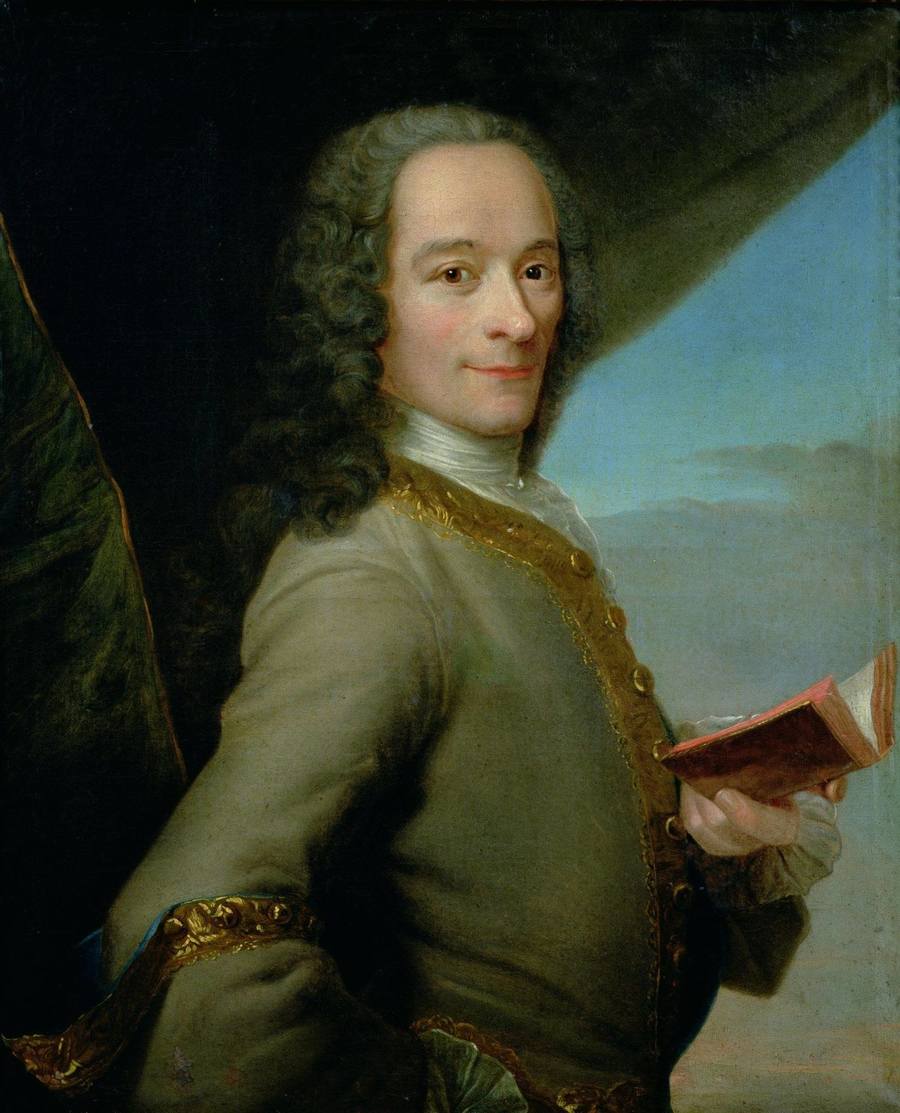
  • Imprisoned in Bastille for nearly a year in 1717

  • Arrested for making fun of the French government in his writings

  • Continued writing critiques of the French government under the pseudonym Voltaire
Slide image

14

Multiple Choice

Why did Voltaire write under a pen name?

1

He could get in trouble for speaking against the French monarchy

2

He did not think anyone would buy a book he had written

3

He was embarrassed by his ideas

4

French noblemen were not allowed to write books

15

Voltaire's Beliefs

  • Wanted to improve society

  • Very citical of greedy officials, lazy nobles, and evil institutions

  • Hated slavery and religious intolerance

  • His remarks made the ruling class of France seem foolish

16

French Government Reactions

  • Mostly ignored Montesquieu's criticisms because he was a noble

  • However, they would not tolerate Voltaire's comments

  • Voltaire was a commoner, so his comments could not be allowed

  • Voltaire was forced to flee to England in 1726

17

Time in England

  • Exposed him to the limited monarchy in England and studied the works of Newton and Locke

  • Became certain that France faced serious problems

  • "In this country [England] it is possible to use one's mind freely and nobly, without fear of cringing."

  • Returned to France and wrote Letters on the English and praised England for its science, philosophy, and government that protected the rights of the people

18

Free Speech

  • Continued to write books and plays out of his estate at Ferney

  • Spoke out against censorship, ignorance, and injustice

  • "I do not agree with a word that you say, but I will defend to the death your right to say it!"

Slide image

19

Multiple Choice

Which of the following did Voltaire most value?

1

An orderly society with strictly enforced laws

2

The freedom to express one's opinions

3

Living according to the religious teachings of the Church

4

Loyalty to the crown

20

Philosophes

  • Free thinkers would meet in small, private groups known as salons

  • These people became known as philosophes

  • Discussed ways to achieve a fairer socierty

  • Voltaire and other philosophes wrote and published the Encyclopedia

  • Philosophes were upper and middle class

Slide image

21

Encyclopedia

  • Over 30 volumes (books) published over 20 years

  • Summed up the major ideas and discoveries of the Enlightenment

Slide image

22

Multiple Choice

The French philosophes were

1

scholars and thinkers who considered ways to achieve a better society

2

Monarchs who refused to give up total control

3

peasants and poor farmers who launched a revolt against the monarchy

4

Noble men and women of the French court

23

Enlightenment Reaches the People

  • Enlightenment ideas did not reach the ordinary people of Paris until the late 1700s

  • It then spread from the city to the rural villages where peasants worked extremely hard and paid high taxes - just as they always had

  • The masses would begin to question the way things were and began to believe that the royals had failed them

Montesquieu and Voltaire

Chapter 5

Slide image

Show answer

Auto Play

Slide 1 / 23

SLIDE
