Search Header Logo
Our Solar System - Overview

Our Solar System - Overview

Assessment

Presentation

Science

7th - 10th Grade

Practice Problem

Medium

NGSS
MS-ESS1-3, MS-ESS1-1, MS-ESS1-2

+7

Standards-aligned

Created by

Michael Belmonte

Used 29+ times

FREE Resource

22 Slides • 30 Questions

1

Our Solar System

Please open another tab and then copy and paste the link below. Let's explore our solar system...


https://solarsystem.nasa.gov/planets/overview/

Slide image

2

Multiple Choice

What unit are astronomers most likely to use to describe distances in the solar system?

1

Light year

2

Kilometers

3

Astronomical Units

4

Miles

3

SOLAR SYSTEM

The Sun & bodies orbiting around it:

-8 planets with about 210 known planetary satellites (moons)

-5 dwarf planets

-countless asteroids, some with moons!

-comets and other icy bodies

-vast amounts of gas/dust (nebula)

Slide image

4

Multiple Choice

Question image

The spinning of an object on its axis is called______

1

orbit

2

rotation

3

revolution

4

tide

5

Slide image

6

Slide image

7

Slide image

8

Multiple Choice

Question image

What makes up most of the mass in our solar system?

1

Jupiter

2

All the asteroids combined

3

The Sun

4

The Moon

9

Multiple Choice

Which of the following is not in our solar system ?

1

Constellations

2

The Sun

3

Planets

4

Asteroids

10

Multiple Choice

Which of the following is a true statement?

1

The galactic center is also the center of our solar system.

2

The Sun is the center of the solar system.

3

Our solar system is near the galactic center of the Milky Way.

4

The Sun is the center of the Milky Way galaxy.

11

Our Solar System - Overview

Let's start with the basics about our solar system....

12

Multiple Choice

Question image

How long ago was our solar system formed?

1

about 4.5 million years ago

2

about 9.2 million years ago

3

about 4.5 billion years ago

4

about 9.2 billion years ago

13

8 Planets

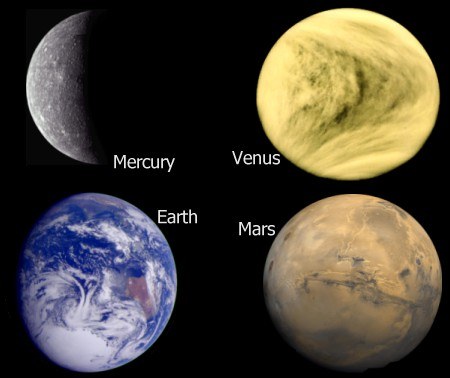
  • Terrestrial (Mercury, Venus, Earth, Mars)

  • Jovian (Jupiter, Saturn, Uranus, Neptune)

Slide image

14

Slide image

15

Multiple Choice

Question image

The plane that the 8 planets all orbit in is called the

1

Planetary plane

2

Ecliptic plane

3

Elliptical plane

4

Promenade plane

16

Multiple Choice

Which is the correct order of the planets?

1

Mercury, Venus, Mars, Earth, Saturn, Jupiter, Neptune, Uranus

2

Mercury, Venus, Earth, Mars, Jupiter, Uranus, Saturn, Neptune

3

Mercury, Venus, Earth, Mars, Jupiter, Saturn, Uranus, Nepture

4

Mercury, Venus, Earth, Jupiter, Saturn, Mars, Uranus, Neptune

17

Terrestrial Planets

  • Made of rocky material

  • Solid surfaces

  • No rings

  • Few moons

  • Small

  • Liquid core of heavy metal

Slide image

18

Multiple Choice

Question image

How is Earth different from all the other planets in our solar system?

1

It is the only planet with its own moon.

2

It has storms in the atmosphere.

3

It has liquid water that allows plants and animals to live.

4

It is close enough to the sun to get heat energy.

19

Multiple Choice

Question image

Which best describes the terrestrial planets?

1

Large, planetary rings

2

Small, dense, rocky

3

Rocky cores, close to sun, surface craters

4

Made of helium and hydrogen

20

Multiple Choice

Earth completes one full ___________ on its axis every 24 hours.
1
rotation
2
revolution
3
resolution
4
reservation 

21

Multiple Choice

How long does it take Earth to complete one revolution around the Sun?
1
24 hours
2
one week
3
one month
4
one year

22

Multiple Choice

A force of attraction between any two objects is called _____________.
1
static electricity 
2
rotation
3
gravity
4
orbit

23

Multiple Choice

Question image

Planets that are closer to the sun

1

take more time to orbit.

2

take less time to orbit.

24

Multiple Choice

Question image
Earth and the other planets closest to the Sun are made mostly of _______
1
gas
2
metal
3
water
4
rock

25

Jovian Planets

  • Gas Giants = Jupiter & Saturn

  • Made of helium & hydrogen

  • Ice Giants = Uranus & Neptune

  • Made of rock, ice, H2O, CH4, & NH3

  • Multiple moons

  • No solid surface !

  • Rings

Slide image

26

Multiple Choice

Saturn is the only planet with a ring system.

1

True

2

False

27

Slide image

28

Slide image

29

Multiple Choice

What is special about Pluto's orbit?

1

It is a perfect circle

2

It is much more tilted than the others

3

Pluto orbits tthe sun in the opposite direction

4

Pluto's orbit places it close to another solar system

30

Slide image

31

Slide image

32

Multiple Choice

Question image

What is Ceres?

1

Asteroid

2

Comet

3

Meteroite

4

Dwarf Planet

33

Asteroid Belt & Kuiper Belt

-Flat discs of rocks and ice orbiting our sun

-Leftover from our solar system's formation

34

Asteroid Belt

  • Collection of ice and rocks located between Mars & Jupiter

  • 2 - 4 AUs from the sun

  • Pebbles to dwarf planets like Ceres

Slide image

35

Multiple Choice

Between which two planets would you find the asteroid belt?

1

Earth and Mars

2

Saturn and Jupiter

3

Mars and Jupiter

4

Saturn and Uranus

36

Multiple Choice

What is the largest object in the asteroid belt?

1

Eris

2

Vesta

3

Ceres

4

Hygeia

37

Multiple Choice

Question image

Which planets are the asteroid belt in between?

1

Venus & Earth

2

Earth & Mars

3

Mars & Jupiter

4

Jupiter & Saturn

5

Saturn & Uranus

38

Kuiper Belt - 30 to 50 AUs from the sun

  • Pluto discovered in 1930

  • Gerard Kuiper predicts a belt of icy objects beyond Neptune (1951)

  • Jane Luu & David Jewitt discover it in 1992

  • Collection of icy objects outside the orbit of Neptune

Slide image

39

Multiple Choice

Pluto was discovered in what year?

1

2015

2

1776

3

1930

4

1945

40

Slide image

41

Kuiper Belts Objects (KBOs)

  • Also known as trans-Neptunian objects (TNOs)

  • Millions of them!

  • Include dwarf planets: Pluto, Eris, Haumea, & Makemake

  • Small KBOs occasionally are tugged free by the sun and become COMETS

Slide image

42

Multiple Choice

What is in the Kuiper Belt?

1

Vbucks

2

Debris left over from the formation of the solar system

3

hot pockets

4

dark matter

43

Multiple Choice

Question image

What distance from the sun is the inner edge of the Kuiper belt?

1

30 AU

2

100 AU

3

4 gallons

4

55 AU

44

Multiple Select

Objects in the Kuiper Belt are known as what?

1

Asteroids

2

Comets

3

Kuiper Belt Objects

4

trans-Neptunian objects

45

Multiple Choice

What was the first Kuiper Belt Object discovered?

1

Makemake

2

Haumea

3

Neptune

4

Pluto

46

Multiple Select

Question image

Select three known Kuiper Belt Objects....

1

Makemake

2

Pluto

3

Neptune

4

Eris

5

Titan

47

Multiple Choice

Who is the Kuiper Belt named after?

1

Henry Ford

2

Donald Trump

3

Gerard Kuiper

4

Bram Stoker

48

Oort Cloud

  • NOT a belt

  • It is a SPHERE

  • Collection of icy debris

  • Edge of our solar system

Slide image

49

Slide image

50

Multiple Choice

Question image

What distance from the sun is the outer edge of the Oort cloud?

1

30 AU

2

100,000 AU

3

1 mile

4

1 Lightyear

51

Multiple Choice

Question image

The Oort Cloud is an origin of ___

1

asteroids

2

Thanos

3

moons

4

comets

52

Slide image

Our Solar System

Please open another tab and then copy and paste the link below. Let's explore our solar system...


https://solarsystem.nasa.gov/planets/overview/

Slide image

Show answer

Auto Play

Slide 1 / 52

SLIDE