

Search Header Logo
Lesson 25: Geography and the Settlement of Greece

Lesson 25: Geography and the Settlement of Greece

Assessment

Presentation

Geography, Social Studies

6th Grade

Practice Problem

Medium

Created by

Kathleen Luptak

Used 20+ times

FREE Resource

15 Slides • 8 Questions

1

Geography and the Settlement of Greece Lesson 25: Part 1 (Sections 1-3)

6th Gr Social Studies Mrs. Luptak

Slide image

2


As sunlight falls on the mountains, hills, and coasts of Greece, reflecting off the surfaces of the glittering sea, white-washed buildings, and ancient ruins, it is dazzling, brilliant, and vibrant. In ancient times, the light of Greece was unaffected by the haze of modern pollution, and was surely even more magical than it is today.


3

Setting the Stage: S1

Greece has three main parts: the mainland, which is part of southern Europe; the peninsula, which nearly touches the mainland and is connected to it by just a thin strip of land; and the islands, which number more than 2,000. The peninsula is called the Peloponnesus. The largest island, Crete, lies in the Mediterranean Sea, south of the main land. Most of the islands of ancient Greece, however, were not suitable places for people to make their homes.

Slide image

4

Settlement in ancient Greece was influenced by geography, just as it was for people of other ancient cultures. High mountains separated Greek communities from one another, making it easier for the Greek people to interact with outsiders than with each other.


Most of Greece is covered with steep mountains. Mount Olympus is the highest, rising about 9,500 feet above sea level. The rest of Greece is made up of lowlands along its many miles of coastline. Greece is surrounded by seas on three sides: the Aegean to the east, the Mediterranean to the south, and the Ionian to the west. Carved out of the land where it meets the sea are many deep inlets and protected bays. It is understandable why shipbuilding, fishing, and seafaring were important in ancient Greece.


5

In early times, coastal villages were separated by the high mountains. The soil was poor, and level land was scarce, but farmers grew olives, grapes, and fruit and nut trees along the coast. Cattle could not graze on the steep hillsides of Greece, so the Greeks raised sheep and goats.

Slide image

6

Over time, as the population of ancient Greece increased, it became harder to produce enough food for everyone. So the Greeks took to the seas, traveling to Asia Minor (present-day Turkey), France, Italy, Spain, and Africa to set up trading colonies. The map opposite shows Greek colonies and trading routes about 550 B.C.E.

Slide image

7

In this unit, you will learn more about the "land of light" and the ways in which the mountains and the sea shaped the history of ancient Greece.

Slide image

8

Multiple Choice

What makes much of Greece a peninsula?

1

the lack of large rivers

2

the water on three sides

3

the steep mountain slopes

4

the large number of islands

9

Isolated Communities & the Difficulties of Travel -S2

The mountains and the seas of Greece contributed greatly to the isolation of ancient Greek communities. Because travel over the mountains and across the water was so difficult, the people in different settlements had little communication with each other.

Travel by land was especially hard. People mostly walked, or rode in carts pulled by oxen or mules. Roads were unpaved. Sharp rocks frequently shattered wooden wheels, and thick mud could stop a wagon in its tracks. Only wealthy people could afford to ride horses.


10


Travelers could stop at inns on the main roads, but many inns provided only shelter. People had to bring their own food and other supplies with them. Slaves or pack animals carried bedding, food, and other necessities. With all these goods to take with them, the Greeks often traveled in groups, moving at a slower pace than someone traveling alone.

Slide image

11

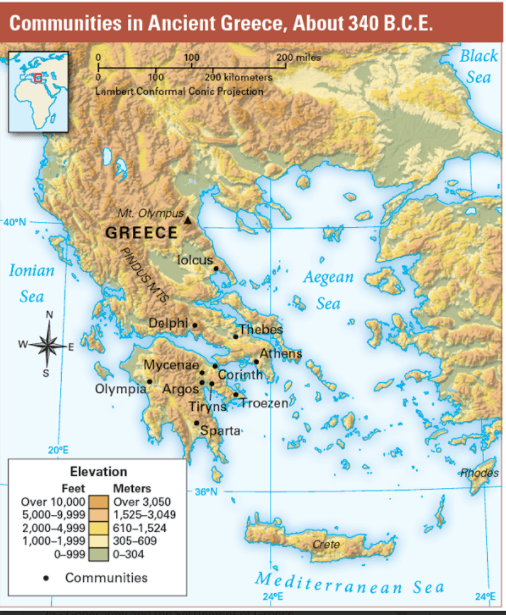
Traveling by water was easier than traveling by land. You can see on the map on this page that mainland Greece is a peninsula, made up of smaller peninsulas. Ancient Greeks were never far from the water. To the south of Greece is the Mediterranean Sea; to the east, the Aegean Sea; and to the west, the Ionian (ahy-OH-nee-uhn) Sea. The ancient Greeks soon learned to travel by ship.
Slide image

12

The Greeks understood the dangers of the sea and treated it with great respect. Sudden storms could drive ships off course or send them smashing into the rocky shoreline. Even in open waters, ships could sink. These hazards encouraged Greek sailors to navigate close to shore, sail only during daylight, and stop at night to anchor.

Slide image

13

Multiple Choice

How did the Greek mountains affect communication?

1

. They isolated communities.

2

They promoted road building

3

They led people to write letters.

4

They made farmers stop speaking.

14

Multiple Choice

The ancient Greeks did not like to travel on land because they

1

. did not want to offend the earth god.

2

were afraid of people from other villages.

3

used the land for farming instead of roads

4

found traveling through the mountains difficult.

15

Farming in Ancient Greece -S3

Most people in ancient Greece made their living by farming. But farming wasn't easy in that mountainous land. Even in the plains and valleys, the land was rocky, and water was scarce. There were no major rivers flowing through Greece, and the rains fell mostly during the winter months.

With limited flat land available, Greek farmers had to find the best ways to use what little land they had. Some farmers built wide earth steps into the hills to create more flat land for planting. A few farmers were able to grow wheat and barley, but most grew crops that needed less land, particularly grapes and olives. Greek farmers produced a lot of olive oil, which was used for cooking, to make soap, and as fuel for lamps.


16


Ancient Greek farmers grew food for their own families. In addition to small vegetable gardens, many farmers planted hillside orchards of fruit and nut trees. Some Greek families kept bees to make honey. Honey was the best-known sweetener in the ancient world.

Slide image

17

Greek farmers also raised animals. But because cattle need wide flat lands for grazing, the ancient Greeks had to raise sheep and goats, which can graze on the sides of mountains. Sheep supplied wool for clothing, while goats provided milk and cheese. Greek farmers kept some oxen, mules, and donkeys for plowing and transportation. Many Greek families also kept pigs and chickens.

Slide image

18

The shortage of good farmland sometimes led to wars between Greek settlements, with each one claiming land for itself. As you will see, some settlements also had to look beyond the mainland for new sources of food and other goods.

Slide image

19

Multiple Choice

What is a reason why the ancient Greeks produced so much olive oil?

1

They could feed the olive oil to their pigs.

2

They could exchange the olive oil for nuts.

3

They could grow olive oil in a small space.

4

They could get olives from other countries in trade.

20

Multiple Choice

What made farming in ancient Greece especially difficult?

1

mud

2

rocks

3

bandits

4

climate

21

Multiple Choice

Question image

The ancient Greeks raised these animals on their farms because these animals (goat, chicken, lamb, and bees for honey)

1

did not need flat land.

2

could drink sea water.

3

supplied oil for lamps.

4

did not eat much food.

22

Multiple Choice

Suppose an adviser told a farmer, "You could grow more crops by using irrigation." What would the farmer most likely reply?

1

Our land is too low and flat.

2

We do not have a big enough river.

3

We do not have the labor to build ditches.

4

Our engineers do not have the skill to design that.

23

Multiple Choice

Why did Greek communities sometimes fight each other?

1

They had too many soldiers.

2

They were crowded together.

3

They could not start colonies.

4

They each wanted more land.

Geography and the Settlement of Greece Lesson 25: Part 1 (Sections 1-3)

6th Gr Social Studies Mrs. Luptak

Slide image

Show answer

Auto Play

Slide 1 / 23

SLIDE
