Search Header Logo
Geography of Ancient Greece

Geography of Ancient Greece

Assessment

Presentation

Geography, History, Social Studies

6th Grade

Medium

Created by

Lee Reay

Used 441+ times

FREE Resource

14 Slides • 6 Questions

1

Geography of Ancient Greece
Slide image

2

Today's Objective

How did geography affect the development of ancient Greece?

3

Anchor Question

  • Of the seven characteristics of a civilization, which do ancient Greece and modern societies have most in common?

  • Reminder: Take notes on your "Ancient Greece Note Catcher."

4

The Land in Greece

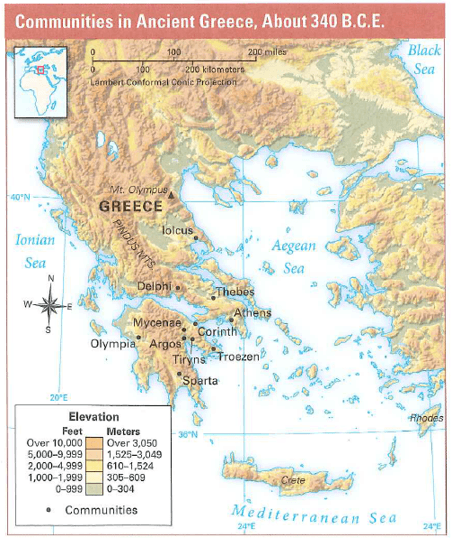
Greece is a small country in southern Europe. It is shaped somewhat like an outstretched hand, with fingers of land that reach into the Mediterranean Sea. The mainland of Greece is a peninsula. A peninsula is land that is surrounded on three sides by water. Greece also includes many islands throughout the Mediterranean and the Aegean (ih-JEE-luhn) seas.

Mainland Greece is a land of steep, rugged mountains, almost entirely surrounded by turquoise blue seas. The ancient Greeks lived on farms or in small villages scattered throughout the country. These farms and villages were isolated, or separated, from each other by the mountains and seas.


5

Multiple Choice

Which physical features are important to understand conditions in ancient Greece?

1

Islands

2

Peninsula

3

Mountains

4

All of the above

6

Isolated by Travel

The mountains and seas of Greece isolated ancient Greek communities (like Sparta). Because travel over mountains was so difficult, people in different settlements had little communication with each other. People mostly walked, or rode in carts pulled by oxen or mules to travel on unpaved roads. Sharp rocks frequently shattered wooden wheels, and thick mud could stop a wagon in its tracks. Only wealthy people could afford to ride horses.

Slide image

7

Sea Travel

Traveling by water was easier than traveling by land. Ancient Greeks were never far from the water. The ancient Greeks soon learned to travel by ship.

The Greeks understood the dangers of the sea. Sudden storms could drive ships off course or smash them into the rocky shoreline. Even in open waters, ships could sink. This is why Greek sailors only sailed close to shore during daylight hours.

Slide image

8

Multiple Choice

Which physical feature made places like Sparta somewhat isolated?

1

Poor soil

2

Broad rivers

3

Major highways

4

Surrounding mountains

9

Farming in Greece

Most people in ancient Greece made their living by farming. But farming wasn't easy in that mountainous land. Even in the plains and valleys, the land was rocky, and water was scarce. There were no major rivers flowing through Greece, and the rains fell mostly during the winter months.

With limited flat land available, Greek farmers had to find the best ways to use what little land they had. Some farmers built wide earth steps into the hills to create more flat land for planting. A few farmers were able to grow wheat and barley, but most grew crops that needed less land, particularly grapes and olives. Greek farmers produced a lot of olive oil, which was used for cooking, to make soap, and as fuel for lamps.

10

Farming in Greece

Ancient Greek farmers grew small vegetable gardens and hillside orchards of fruit and nut trees. Some Greek families kept bees to make honey.

Greek farmers also raised sheep and goats, which can graze on the sides of mountains, and pigs and chickens. Sheep supplied wool for clothing, while goats provided milk and cheese. Greek farmers kept some oxen, mules, and donkeys for plowing and transportation.

Slide image

11

Multiple Choice

What made farming in ancient Greece especially difficult?

1

Mud

2

Rocks

3

Bandits

4

Climate

12

Greek Colonies

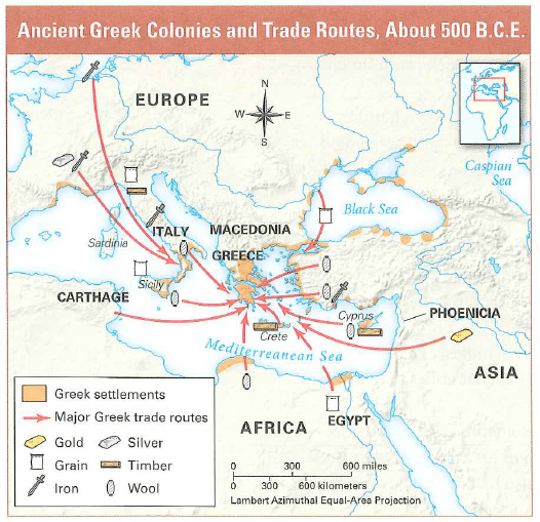
As the populations of Greek communities increased, the existing farmland no longer produced enough food to feed all of the people. One solution was to start colonies, or settlements in distant places. Many Greek communities sent people across the sea, in search of new places to farm so that they could ship food back home. People who set up colonies are called colonists.

The ancient Greeks began colonization by consulting an oracle to ask the Greek gods if their efforts would be successful. An oracle was a holy person who the Greeks believed communicated with the gods.

Next, the colonists gathered food and supplies. They took a flame from their town's sacred fire so they could start a sacred fire in their new home.

13

Greek Colonies

Greek colonists faced many hardships. They had to take a long sea voyage and then find a good location for their colony. They looked for areas with natural harbors and good farmland. They tried to avoid places where the local people might oppose the new colonies. Finally, they had to build their new community and make it successful.

Slide image

14

Greek Colonies

The Greeks established colonies from 1000 to 650 B.C.E. The first group of settlers colonized Ionia in Asia Minor (present-day Turkey). Later groups started colonies in Spain, France, Italy, and on the coast of Africa and the Black Sea.

These colonies helped spread Greek culture. Some flourished through farming and trade. Colonists still enjoyed the rights they held in Greece, including the right to participate in Greek athletic games.

Slide image

15

Multiple Choice

How did colonies affect ancient Greek culture?

1

They spread Greek culture over a wide area.

2

They led the Greeks to adopt Asian culture.

3

They caused village cultures to develop in different ways.

4

They forced settlers to lose their culture and rights as Greeks.

16

Greek Trade


Slide image

17

Greek Trade

     The Greeks traded among the city-states, colonies, and others. Olive oil and pottery from the mainland were exchanged for grain, timber, and metal.

Most goods were carried on wooden ships with large rectangular cloth sails. Merchants had ships built, not for speed, but for space to hold goods. Because these ships traveled only about three to five miles per hour, a one-way trip from the mainland could take two months. 

Slide image

18

Greek Trade

Navigating these ships was difficult. The Greeks had no compasses or charts. They had only the stars to guide them. The stars could tell sailors a ship's location, but not what hazards lay nearby. No lighthouses warned sailors of dangerous coastlines. Despite these dangers, adventurous sailors carried more and more goods, and trade flourished along the Mediterranean coast.

Slide image

19

Multiple Choice

Greek trading ships were built mostly for:

1

SPEED (so they could sell their goods faster)

2

COMFORT (for crew members on long journeys)

3

SPACE (to carry as many goods as possible)

4

STRENGTH (to withstand rocks in the water)

20

Open Ended

Describe how the realities of Greek life that you learned today helped spread Greek influence outside of Greece. (2-3 sentences)

Geography of Ancient Greece

Slide image

Show answer

Auto Play

Slide 1 / 20

SLIDE