Search Header Logo
Traits and Heredity

Traits and Heredity

Assessment

Presentation

Science

7th Grade

Practice Problem

Easy

NGSS
MS-LS1-1, HS-LS3-1, MS-LS3-2

+5

Standards-aligned

Created by

Randi Kelleher

Used 31+ times

FREE Resource

9 Slides • 17 Questions

1

Traits and Heredity

Unit 4 Notes

Slide image

2

Open Ended

What is heredity?

3

Genetics is

the study of Heredity


Heredity is the passing of traits from parents to offspring

4

Traits

A trait is a specific characteristic inherited from an organism's parents.


Traits are inherited from your parents and can be expressed as homozygous or heterozygous

5

Genes are the combination of alleles you inherit from your parents.


Examples include:

  • AA (homozygous dominant)

  • aa (homozygous recessive)

  • Aa (heterozygous)

6

Alleles

An allele is a different form of a gene.


Example: Genes for plant height can either be genes for a tall plant or genes for a short plant.

Slide image

7

Multiple Choice

Which genotype is homozygous recessive?

1

Bb

2

BB

3

bb

4

brown eyes

8

Multiple Choice

Which is NOT an example of a phenotype?

1

black fur

2

blue eyes

3

brown hair

4

bb

9

Multiple Choice

Which genotype is homozygous dominant?

1

Bb

2

bb

3

BB

4

Dd

10

Multiple Choice

Which genotype is hetrozygous?

1

Bb

2

BB

3

DD

4

dd

11

Multiple Choice

Genetic instructions are passed from both parents to their...

1

offspring

2

organism

3

organelle

4

parents

12

Multiple Choice

The inherited traits of an organism is governed by...

1

Mitochondria

2

Genes

3

Enzymes

4

Cytoplasm

13

Multiple Choice

Question image

Which piece of genetic information looks like a long twisted/coiled ladder?

1

Chromosome

2

DNA

3

ATP

4

Nucleus

14

Multiple Choice

Which choice is NOT true about genes?

1

They are found in the nucleus.

2

They are located on chromosomes.

3

They provide energy to the cell.

4

They provide genetic information for traits.

15

Eukaryotic vs. Prokaryotic Organisms

In eukaryotic organisms, chromosomes are larger than in prokaryotes.

Slide image

16

Eukaryotic Organisms

Eukaryotic DNA is linear with two distinct ends and codes for more proteins.


This means that eukaryotes lead to more diversity with trait expression than prokaryotes do.

Slide image

17

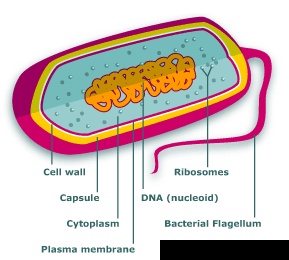
Prokaryotes

In prokaryotic organisms, the chromosomes are covalently closed circles of DNA. This closed off structure leads to fewer proteins being made, and ultimately leads to fewer possible allele combinations. Unlike eukaryotes, prokaryotes tend to only have one chromosome per cell.

Slide image

18

19

Multiple Choice

Question image

Eukaryotic cells are

1

Unicellular

2

Multiceullar

3

Both - unicellular and multi-cellular

20

Multiple Choice

Question image

Prokaryotes are

1

Unicellular - Made of ONE cell

2

Multiceullular - made of many cells

21

Multiple Choice

Where is the DNA found in a prokaryotic cell? 
1
floating around in the cytoplasm 
2
in the nucleus 

22

Multiple Choice

Question image

Where is DNA found in a Eukaryotic cell?

1

in the nucleus

2

in the cell wall

3

in the mitochondria

23

Multiple Choice

Question image

All of the following are Eukaryotic EXCEPT . . . .

1

animal cells

2

plant cells

3

fungi

4

bacteria

24

Multiple Choice

Question image

Eukaryotes are complex cells with a nucleus and other membrane bound organelles.

1

True

2

False

25

Multiple Choice

Question image
Which type of cell?
1
Prokaryote
2
Eukaryote

26

Multiple Choice

Question image

What is unicellular?

1

one cell

2

many cells

3

no nuclues

4

DNA

Traits and Heredity

Unit 4 Notes

Slide image

Show answer

Auto Play

Slide 1 / 26

SLIDE