Search Header Logo
1.1 & 1.2 Cells so far....

1.1 & 1.2 Cells so far....

Assessment

Presentation

Biology

11th - 12th Grade

Medium

Created by

Ruth Hamilton

Used 22+ times

FREE Resource

1 Slide • 20 Questions

1

1.1 & 1.2 Cells so far....

You've got to be in it to win it!

Slide image

2

Multiple Choice

Question image

What is diffusion?

1

When molecules move from a low concentration to a high concentration

2

When molecules move from a high concentration to a low concentration.

3

When there is no movement of molecules

4

When molecules move everywhere regardless of concentration

3

Multiple Choice

Question image

Why are embryonic stem cells more 'valuable' than adult stem cells?

1

Because they are multipotent

2

Because they are unipotent

3

Because they are pluripotent

4

Because they are unimpotent

4

Multiple Choice

Question image

Large numbers of ribosomes are present in cells that specialize in producing which of the following molecules?

1

lipids

2

steroids

3

carbohydrates

4

proteins

5

Multiple Choice

Question image

What is the pili used for in prokaryotes?

1

movement

2

attachement

3

protection

4

homeostasis

6

Multiple Choice

Question image

Structure A is......

1

smooth endoplasmic reticulum

2

Golgi apparatus

3

rough endoplasmic reticulum

4

vesicles

7

Multiple Choice

Question image

This organelle is responsible for translation...

1

Golgi apparatus

2

ribosome

3

lysosome

4

rough endoplasmic reticulum

8

Multiple Choice

Question image

How do stem cells know what type of cells to differentiate into?

1

The nucleus has instructions to turn some genes on and some genes off.

2

Signals from chemicals in the organism or from the environment determine which genes will be turned on and off.

3

Genes turn on and off randomly.

4

The cell has unique DNA that determines what the cell will become.

9

Multiple Choice

Question image

This is how prokaryotic cells reproduce....

1

mitosis

2

meiosis

3

binary fission

4

binary fusion

10

Multiple Choice

Question image

Which of the following is the closest definition of LYSOSOMES?

1

An organelle in which cellular respiration occurs.

2

The organelle that makes proteins by putting together chains of amino acids using instructions from the DNA.

3

Organelles that contain digestive enzymes, which break down worn-out or damaged organelles and foreign invaders in the cell.

4

A storage organelle, that may give structure and rigidity to plant cells.

11

Multiple Choice

Question image

What is the function of this organelle?

1

protein synthesis

2

transport proteins

3

modify, package, and ship proteins

4

storage of water, food or wastes

12

Multiple Choice

Question image

This organelle makes protein for cells and are made in the nucleolus

1

cytoplasm

2

ribosomes

3

golgi bodies

4

E.R

13

Multiple Choice

Question image

Endoplasmic Reticulum is....

1

the transportation system of the cell

2

is clear, thick, jelly-like substance

3

release materials outside the cell

4

break down sugars into water and CO2

14

Multiple Choice

Question image

Which of the following is FALSE when comparing and contrasting eukaryotes and prokaryotes?

1

Prokaryotes have 70s ribosomes, eukaryotes have 80s ribosomes.

2

Eukaryotes have membrane bound organelles, prokaryotes do not.

3

Both prokaryotes and eukaryotes have mitochondria.

4

Eukaryotes are larger than prokaryotes.

15

Multiple Choice

Question image

What type of cell could this be?

1

Pancreatic

2

Palisade

3

Epithelial

4

White blood cell

16

Multiple Choice

Cells of the pancreas will incorporate radioactively labeled amino acids into proteins. This tagging of newly synthesized proteins enables a researcher to track their location. In this case, we are tracking an enzyme secreted by pancreatic cells. What is its most likely pathway?

1

ER lysosomes → vesicles → that fuse with the plasma membrane

2

Golgi →ER → Lysosome

3

nucleus → ER → Golgi

4

ER → Golgi → vesicles that fuse with the plasma membrane

17

Multiple Choice

Question image

Approximately how big are eukaryotic cells?

1

1-10 nm

2

10-100 nm

3

10-100 μm

4

1-10 μm

18

Multiple Choice

Question image

Which of the following is FALSE when comparing the use of a light microscope compared to an electron microscope?

1

Organisms can be alive when viewed with a light microscopes compared to an electron microscope where the vacuum chamber kills them.

2

You can watch moving organisms with an light microscope but not with an electron microscope.

3

You can see in actual color using a light microscope, not 'added' color using an electron microscope.

4

You can magnify organisms over 2,000X with high resolution with a light microscope compared to 200X with an electron microscope.

19

Multiple Choice

Question image

In what way is the DNA of a nerve cell different to the DNA of a muscle cell?

1

The DNA is the same but each cell contains different genes

2

The DNA is the same but different genes are turned on and turned off in each cell

3

The DNA is different, but the same genes are turned on and off in each cell

4

The DNA is different, but each cell contains the same genes

20

Multiple Choice

Question image

How is aseptate fungal hyphae an example that contradicts the cell theory?

1

Each hyphae is separated by septa each with its own nucleus.

2

Each hyphae is a continuous cell that has many nuclei.

3

Each hyphae does not contain a nucleus.

4

Each hyphae does not come from a preexisting cell.

21

Multiple Choice

Question image

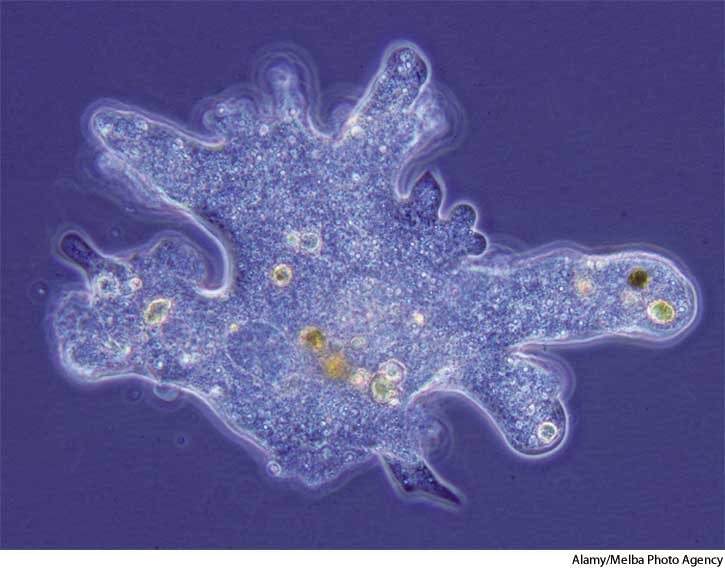
An Amoeba is a unicellular, animal-like protist that lives in ponds and streams. According to cell theory, where did this cell come from?

1

another pre-existing amoeba cell.

2

energy from sun that allowed the protist to reproduce.

3

a multicellular organism.

4

the nonliving environment.

1.1 & 1.2 Cells so far....

You've got to be in it to win it!

Slide image

Show answer

Auto Play

Slide 1 / 21

SLIDE