

Determine the Figurative Meaning of Words and Phrases

Presentation
•
English
•
7th Grade
•
Medium
+11
Standards-aligned

Sutania McBean
Used 218+ times
FREE Resource
2 Slides • 10 Questions
1
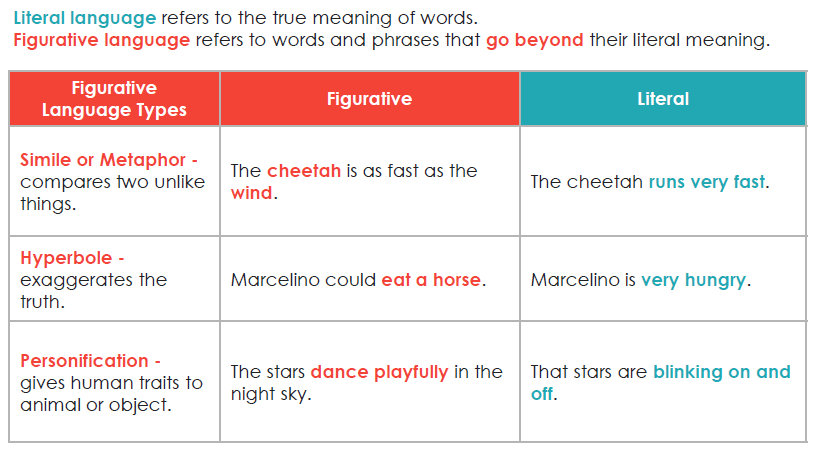
Determine the Figurative Meaning of Words and Phrases

2
3
Multiple Choice
Winter Trees
By William Carlos Williams
All the complicated details of the
attiring and
the disattiring are completed!
A liquid moon
moves gently among
the long branches.
Thus having prepared their buds
against a sure winter
the wise trees
stand sleeping in the cold.
When the author writes “attiring and disattiring ” he means:
The trees get dressed every morning.
The trees have finished putting clothes on.
The trees change seasons and shed leaves like people dressing and undressing.
4
Multiple Choice
excerpt from The Eagle by Alfred Lord Tennyson
He clasps the crag with crooked hands ;
Close to the sun in lonely lands,
Ring'd with the azure world, he stands.
The wrinkled sea beneath him crawls;
He watches from his mountain walls,
And like a thunderbolt he falls .
Why did the author use the phrase “crooked hands" ?
To give an example of how hard it is to hold on to the crag.
To give an example of what the eagle’s claws look like.
To help the reader better understand the danger of claws.
5
Multiple Choice
excerpt from The Eagle by Alfred Lord Tennyson
He clasps the crag with crooked hands ;
Close to the sun in lonely lands,
Ring'd with the azure world, he stands.
The wrinkled sea beneath him crawls;
He watches from his mountain walls,
And like a thunderbolt he falls .
Why type of figurative language is “like a thunderbolt he falls" ?
It gives human traits to the eagle’s landing.
It exaggerates the eagle’s landing.
It compares the eagle’s landing to a thunderbolt.
6
Multiple Choice
excerpt from The Eagle by Alfred Lord Tennyson
He clasps the crag with crooked hands ;
Close to the sun in lonely lands,
Ring'd with the azure world, he stands.
The wrinkled sea beneath him crawls;
He watches from his mountain walls,
And like a thunderbolt he falls .
Why did the author use the phrase “like a thunderbolt he falls"?
To tell the reader that the eagle lands on the ocean.
To tells the reader that the eagle lands really fast
To tell the reader that the eagle lands with a loud sound.
7
Multiple Choice
excerpt from The Eagle by Alfred Lord Tennyson
He clasps the crag with crooked hands ;
Close to the sun in lonely lands,
Ring'd with the azure world, he stands.
The wrinkled sea beneath him crawls;
He watches from his mountain walls,
And like a thunderbolt he falls .
Why type of figurative language is “ crooked hands"?
It compares the eagle to the cliff.
It gives human traits to the eagle’s claws.
It exaggerates the eagle’s fierceness.
8
Multiple Choice
excerpt from A Red, Red Rose by Robert Burns
O my luve's like a red, red rose
That's newly sprung in June;
O my luve's like the melodie
That's sweetly played in tune.
Why type of figurative language is “luve’s like a red rose”?
It gives human traits to love.
It compares love to a red rose.
It exaggerates the color of love.
9
Multiple Choice
excerpt from Daffodils By William Wordsworth
I wandered lonely as a cloud
That floats on high o'er vales and hills,
When all at once I saw a crowd,
A host, of golden daffodils;
Beside the lake, beneath the trees,
Fluttering and dancing in the breeze.
Why type of figurative language is “ lonely as a cloud" ?
It exaggerates the person’s loneliness.
It gives human traits to the clouds.
It compares loneliness to a cloud.
10
Multiple Choice
excerpt from Daffodils By William Wordsworth
I wandered lonely as a cloud
That floats on high o'er vales and hills,
When all at once I saw a crowd,
A host, of golden daffodils;
Beside the lake, beneath the trees,
Fluttering and dancing in the breeze.
Why did the author use the phrase “lonely as a cloud ”?
To tell the reader he wishes he had company during his travels.
To tell the reader that the clouds float over the hilltops.
To tell the reader he travels alone over the vales and hills.
11
Multiple Choice
excerpt from Daffodils By William Wordsworth
I wandered lonely as a cloud
That floats on high o'er vales and hills,
When all at once I saw a crowd,
A host, of golden daffodils;
Beside the lake, beneath the trees,
Fluttering and dancing in the breeze.
What type of figurative language is “dancing"?
It exaggerates how well the flowers dance.
It gives human traits to flowers.
It compares the flowers to the breeze.
12
Multiple Choice
excerpt from Daffodils By William Wordsworth
I wandered lonely as a cloud
That floats on high o'er vales and hills,
When all at once I saw a crowd,
A host, of golden daffodils;
Beside the lake, beneath the trees,
Fluttering and dancing in the breeze.
Why did the author use the phrase “dancing in the breeze"?
To tell the reader how the flowers move with the breeze.
To tell the reader that the flowers need the breeze to dance.
To tell the reader that the flowers couldn’t move without the breeze.
Determine the Figurative Meaning of Words and Phrases
Show answer
Auto Play
Slide 1 / 12
SLIDE
Similar Resources on Wayground

10 questions
Inference
Presentation
•
7th Grade
10 questions
Narrative Writing
Presentation
•
7th Grade
11 questions
Direct and Indirect Characterization
Presentation
•
7th Grade
11 questions
Fantasy Genre
Presentation
•
7th Grade
10 questions
7th grade Suffixes
Presentation
•
7th Grade
8 questions
Summarizing
Presentation
•
7th Grade
10 questions
Thesis Statements
Presentation
•
7th Grade
10 questions
At the Crossroads - My Perspectives
Presentation
•
7th Grade
Popular Resources on Wayground
21 questions
Continents and Oceans

Quiz
•
6th Grade
20 questions
Parts of Speech
Quiz
•
5th Grade
16 questions
Subject & Predicate
Quiz
•
5th Grade
25 questions
Multiplication Facts
Quiz
•
5th Grade
12 questions
Map Skills
Quiz
•
3rd Grade
22 questions
Continents and Oceans
Quiz
•
5th Grade
15 questions
Rounding Decimals
Quiz
•
5th Grade
20 questions
Brand Labels
Quiz
•
5th - 12th Grade
Discover more resources for English
25 questions
Making Inferences
Quiz
•
6th - 8th Grade
15 questions
Thank You Ma'am
Quiz
•
7th Grade
16 questions
Theme Practice
Quiz
•
7th Grade
17 questions
Figurative Language
Quiz
•
7th Grade
20 questions
Revising & Editing practice
Quiz
•
7th Grade
20 questions
Simple, Compound, and Complex Sentences
Quiz
•
7th Grade
12 questions
Final Figurative Language Review
Presentation
•
6th - 8th Grade
27 questions
1st Nine Weeks: ELA Final Exam Study Guide
Quiz
•
6th - 8th Grade