Search Header Logo
Introduction to Waves

Introduction to Waves

Assessment

Presentation

Science

8th Grade

Practice Problem

Medium

NGSS
MS-PS4-1, MS-PS4-2

Standards-aligned

Created by

Ashley Mason

Used 56+ times

FREE Resource

13 Slides • 14 Questions

1

Introduction to Waves

What are waves?
Slide image

2

Slide image

3

Slide image

4

Slide image

5

Slide image

6

Slide image

7

Multiple Choice

Jenny is trying to describe a wave. Which example would be the best description?

1

a toy car hitting a wall and bouncing back

2

a toy car rear-ending a toy car that then rear-ends another toy car

3

two toy cars driving parallel to each other at the same speed

4

two toy cars driving away from each other at the same speed

8

Multiple Choice

Which refers to any disturbance that carries energy from one place to another?

1

wave

2

trough

3

motion

4

crest

9

Multiple Choice

Which game most represents a wave?

1

hide and seek

2

tic-tac-toe

3

poker

4

tipping over dominoes

10

Multiple Choice

Brody and Ethel are arguing about waves. Brody says that waving his hand back and forth is a scientific wave. Ethel says that it is not. Which statement best describes who is correct?

1

Brody is correct because the wave involves an input of energy.

2

Ethel is correct because energy is not carried from one place to another.

3

Brody is correct because the pattern repeats.

4

Ethel is correct because the motion has no pattern.

11

Slide image

12

Slide image

13

Slide image

14

Multiple Choice

Which is a characteristic of all waves?

1

All waves carry energy

2

All waves move through space

3

All waves move through matter, from particle to particle.

4

All waves transfer energy parallel to the direction of wave motion.

15

Multiple Choice

Question image

Which statement is best supported by the information in the chart?

1

Wave X and Wave Y are mechanical waves, and Wave Z is an electromagnetic wave.

2

Wave X and Wave Y are electromagnetic waves, and Wave Z is a mechanical wave.

3

Wave X and Wave Z are electromagnetic waves, and Wave Y is a mechanical wave.

4

Wave X and Wave Z are mechanical waves, and Wave Y is an electromagnetic wave.

16

Multiple Choice

Natalia is studying a wave produced in her magnetics lab. This wave can move through the empty space in a vacuum and carries a lot of energy.

What wave is Natalia most likely studying?

1

a sound wave

2

an ocean wave

3

a gamma ray

4

an earthquake shock wave

17

Multiple Choice

A scientist is studying a shock wave from an earthquake. What kind of wave is being studying?

1

an electromagnetic wave

2

a gamma ray

3

a radio wave

4

a mechanical wave

18

Multiple Choice

Question image

This Venn diagram is comparing mechanical and electromagnetic waves.


What could be put into the center section of this Venn diagram?

1

“Carry energy through space” and “Follow a pattern”

2

“Carry energy” and “Follow a pattern”

3

“Carry energy through space” and “Can be heard”

4

“Carry energy” and “Can be heard”

19

Multiple Choice

What do sound waves and infrared waves have in common, and what makes them different?

1

Both carry energy through space, but sound waves are mechanical and infrared waves are electromagnetic.

2

Both can transfer energy through matter, but sound waves travel through air and infrared waves travel through space.

3

Both can transfer energy through matter, but sound waves can be heard and infrared waves can be seen.

4

Both carry energy through space, but sound waves require matter to pass through and infrared waves do not.

20

Slide image

21

Slide image

22

Slide image

23

Slide image

24

Multiple Choice

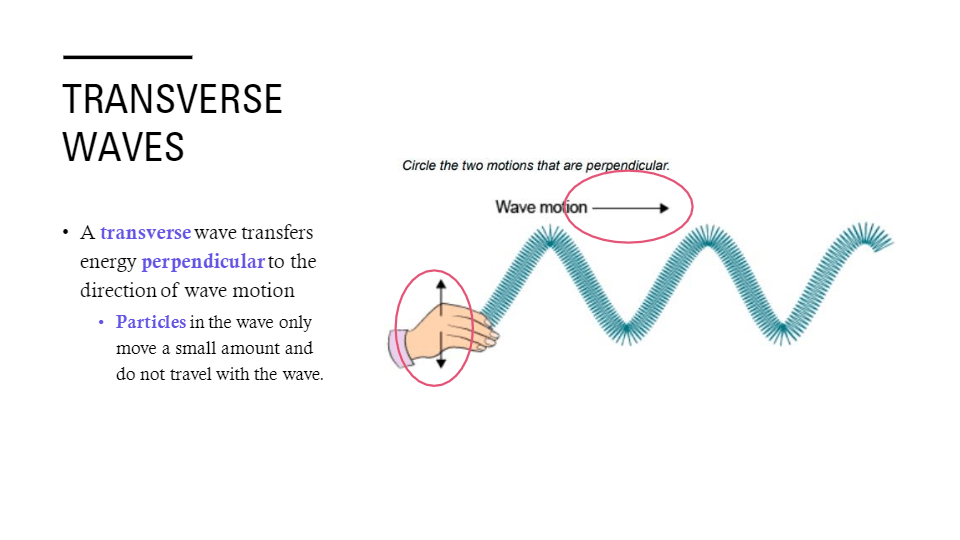
Which statement applies to transverse waves?

1

The waves have a trough.

2

Particles move great distances.

3

The waves have alternating compressions and expansions.

4

The energy is transferred parallel to the direction of the wave motion.

25

Multiple Choice

Question image

Which best labels the chart?

1

Title 1 is “Longitudinal Waves,” and Title 2 is “Transverse Waves.”

2

Title 1 is “Transverse Waves,” and Title 2 is “Longitudinal Waves.”

3

Title 1 is “Electromagnetic Waves,” and Title 2 is “Mechanical Waves.”

4

Title 1 is “Mechanical Waves,” and Title 2 is “Electromagnetic Waves.”

26

Multiple Choice

Question image

What is the motion of the particles in this kind of wave?

1

The particles will move up and down over large areas.

2

The particles will move up and down over small areas.

3

The particles will move side to side over small areas.

4

The particles will move side to side over large areas.

27

Multiple Choice

Question image

This Venn diagram is comparing longitudinal waves and transverse waves.

Where is the error in this Venn diagram?

1

“Parallel” and “Perpendicular” are switched.

2

The spring descriptions of motion are switched.

3

Particles move long distances in transverse waves.

4

Particles travel along the wave in longitudinal waves.

Introduction to Waves

What are waves?

Slide image

Show answer

Auto Play

Slide 1 / 27

SLIDE