Search Header Logo
C8 - Lesson 4 Rates of Reaction

C8 - Lesson 4 Rates of Reaction

Assessment

Presentation

Science, Chemistry

7th - 9th Grade

Practice Problem

Medium

Used 41+ times

FREE Resource

13 Slides • 9 Questions

1

C8 - Lesson 4 Rates of Reaction

Dr Ahmed

Slide image

2

Rates of Reaction

-State why reactions occur

- State the units for rate

-Describe the different methods for measuring the rate of the reaction

Slide image

3

Open Ended

What does rate of reaction mean? Type some words that you think of when thinking about the word Rate ….

4

What does Rate of Reaction mean?

  • The speed of chemical reactions varies greatly

  • Some reactions are FAST - FIREWORKS

  • Some reaction are SLOW - Your bicycle chain rusting

  • Rate of reaction is the speed of the reaction

5

Slide image

Why do reactions occur?? THINK

6

Why do reactions occur?

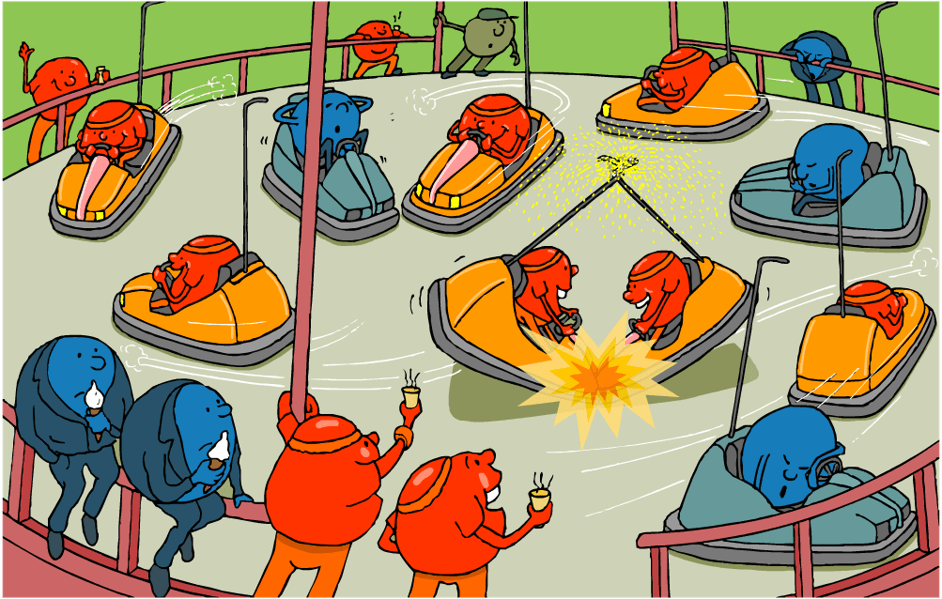
- Particles need to COLLIDE

-Particles need to collide with enough ENERGY

Slide image

7

Reactions, Particles and Collisions

Reactions take place when particles collide with a certain amount of energy.


The minimum amount of energy needed for the particles to react is called the activation energy, and is different for each reaction.


The rate of a reaction depends on two things:

- Frequency of collisions

- The energy with which the particles collide


If particles collide with less energy than the activation energy, they will not react. The particles will just bounce off each other

8

Poll

Are you happy so far??

NO!! I'm so confused

I think so but I might need to go over this again

YES This is easy

9

Multiple Choice

In order for a reaction to occur what needs to happen?

1

Particles need to be a gas

2

Particles need to collide

3

Particles need to vibrate

4

Lots of different particles need to be in the same beaker

10

Multiple Choice

If particles collide what needs to happen for a reaction to take place

1

The collision needs to cause one of the particles to split in half

2

The collision needs to be between gases

3

The collision needs to happen with enough energy

4

The particles need to fit

11

Fill in the Blanks

Type answer...

12

So how do we measure Rate of Reaction?

It depends on the reaction!

13

Loss of mass method

This is if one of the products is a gas (g)

•When it is produced it will escape to the atmosphere

•The overall mass will decrease over time

Slide image

14

Production of gas method

Again this is if one of the product is gas (g)

•We can collect it as it is produced

•We can use a measuring cylinder or a gas syringe

Slide image

15

Disappearing cross method

This is if one of the products is a solid (s)

•Some products cause the solution to go cloudy

•We can measure this by seeing how long it takes to no longer see a cross through the solution

•A light sensor can make this more accurate

Slide image

16

Multiple Select

Which method could work out the rate in this reaction:

CaCO3(s) + 2 HCl(aq) -> CaCl2(aq) + H2O(aq) + CO2(g)

1

Disappearing cross

2

Loss of mass

3

Production of gas

17

Multiple Choice

Which method would you use to determine rate in this reaction:


Na2SO3 + HCl --> S(s) + 2NaCl(aq) + SO2(g) + H2O(l)

1

Disappearing cross

2

Loss of mass

3

Production of gas

18

Fill in the Blanks

media image

Type answer...

19

Fill in the Blanks

media image

Type answer...

20

Measuring Rate

Once you have your graph. The gradient will tell you your rate.

Gradient is worked out by doing

 y÷xy\div x  

This gives units of mass/time or 
g/min

Slide image

21

Copy and fill in the gaps - Revision

Activity:

It is usually more helpful to describe how the energy of the chemicals changes during the reaction, so a reaction profile is more useful than an energy level diagram.

A reaction profile includes the a_______ e_____ which is the minimum energy needed by p______when they c______for a reaction to occur. The activation energy is shown as a 'hump' in the line, which:

starts at the energy of the r________

is equal to the difference in energy between the top of the 'hump' and the reactant

The overall change in e_____ in a reaction is the difference between the energy of the reactants and p____________.

22

Copy and fill in the gaps

Activity:

It is usually more helpful to describe how the energy of the chemicals changes during the reaction, so a reaction profile is more useful than an energy level diagram.

A reaction profile includes the activation energy which is the minimum energy needed by particles when they collide for a reaction to occur. The activation energy is shown as a 'hump' in the line, which:

starts at the energy of the reactants

is equal to the difference in energy between the top of the 'hump' and the reactant

The overall change in energy in a reaction is the difference between the energy of the reactants and products

C8 - Lesson 4 Rates of Reaction

Dr Ahmed

Slide image

Show answer

Auto Play

Slide 1 / 22

SLIDE