Balancing Chemical Equations
Presentation
•
Chemistry
•
9th - 12th Grade
•
Practice Problem
•
Medium
+1
Standards-aligned
Michaela Bratsch
Used 53+ times
FREE Resource
13 Slides • 22 Questions
1
Balancing Chemical Equations
Lesson about the parts of a chemical equation and how to balance chemical equations.
2
3
Multiple Choice
What does a chemical change result in?
A change in state of the substance (ex. liquid to solid)
A change in texture of the substance.
A change in the way atoms are bonded to each other.
A change in the appearance of the substance.
4
Multiple Choice
The difference between a Physical change and a Chemical change is…
Physical change is only a change to the outside appearance.
Chemical change is when matter is changed into something new.
Atoms are rearranged in chemical changes & not in physical.
All are correct.
5
6
7
Multiple Choice
Which of the following could indicate that a chemical change took place?
Change in color
Production of Energy
Formation of Gas
All are correct
8
9
Multiple Choice

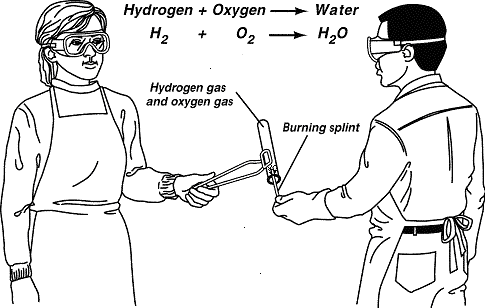
Identify the reactant(s) and product(s) of the reaction.
All three are reactants and none are products.
Hydrogen and water are the reactants, and oxygen is the product.
Water and oxygen are the reactants, and hydrogen is the product.
Hydrogen and oxygen are the reactants, and water is the product.
10
Multiple Choice
The substances listed on the left side of a chemical equation are the
Products
Coefficients
Precipitates
Reactants
11
Multiple Choice
The substances listed on the right side of a chemical equation are the
Yields
Reactants
Products
Precipitates
12
13
Multiple Choice
In chemical reactions, what does the principle of conservation of mass mean?
Matter is not created or destroyed.
The total mass of the reactants is greater than the total mass of the products.
The total mass of the reactants is less than the total mass of the products.
Matter is not changed.
14
15
Multiple Choice
Diatomic molecules are __________ found in nature as their single element: I, O, N, H, Br, Cl, or H.
often
never
sometimes
always
16
Multiple Choice
N2, Cl2, and O2 are all
diatomic molecules.
ionic bonds.
of equal mass.
solids.
17
18
19
2 H2 + 1 O2 --> 2 H2O
20
21
Multiple Choice
What are the larger numbers that you CAN CHANGE in a chemical equation?
Coefficient
Products
Reactants
Subscripts
22
Multiple Choice
What are the smaller numbers that you CANNOT change in a chemical equation?
Coefficient
Products
Reactants
Subscript
23
Multiple Choice
How many aluminum atoms are in Al2(SO4)3?
1
2
3
4
24
Multiple Choice
What is the number before a chemical formula called?
Ex: 2H2 + O2 --> 2H2O
Coefficient
Subscript
Atom
Equation
25
Multiple Choice
What is the little number after an element in a chemical equation called.
Example: H2
Coefficient
Subscript
Atom
Equation
26
Multiple Choice
How many atoms of carbon (C) are in C6H12O6?
3
6
12
24
27
28
Multiple Choice
2 Na+ _ Cl2 -> 2 NaCl
29
Multiple Choice
Balance this equation
_Al +_HCl --> _H2 +_AlCl3
2, 6, 3, 2
it is already balanced
4, 12, 3, 4
2, 1, 4, 5
30
Multiple Choice
Balance this equation.
_CF4 + _Br2 --> _CBr4 + _F2
2,1,2,1
1,2,2,1
1,2,1,2
2,2,2,2
31
Multiple Choice
How many HCl molecules do you need to balance this equation?
Mg + __HCl ---> MgCl2 + H2
1
2
3
4
32
Multiple Choice
Which of the following shows the correct way to balance the chemical equation?
Fe + O2 -> Fe2O3
4Fe + 3O2 -> 2Fe2O3
2 Fe + 3O2 -> Fe2O6
4 Fe + O6 -> 2Fe2O3
None of the options are correctly balanced.
33
34
Multiple Choice
Which of the following reactions is balanced?
2CH4 + O2 -> CO2 + H2O
CH4 + 2O2 -> CO2 + H2O
CH4 + 2O2 -> CO2 + 2H2O
None of the chemical equations are balanced.
35
Multiple Choice
Balance this equation.
_CH4 + _O2 --> _CO2 + _H2O
1,2,1,1
2,1,2,1
1,2,1,2
0,2,0,2
Balancing Chemical Equations
Lesson about the parts of a chemical equation and how to balance chemical equations.
Show answer
Auto Play
Slide 1 / 35
SLIDE

Similar Resources on Wayground
25 questions
Separating a Mixture
Presentation
•
9th - 12th Grade
33 questions
Naming Covalent and Ionic Compounds
Presentation
•
9th - 12th Grade
24 questions
History of the Periodic Table
Presentation
•
9th - 12th Grade
31 questions
Stoichiometry Practice
Presentation
•
9th - 12th Grade
28 questions
Acids & Bases - Introduction
Presentation
•
9th - 12th Grade
27 questions
Acids & Bases - Part 2
Presentation
•
9th - 12th Grade
31 questions
Properties of Solutions
Presentation
•
9th - 12th Grade
31 questions
Classification of Matter Lesson
Presentation
•
9th - 12th Grade
Popular Resources on Wayground
10 questions
5.P.1.3 Distance/Time Graphs
Quiz
•
5th Grade
10 questions
Fire Drill
Quiz
•
2nd - 5th Grade
20 questions
Equivalent Fractions
Quiz
•
3rd Grade
22 questions
School Wide Vocab Group 1 Master
Quiz
•
6th - 8th Grade
20 questions
Main Idea and Details
Quiz
•
5th Grade
20 questions
Context Clues
Quiz
•
6th Grade
20 questions
Inferences
Quiz
•
4th Grade
12 questions
What makes Nebraska's government unique?
Quiz
•
4th - 5th Grade
Discover more resources for Chemistry
25 questions
Solutions Test Review
Quiz
•
10th Grade
20 questions
Acids and Bases
Quiz
•
10th Grade
22 questions
Solubility Curve Practice
Quiz
•
10th Grade
15 questions
STAAR Review Quizziz 1
Quiz
•
10th Grade
15 questions
STAAR Wayground #2
Quiz
•
10th Grade
41 questions
Unit 5 Test - Biology
Quiz
•
12th Grade
15 questions
Ionic Compounds: Naming and Formula Writing
Quiz
•
9th - 12th Grade
5 questions
DOL IP: Solubility and Precipitation Reactions
Quiz
•
9th Grade