

Ideal Gases And Kinetic Theory U1 M2

Presentation
•
Physics
•
11th Grade
•
Medium

PIERRE ROCK
Used 13+ times
FREE Resource
15 Slides • 15 Questions
1
Ideal Gases And The Kinetic Theory U1 M3

2

3

4

5

6

7

8

9

10
Multiple Choice
11
Multiple Choice
12
Multiple Choice
What is the formula Charles' Law?
V = T
VT = VT
T1 / V1 = T2 / V2
V1 / T1 = V2 / T2
13
Multiple Choice
What remains constant according to Charles’ Law?
Length
Pressure
Temperature
Volume
14
Multiple Choice
In CHARLES'S LAW, volume and temperature have a ______ proportionality.
direct
inverse
linear
exponential
15
Multiple Choice
In CHARLES' LAW, at constant pressure, what happens to temperature of a gas when the volume doubles?
The temperature also doubles.
The temperature decreases to half of its original volume.
The temperature doesn't change.
The temperature quadruples.
16
Multiple Choice
17
Multiple Choice
What is the formula for Boyle's Law?
P1V1=P2V2
P1V1/P2V2
P1V2=P2V1
P1/V1=P2/V2
18
Multiple Choice
In BOYLE'S LAW, when Pressure increases then the Volume must...
Increase
Decrease
19
Multiple Choice
In BOYLE'S LAW, when Volume increases then Pressure must...
Increase
Decrease
20
Multiple Choice
In BOYLE'S LAW, what type of relationship do pressure and volume have?
Direct
Inverse
No relationship
21
Multiple Choice
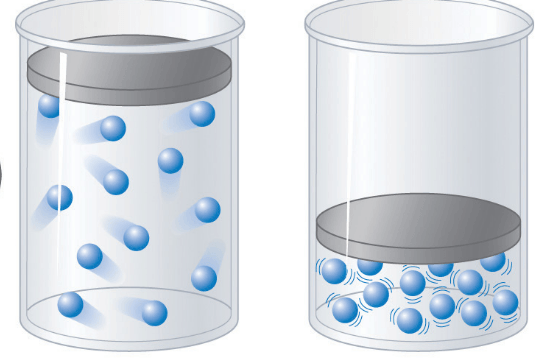
Which container will have a lower pressure?
left
right
they both have the same pressure
22

23

24

25

26

27

28
Multiple Select
Kinetic Theory Equations
Kinetic Theory is used to explain all the gas laws by observing the movement of the particles. Several assumptions are made to derive these equations:
Please tick the correct assumptions below.
(Hint: Use the Note entitled "4 Physics U1 M3 THE KINETIC THEORY OF GASES")
The molecules of the gas can be assumed to be point molecules. This means that they have negligible volume.
There is no intermolecular forces of attraction. The particles are in random motion and the average speed of the random motions produce a constant force (constant
force → constant pressure)
Collisions are (perfectly) elastic, the particles rebound after collision and kinetic energy is conserved.
Impact time is minimum. The rate of change of momentum during the impact gives an average force provided that the time of impact is much less than the time
between impacts.
All molecules of a particular gas are identical.
29
Multiple Select
Kinetic Theory Equations (Continued)
Kinetic Theory is used to explain all the gas laws by observing the movement of the particles. Several assumptions are made to derive these equations:
Please tick the correct assumptions below. (Hint: Use the Note entitled "4 Physics U1 M3 THE KINETIC THEORY OF GASES")
Newton’s Three Laws are adhered to.
There is a sufficiently large number of molecules for statistics to be meaningfully
applied.
30
Poll
How did you find this lesson to be?
This lesson was very informative, please do more like this.
This lesson was very informative, but please do less like this.
This lesson needs more explanations, but I like the format.
This lesson needs more explanations and I do not like the format.
Ideal Gases And The Kinetic Theory U1 M3
Show answer
Auto Play
Slide 1 / 30
SLIDE
Similar Resources on Wayground

23 questions
LKPD pertemuan 4 Fisika
Presentation
•
11th Grade
23 questions
Ecosystems and Biomes
Presentation
•
11th - 12th Grade
21 questions
Physics 4/14: Sound & Earthquake Waves
Presentation
•
11th Grade
26 questions
Work/Power/Energy
Presentation
•
11th Grade
24 questions
Energy Types and Law of Conservation of Energy
Presentation
•
10th - 12th Grade
23 questions
John Travoltage Lab
Presentation
•
11th Grade
24 questions
Computer Networks
Presentation
•
11th Grade
21 questions
Theme in Literature
Presentation
•
11th Grade
Popular Resources on Wayground
6 questions
PRIDE Always and Everywhere
Presentation
•
12th Grade
20 questions
Lab Safety Quiz

Quiz
•
6th Grade
26 questions
KOR Review Kahoot Questions
Quiz
•
8th Grade
21 questions
Continents and Oceans
Quiz
•
6th Grade
12 questions
Unit Zero lesson 2 cafeteria
Presentation
•
9th - 12th Grade
20 questions
Parts of Speech
Quiz
•
5th Grade
10 questions
Riddles Riddles fun Riddles
Quiz
•
6th - 12th Grade
16 questions
Subject & Predicate
Quiz
•
5th Grade