Search Header Logo
Properties of Waves

Properties of Waves

Assessment

Presentation

Physics

10th Grade

Practice Problem

Easy

NGSS
HS-PS4-1, HS-PS4-3

Standards-aligned

Created by

Derek Lim

Used 157+ times

FREE Resource

16 Slides • 9 Questions

1

Waves Physics

by Derek Lim

​Images and animation taken from Brilliant.org

2

media

​Recap: The parts of a wave

3

Multiple Choice

Question image

Name the missing part of the wave

1

Amplitude

2

Wavelength

4

Multiple Choice

Question image

Name the missing part of the wave ....?

1

Wavelength

2

Amplitude

5

media
media
media

​The wavelength is the length of a complete wave cycle. Here it is the distance between the crests.

​The period ,(T) is the time it takes to complete one wavelength.

​Can you measure the period here? What's the best way?

6

media
media

​Here are two types of waves... can you remember what they are called?

7

Multiple Choice

Question image

This type of wave is called a...

1

Longitudinal wave, because it's particle motion is parallel to direction of wave travel

2

Transverse wave, because it's particle motion is perpendicular to the direction of wave travel

8

Multiple Choice

Question image

This type of wave is called a...

1

Longitudinal wave, because it's particle motion is parallel to direction of wave travel

2

Transverse wave, because it's particle motion is perpendicular to the direction of wave travel

9

Frequency is a measure of how often something happens in a given time period.

​For example, if you go shopping every Monday. Your frequency of shopping is once per week.

​If you go shopping every Monday and Friday, then your frequency is twice per week.

​Let's talk about frequency...

media

10

​A wave's frequency (f) is the amount of wavelengths that pass a point in a certain amount of time.

​It is most often represented in units of 'per second' or '1/second' or Hertz (Hz)

media

​So, if 1 complete wavelength passes a point at every second, its frequency is '1 per second' or '1 Hertz'.

​And if 320 wavelengths pass a point at every second, its frequency is 320 Hz.

11

​A wave's frequency (f) is the amount of wavelengths (λ) that pass a point in a certain amount of time.

​It is most often represented in units of 'per second' or '1/second' or Hertz (Hz)

​So, if 1 complete wavelength passes a point at every second, its frequency is '1 per second' or '1 Hertz'.

​And if 320 wavelengths pass a point at every second, its frequency is 320 Hz.

media

12

Multiple Choice

Question image

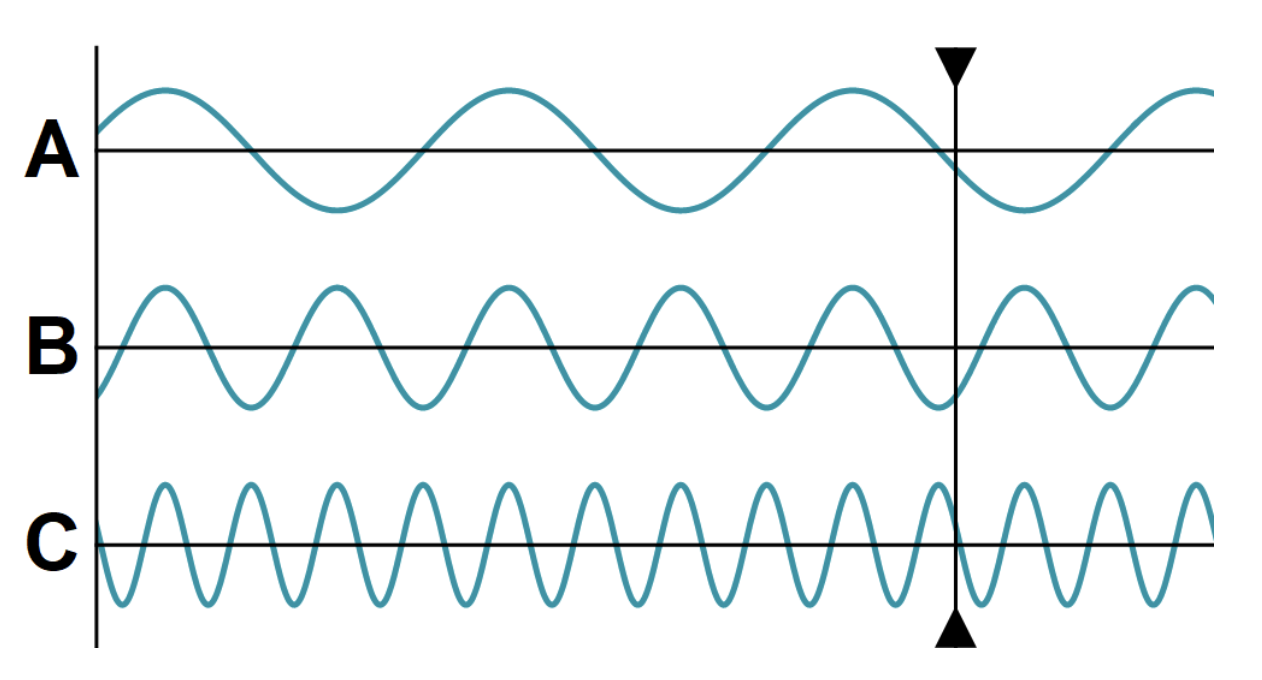
Which of the following travelling waves has a higher frequency?

1

A

2

B

3

C

13

​There is an important relationship between, speed, wavelength and frequency.

media
media

​Suppose that the 2 lanes above are moving with the same velocity. Will there be more cars or trucks passing the arrow after a given amount of time?

14

media

​Like the cars and trucks, these waves are propagating at the same speed.

​What can you conclude about the relationship between wavelength, λ and frequency­, f ?

15

Multiple Choice

Question image

What can you conclude about the relationship between wavelength and frequency by observing them?

1

Wavelength and frequency are unrelated

2

When wavelength increases, the frequency decreases.

3

When wavelength increases, the frequency also increases.

16

​The speed that a wave propagates is called the wave speed, v

​Wave speed

​How could we represent the wave speed using wavelength λ and period T?

17

Multiple Choice

Question image

​How could we represent the wave speed using wavelength λ and period T?

1

v=λTv=\frac{\lambda}{T}  

2

v=Tλv=\frac{T}{\lambda}  

3

v=λTv=\lambda\cdot T  

18

​So, now... we know that wave speed is:

​From the previous slides, we also know that frequency f is the number of waves that pass a point per unit time. And that it is represented by '1/sec' or Hz.

​But now, if instead of seconds, we replaced the time with the period T, the frequency f becomes...

​Now we can replace the period T in the formula for wave speed with frequency f ...

19

​So we obtain the very important formula for waves ...

20

media
media

​Sammy the squirrel dropped his acorn into the pond.

​And you observed that the ripples propagate out in concentric circles.

​Say that you observe 4 ripples per second reaching the edge of the pond and that the distance between the crest of the ripples are 7cm.

​Can you calculate the speed of the ripples caused by the acorn?

​Remember...

21

Multiple Choice

Question image

Say that you observe 4 ripples per second reaching the edge of the pond and that the distance between the crest of the ripples are 7cm.

​Can you calculate the speed of the ripples caused by the acorn? Remember  v=λfv=\lambda\cdot f  

1

28 cm/sec

2

1.75 cm/sec

3

40 cm/sec

22

Multiple Choice

Question image

Human ears can hear between 20 Hz and 20,000 Hz. But animals can hear frequencies higher and lower than these. If a baby mouse makes sound wave travelling at 343 m/s and with a wavelength of 0.00858 m, can you hear it?

1

Yes

2

No

23

​No, we cannot hear the sound because...

​The frequency of the sound wave of 41,425 Hz is way above the limit of human hearing, which is between 20 Hz to 20,000 Hz.

24

So, to recap the important formula today is...

25

​That's a wrap...

Waves Physics

by Derek Lim

​Images and animation taken from Brilliant.org

Show answer

Auto Play

Slide 1 / 25

SLIDE